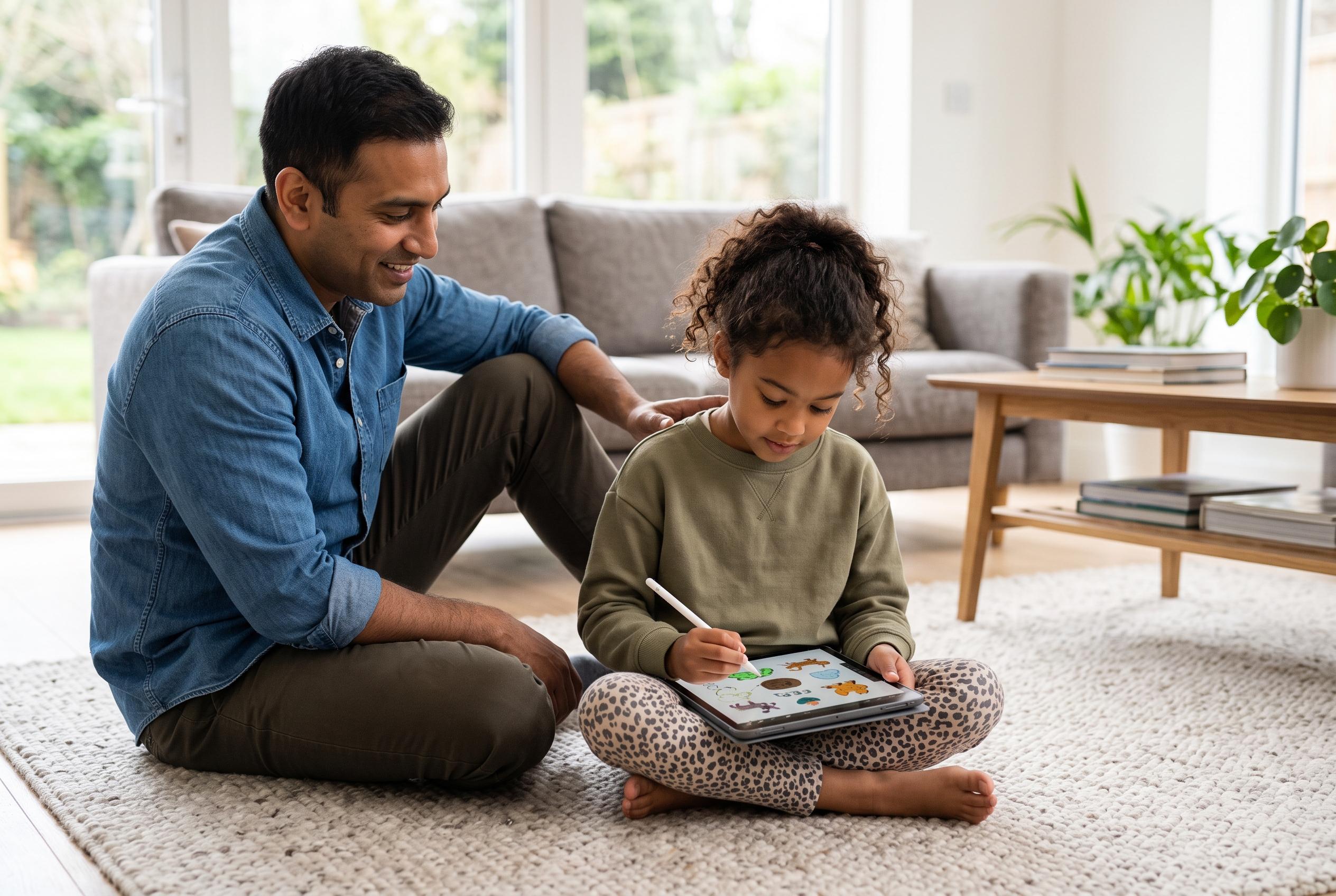

New research and expert insights challenge conventional ideas on children’s device use, highlighting the importance of active engagement and the nuanced role of technology in education and wellbeing.
The familiar argument over children and devices often begins with minutes, but the research suggests that is the wrong measure. A 2019 analysis in Nature Human Behaviour by Oxford researchers Amy Orben and Andrew Przybylski found that screen time explained very little of the variation in adolescent wellbeing, while a 2017 study by Przybylski and Netta Weinstein suggested that moderate use was not linked with harm and sometimes tracked with slightly better wellbeing than no use at all. The American Academy of Pediatrics has also moved away from rigid hour limits, instead urging families to judge what children are doing on a screen rather than simply how long they are there.
That does not mean concerns about phones and childhood are imaginary. Jonathan Haidt’s The Anxious Generation has energised parents and schools, arguing that smartphones changed the texture of growing up. But psychologist Candice Odgers, in a review for Nature, said the causal case remains unproven and warned against letting a moral panic eclipse other pressures on teenagers. The result is a live debate with two serious camps, but one point on which both sides broadly agree: raw screen-time totals tell only part of the story.
A more useful distinction, educators say, is between passive use and active creation. An hour spent mindlessly scrolling is not the same as an hour spent building a game, editing a film or assembling a class presentation. Dominic Liechti, Apple’s senior director of worldwide product marketing for education, put that idea in the context of the World Economic Forum’s work on future jobs, which places AI and technology literacy alongside curiosity, creativity and critical thinking. In an interview in Kuala Lumpur, he argued that technology should support those skills rather than replace them.
Liechti’s more practical point was that AI can become a partner in learning only if students do the thinking first. He said pupils should draft their own work before using AI to probe assumptions, challenge ideas and test whether a response holds up. That matters because, as he noted, students often cannot tell whether an AI-generated answer is right or wrong without help from a teacher and other sources. In that framing, checking the machine is the lesson, not a shortcut around it.
The same logic applies to homework. Tasks that can be answered easily by AI may be too low-level to teach much at all, while work that demands judgement, complex problem-solving and original thought remains firmly human. That is consistent with longstanding education research, including Benjamin Bloom’s two-sigma problem, which showed the gains from one-to-one tutoring and still shapes thinking about personalised learning. AI may offer one route towards more individualised instruction, but the broader question is whether it helps children learn at their own pace rather than merely produce faster answers.
There is also a quieter promise in the way some devices are designed. Liechti said accessibility tools built into Apple products can help children who are second-language learners or who have disabilities without requiring a formal diagnosis. That approach fits the Universal Design for Learning principle, developed by CAST in the 1990s, which argues that if education is designed with the margins in mind, more students benefit. Yet the caution remains that technology alone does not improve learning; OECD analysis of PISA data has found that heavy investment in classroom technology has not, by itself, delivered better results. The decisive factor is still pedagogy, teacher readiness and how the tools are used.
Disclaimer: This content is for informational purposes only and is not intended to be a substitute for professional medical judgment, advice, diagnosis, or treatment.