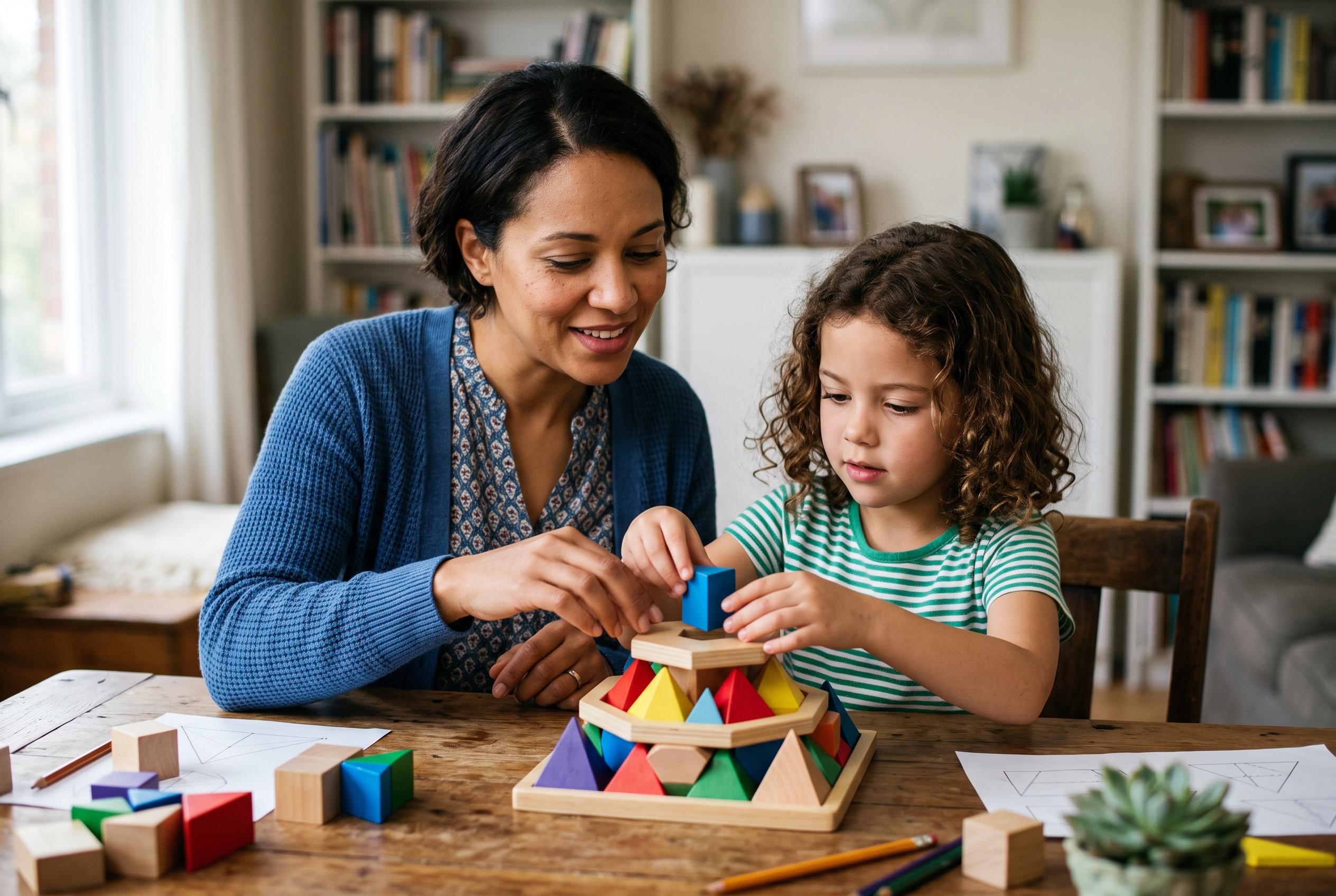

While puzzles may not significantly boost overall intelligence, recent research highlights their role in enhancing spatial reasoning , a skill vital for STEM success , which is influenced by adult guidance and puzzle complexity.
Puzzle boxes often promise to make a child “brainier”, but the evidence is narrower than the marketing suggests. The strongest research does not show that jigsaws make children broadly more intelligent. It points instead to a more specific gain: better spatial reasoning, a skill that helps children judge shapes, positions and movement in their heads.
That conclusion comes from a study led by Susan Levine at the University of Chicago and published in 2012. Researchers observed 53 children and their parents at home, following them from about age 2 to 4. Rather than using a laboratory test, they watched ordinary play over repeated 90-minute visits and noted which families used puzzles. When the children were 4 and a half, they were tested on a task that required mentally rotating and combining flat shapes. Those who had played with puzzles tended to do better, and more frequent or more complex puzzle play was linked with stronger performance.
Still, the result should not be mistaken for proof of cause and effect. The study was observational, not experimental, so families chose whether to buy and use puzzles. That leaves open the possibility that puzzle play was simply a marker for other advantages in the home. Levine’s team accounted for factors such as parental income, education and language input, but that cannot eliminate every difference between households. The sample was also small, which makes the finding useful but not definitive.
Even so, the skill involved is not trivial. Research by Jonathan Wai, David Lubinski and Camilla Benbow published in 2009 found that spatial ability measured in adolescence predicted later achievement in science, technology, engineering and mathematics, even after verbal and mathematical ability were taken into account. Taken together, the studies suggest a chain of association rather than a guarantee: early puzzle play is linked to spatial skill, and spatial skill is linked to later success in technical fields. That is a long way from proving that a jigsaw turns a toddler into an engineer, but it does help explain why the topic keeps drawing attention.
There is also a more practical lesson for parents and educators. In the Chicago study, boys were given more complex puzzles than girls, and adults used more spatial language with them, including words such as edge, corner, rotate and flip. Boys also outperformed girls on the later task. That implies the benefit may come not only from the puzzle itself, but from the way adults talk about it and the level of challenge they offer. The most useful takeaway may be less about buying a particular toy and more about how children are guided while they play.
Disclaimer: This content is for informational purposes only and is not intended to be a substitute for professional medical judgment, advice, diagnosis, or treatment.