

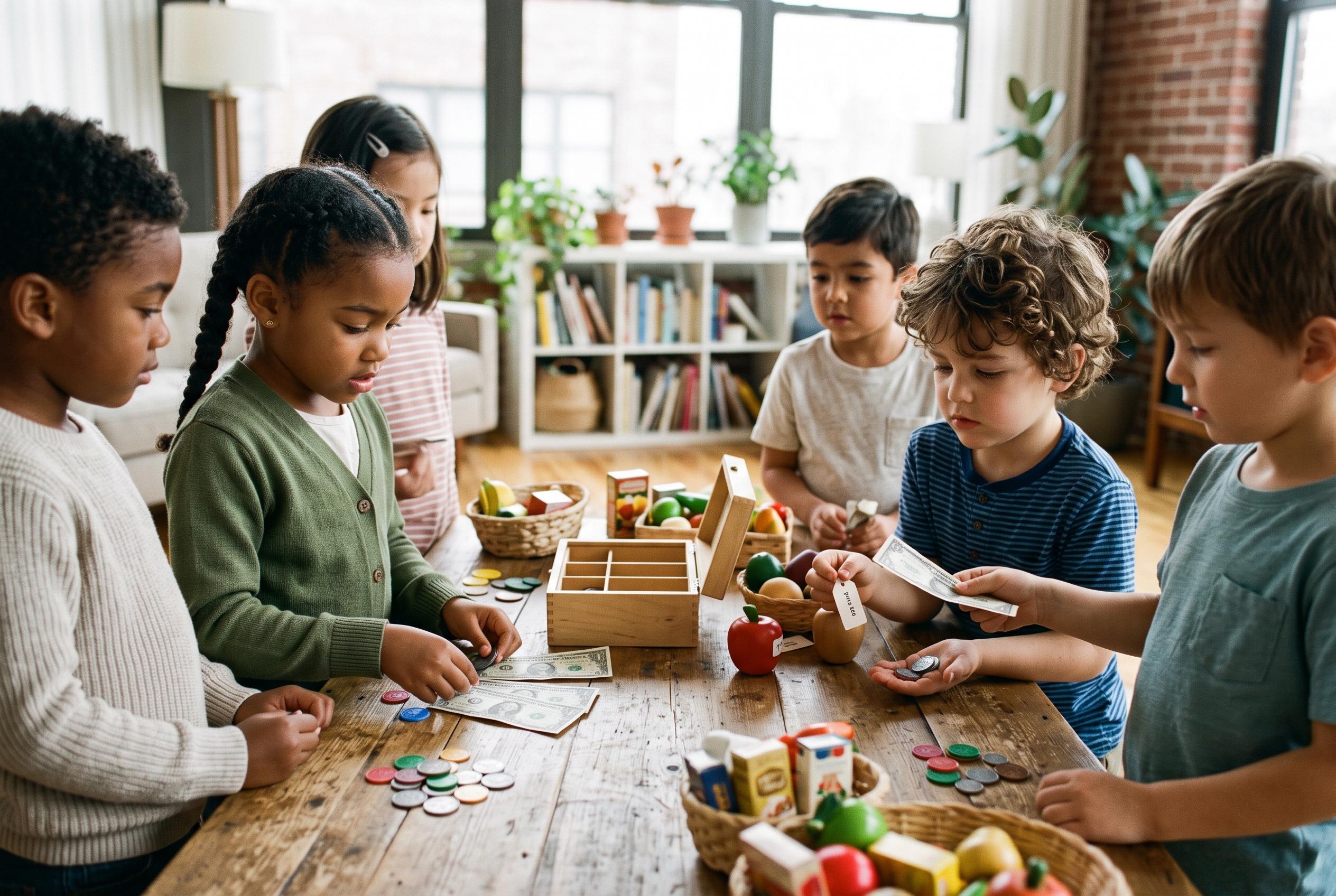

Using simple pretend shop games to teach children practical maths skills by integrating money into play can foster decision-making, understanding of value, and confidence in everyday arithmetic, making learning both educational and enjoyable.
Children often learn numbers best when those numbers have something to do. A pretend café, shop or market can turn counting into a practical task, because a child is no longer just reciting figures but using them to decide what can be bought, what must be left out and whether there is enough left over. That simple shift is what makes money play such an effective bridge to everyday maths.
At its core, the activity gives arithmetic a job. Addition becomes working out a total, subtraction becomes seeing what remains, and comparison becomes a judgement about value or affordability. The KidsDoMath guide on teaching children about money says these kinds of real-world situations help children apply addition and subtraction in a way that feels concrete rather than abstract. The Think Academy similarly notes that hands-on money games can make budgeting, coin recognition and making change easier to grasp.
The best versions of the game are usually the simplest. A few household objects, some large paper notes or cardboard tokens and clear price labels are enough to get started. The point is not to build an elaborate shop with receipts, discounts and multiple kinds of currency, but to create decisions that the child can actually manage. Early math specialists at the Erikson Institute say play works well when children can explore, understand and enjoy the process, rather than race towards a perfect answer.
That is why a small shop with limited choices often teaches more than a busy one. A child who is given five tokens and asked to buy one of several priced items must compare, count and choose. If they spend three tokens on one item, they can physically see that two remain. That visible exchange helps subtraction make sense long before written number sentences feel natural.
As children become more confident, the game can grow with them. They can move from one token value to more than one denomination, then on to making the same amount in different ways, planning a purchase within a fixed budget or checking whether a total is correct. The Think Academy recommends this kind of practice because it combines skill-building with repetition that does not feel like drill. The wider aim is not to memorise coin names, but to learn how quantities combine and how limits shape choice.
The playful format also supports more than arithmetic. According to the Early Math Collaborative, play can build autonomy and focus by letting children solve problems for themselves. In a money game, that might mean deciding whether to buy one item now or save for something better later. It may also mean noticing that a choice has consequences, which is an important lesson for children long before they encounter real accounts, cards or credit.
Adults can strengthen the learning by linking the pretend game to everyday life. In a real shop, a child can help compare two items, find a label, count a small number of products or think about which purchase leaves enough room in a limited budget. A parent can also talk through decisions aloud: one item costs less, but another feeds more people; one package is smaller, but it lasts longer. That helps children see that the cheapest option is not always the best one.
The history of money itself offers a useful reminder of why this matters. As WGBH’s “Two Cents” programme has explained, many mathematical ideas grew out of the need to manage trade and resources. In that sense, money play is not a distraction from maths. It is a return to one of the reasons maths became useful in the first place.
Used well, the activity can be both educational and joyful. Children get to practise counting, estimating, choosing and checking without feeling as though they are sitting a test. The lesson is modest but lasting: numbers are not just something to recite. They are tools for making sense of the world.
Disclaimer: This content is for informational purposes only and is not intended to be a substitute for professional medical judgment, advice, diagnosis, or treatment.



