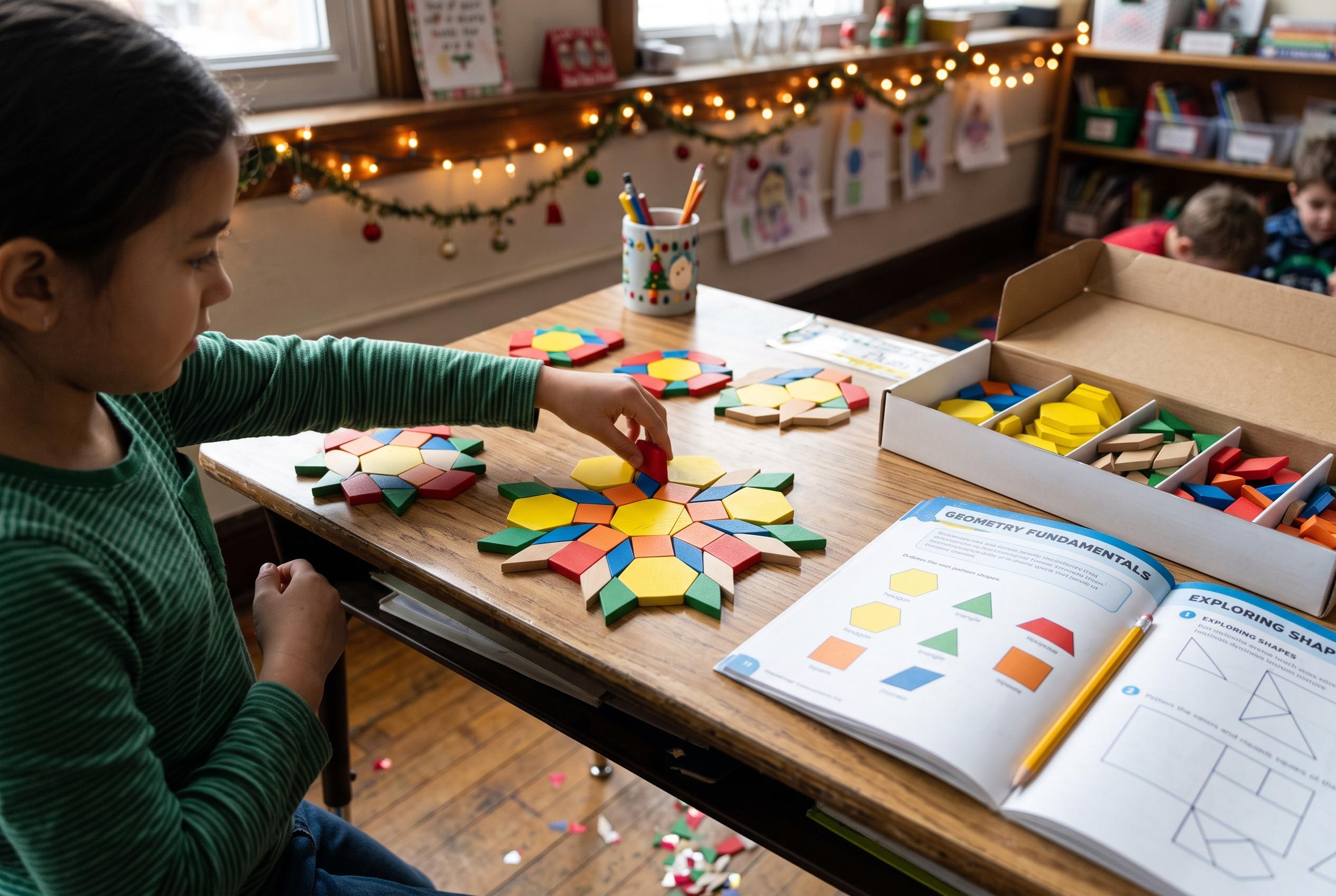

As November brings holiday hustle to classrooms, pattern block activities offer a playful yet purposeful way to sustain children’s focus and deepen their understanding of geometry, problem-solving, and fine motor skills amid festive chaos.
By November, many primary classrooms are running on extra excitement and shorter attention spans. Thanksgiving talk, holiday plans and end-of-term energy can make it harder to keep children focused, but pattern block activities offer a simple way to hold interest while keeping the learning purposeful. According to the original article, they are especially useful at this point in the school year because they feel playful without losing their educational value.
Pattern blocks turn geometry into something children can handle and test for themselves. ClassPlayground describes them as six familiar shapes in six colours, and says they help pupils see how smaller pieces fit together to make larger forms, while strengthening spatial reasoning. TERC’s investigations guide adds that filling shape outlines with pattern blocks helps children in kindergarten and first grade explore how shapes can be composed and decomposed, which deepens their understanding of geometric relationships.
They also give young children a built-in problem-solving task. As the original piece explains, each picture becomes a small puzzle, and children have to try, adjust and try again when a piece does not fit. Kindergarten Chaos makes a similar point, saying pattern blocks support creative problem-solving and flexible thinking. At the same time, the fine-motor work is easy to overlook but important: children practise picking up, turning and placing the pieces carefully, which helps strengthen the hand control they need for writing and cutting.
Another reason teachers keep returning to pattern blocks is that they are easy to set up and adapt. The article notes that a printable page and a set of blocks can be enough for a centre, an early-finisher task, morning tubs or indoor recess. That flexibility matters in November, when classrooms are often packed with conferences, events and holiday preparations. Resources from Play to Learn Preschool also point out that pattern blocks can support counting, comparing, patterns and size awareness, which makes them useful well beyond a single lesson.
The appeal, though, is not only practical. Seasonal themes can make the same maths work feel fresh, and TERC’s materials show that pattern-block tasks can be used to reinforce core shape learning in a way that feels active and visual. For many teachers, that is the real value: children stay engaged, but they are still building the foundations of geometry, persistence and confidence. The original article frames a Thanksgiving turkey pattern-block activity as a low-prep way to do exactly that, and the wider classroom guidance supports the idea that these simple materials can carry a surprising amount of learning.
Disclaimer: This content is for informational purposes only and is not intended to be a substitute for professional medical judgment, advice, diagnosis, or treatment.