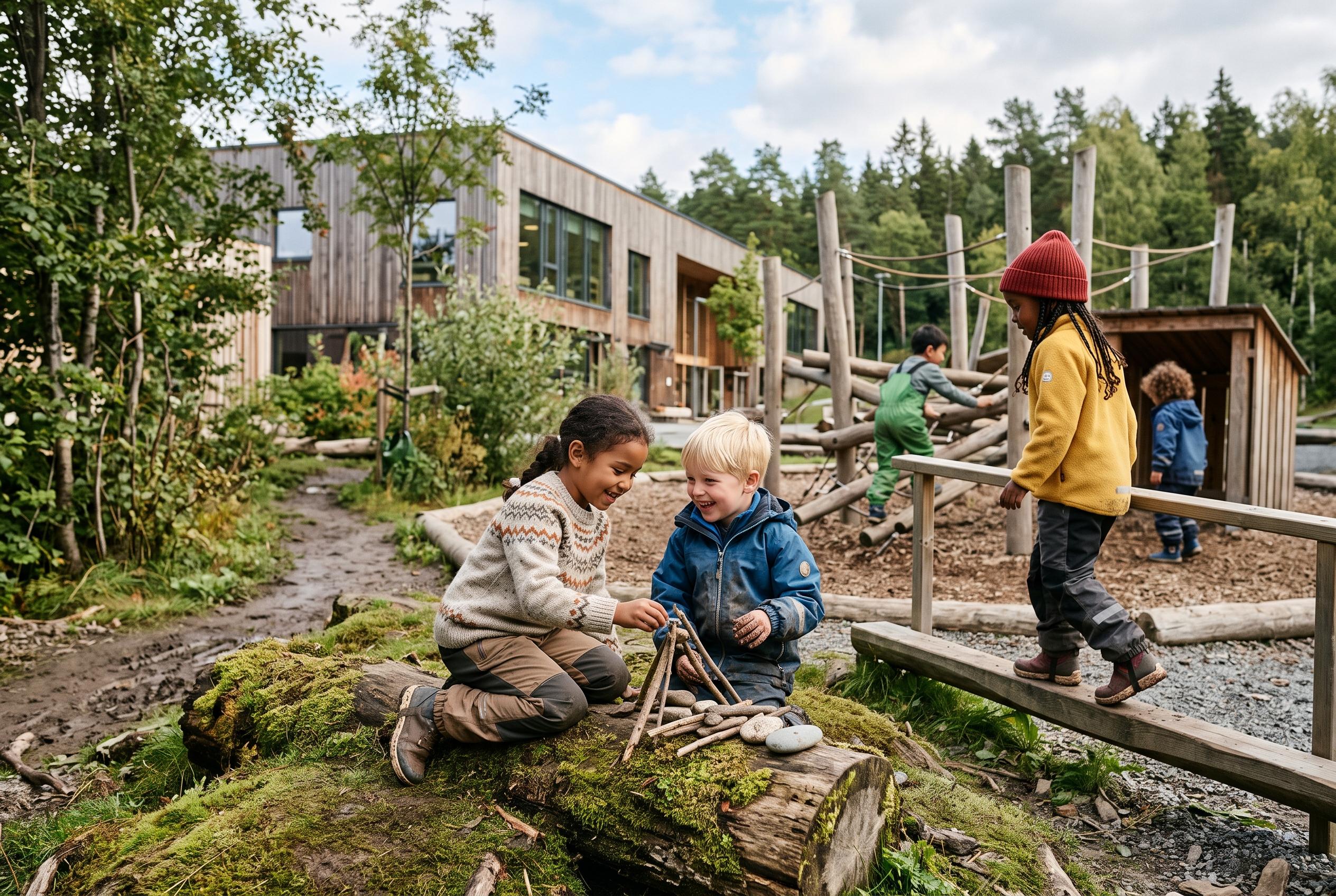

A shift in Norwegian educational policy fosters increased outdoor and unstructured play in early years, challenging traditional schooling methods and sparked by growing concerns over children’s mental health and resilience.
An argument that once sounded like a specialist warning is now edging into official policy and classroom practice. In a Norwegian Directorate for Education resource updated on 20 August 2026, child psychiatrist Charlotte Lunde says play is not merely enjoyable but “helt essensiell” to children learning life skills, while the kindergarten framework states that play must have a central place. That endorsement lands after several years in which Lunde has been pressing the same case in newspapers, books and public talks: that childhood has been reorganised in ways that leave too little room for children to play on their own terms.
That concern was already being aired nationally in 2022. Aftenposten reported then that Lunde and the neuroscientist Per Brodal had issued what they called a warning through a book-length intervention, arguing that children had been stripped of time and space for play just as mental distress was becoming more visible. Lunde told the paper that high use of medicines for psychological difficulties among the young was “et tegn på mistrivsel og et reelt problem”. She added that services in child psychiatry were unable to offer help to everyone seeking it, framing the issue not as an isolated parenting problem but as a broader sign of how childhood had changed.
Dagsavisen pushed the argument further on to the school system. In its telling, the loss of play was not simply sad or nostalgic; it was making children less robust when faced with the demands of school. The paper linked that claim to a backdrop of rising use of antidepressants and ADHD medication, alongside stress and school refusal. That made the dispute as much about what schools are asking of six- and seven-year-olds as about screens or family life. The implication was blunt: if children arrive at school with less practice in negotiation, self-direction and risk-taking, the institution may end up magnifying the very fragilities it later struggles to manage.
By September 2025, Lunde was taking the same message directly to teachers, clinicians and parents. At a Utdanningsforbundet meeting in Volda, according to Nærnett, 115 people gathered in a room where the organiser, Sirikit Kari Vågen, opened with a prompt on the screen asking: “Hva var din favorittlek da du var barn?” When Lunde arrived, still “med vått hår” from her journey, the audience applauded. She showed images of children in free play and pointed to what had changed: earlier scenes lacked both hovering adults and mobile phones. Lunde’s conclusion, as quoted by Nærnett, was that “Vi trenger en grasrotbevegelse. Å leke er det barn vil.”
The evidence repeatedly cited around her campaign is not confined to sentiment. Nærnett’s report said the share of children aged six to 12 who played outdoors had fallen from 90 per cent to 70 per cent over a decade, citing figures from NINA. The same report said Lunde drew on research by Vidar Ulset at the University of Oslo, in which 562 children were followed from 2013 and contacted again 10 years later, with greater outdoor time in kindergarten linked to stronger concentration later at school. The Directorate’s own resource now echoes another key plank of her argument, stating that risk play helps children become robust because they learn to manage fear, their bodies and their limits.
The most concrete test of these ideas has come in Tønsberg. Utdanningsnytt reported that four pilot schools there have, since autumn 2024, used roughly half of first-year teaching time for play, and that the cohort continued with more free play in the second year. At Byskogen school, headteacher Andreas Dyre-Hansen said the school had gone furthest: systematic reading instruction did not begin until after Christmas, tablets were removed and all pilot schools dropped the first-year mapping test. His verdict was that no child was learning less, many were learning more, and there was markedly less stress among pupils, staff and parents, with fewer conflicts.
What makes the Tønsberg experiment more than a slogan is the amount of structure behind it. Utdanningsforbundet’s own reporting said Tina Nordbotten Olsen, the psychologist behind “Lekende lett skolestart”, insisted that child-led play still requires knowledgeable adults if every child is to be included. Teachers have been given competence-building, and kindergarten teachers have been brought in to share expertise on how to facilitate play without taking it over. At Eik school, teacher Birgitte Blix Stray said the shift was about giving children enough time and organising the day on their terms; three months into the project, the school said reading and maths results were at least as good as before, while relationships and classroom climate had improved.
The politics around that model are notable too. Utdanningsnytt said the local coalition of Conservatives, the Progress Party, the Christian Democrats and the Liberals had written a stronger place for play in first year into their platform before the project began, and Labour politician Siri Sønderborg also backed it, saying the approach matched her party’s national programme. Utdanningsforbundet later reported that Tønsberg’s municipal council had decided to expand the pilot to more schools in 2025/2026 and start follow-up research. For a debate that began as a warning from a psychiatrist and a brain researcher, that marks a shift: the question is no longer only whether children play less than they once did, but whether schools and local authorities are prepared to rebuild a childhood with more unsupervised initiative, more outdoor time and more room for manageable risk.
Disclaimer: This content is for informational purposes only and is not intended to be a substitute for professional medical judgment, advice, diagnosis, or treatment.