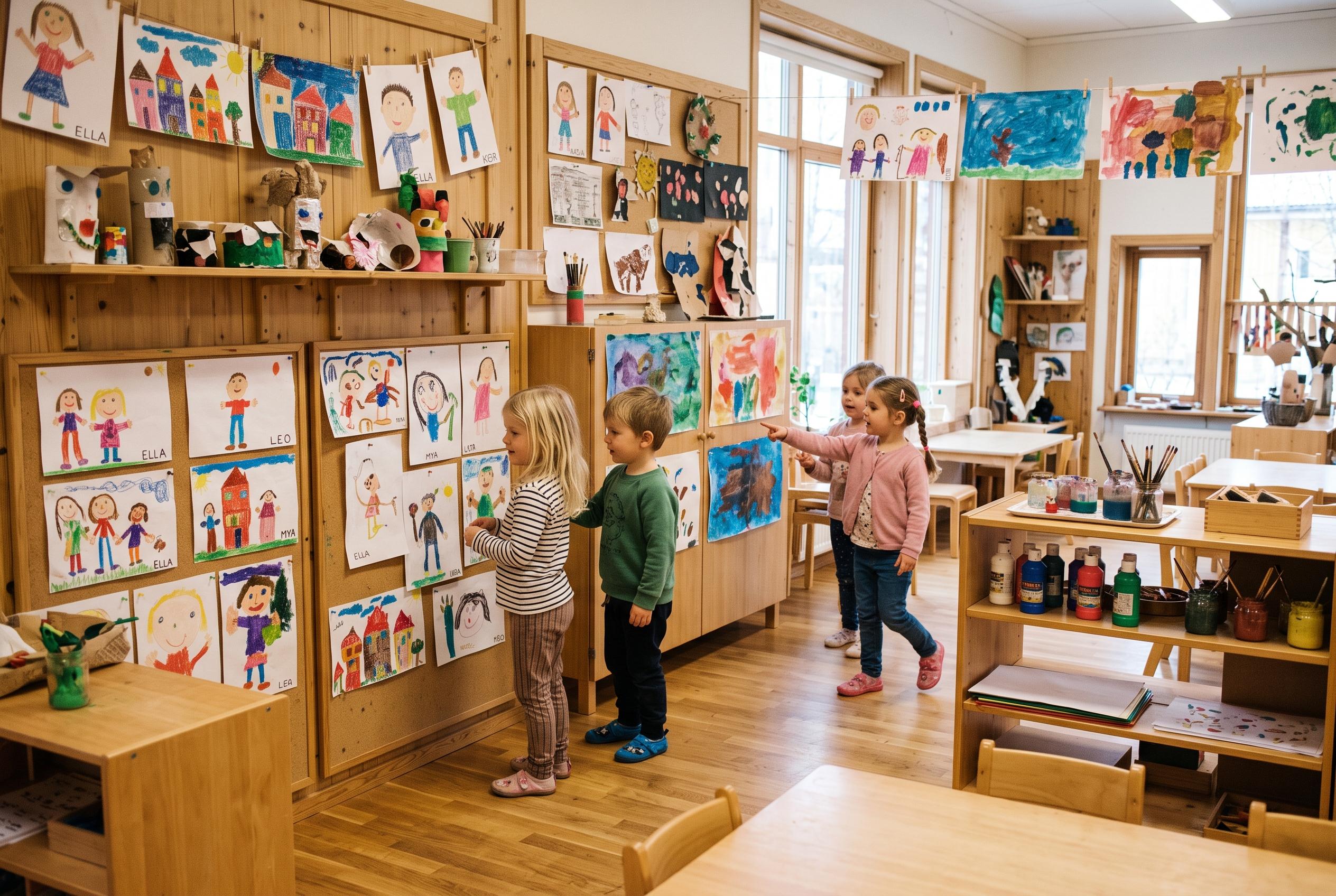

Swedish and Norwegian preschools display children’s artwork at their eye level, reflecting a broader commitment to creative self-expression inspired by the Reggio Emilia approach and regional policies promoting art and culture in early learning.
In Swedish preschools and Norwegian kindergartens, the walls often tell a simple story: children are expected to make things, and their drawings are displayed at their own height rather than tucked away as afterthoughts. According to Scandinavia Standard, that everyday visibility reflects a wider Nordic habit of treating children’s mark-making as part of ordinary learning, not just decoration.
The educational philosophy most closely associated with that practice began far from Scandinavia. Reggio Emilia, the northern Italian city where educator Loris Malaguzzi helped shape a child-centred model after the Second World War, is built around the idea that children communicate through “hundred languages” , drawing, painting, movement, music and other forms of expression. Reggio Children says the approach sees children as capable, curious learners, while a study archived by the University of Modena and Reggio Emilia notes that Sweden adapted the model in ways that matched local ideas about learning environments and inclusion.
That influence is especially visible in Sweden, where the Reggio Emilia Institutet has operated in Stockholm since 1993 and where many preschools have adopted the model’s atelier, or studio space for creative work. Scandinavian practice also reflects policy. Sweden’s preschool curriculum calls for children to have time, space and calm for creative activity, while Norway’s Framework Plan for Kindergartens places art, culture and creativity among the core areas every child should encounter. In both countries, drawing is typically woven into daily life rather than reserved for a separate art lesson.
Still, the Nordic example is better understood as a choice than a triumphal claim. Nothing in the evidence suggests children in Scandinavia are inherently more creative than children elsewhere, only that the region has chosen to give early self-expression considerable room. That depends on public funding, trained staff and a play-based system that delays formal schooling until later than in many countries. The broader lesson is modest but practical: children want to draw anyway, and some education systems decide to take that impulse seriously.
Disclaimer: This content is for informational purposes only and is not intended to be a substitute for professional medical judgment, advice, diagnosis, or treatment.