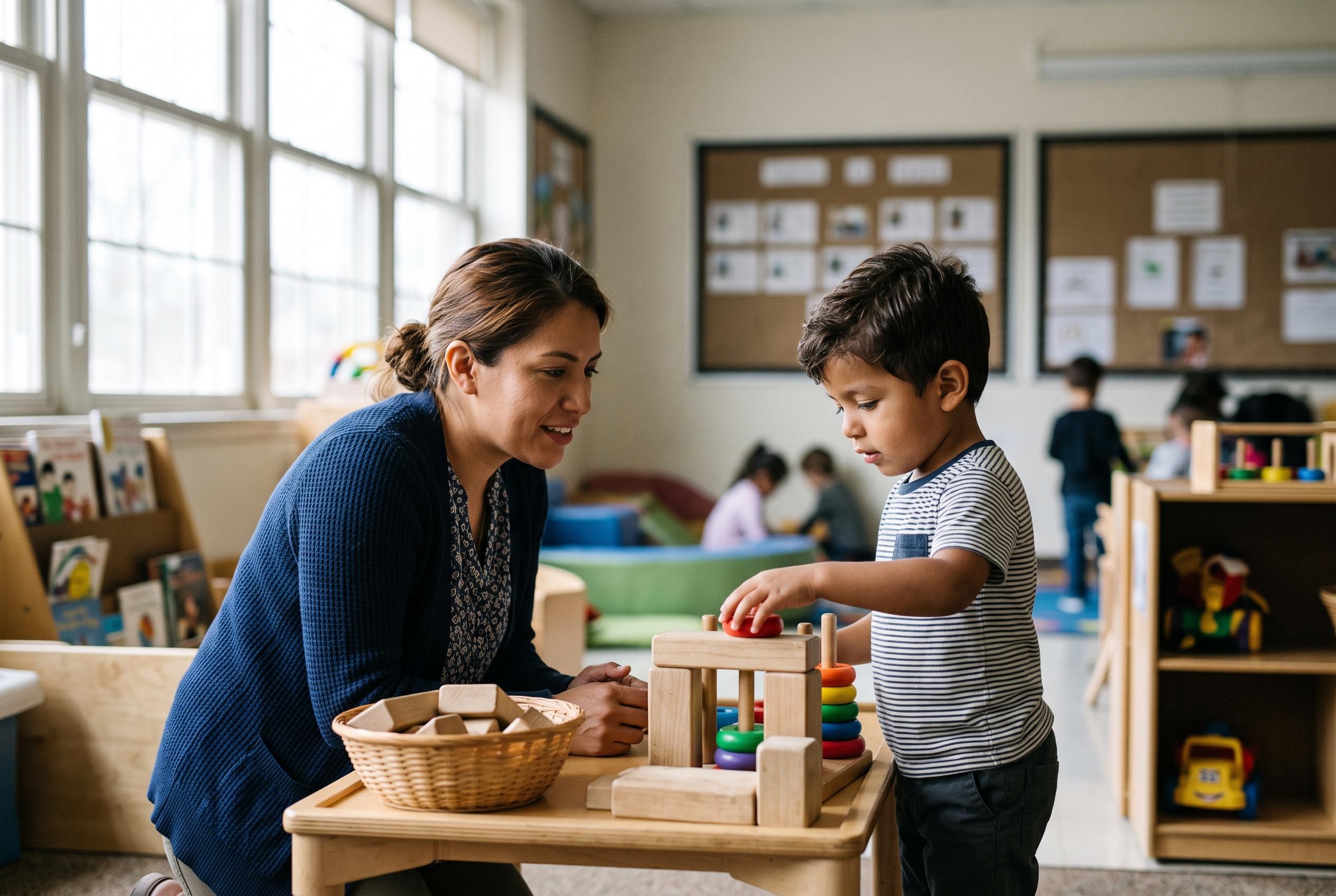

Emerging assessment tools designed for bilingual children promise more accurate evaluation of dual language PreK learners, helping educators better identify support needs and ensure equitable education outcomes.
For public PreK programmes that serve dual language learners, assessment only works if children can show what they know in the language, or languages, they know best. But language access alone is not enough. As Isabel Andrade of Khan Academy Kids argues, programmes also need to know whether a tool was merely translated from English or designed and validated for bilingual children from the outset. That distinction can determine whether a score reflects a child’s ability or a flaw in the test itself.
A translated assessment starts with a measure built for English-speaking children and then converts the prompts into another language. A bilingual assessment is built in parallel across both languages, with items checked for comparable difficulty and tested with bilingual children. Speech-language resources and guidance for bilingual service delivery make the same point: direct translation can miss the difference between a language variation and a true learning concern, and it can leave educators with results that are hard to interpret.
The problem is not just theoretical. Words rarely match neatly across languages, even when they appear to mean the same thing. A simple vocabulary item can become more difficult after translation, a sentence can change in complexity because of grammar, and regional vocabulary can disadvantage children from different Spanish-speaking communities. The Children’s Equity Project has noted that these kinds of issues make it difficult to tell whether a child is struggling with language, or whether the assessment is failing to capture what the child actually knows. Research on bilingual assessment likewise stresses that translation alone does not guarantee valid results.
That is why well-built bilingual measures are developed in both languages at the same time, calibrated against data from monolingual and bilingual children, and reviewed by people who understand the dialects and communities they are meant to serve. Experts in bilingual assessment also caution that without this work, children may be wrongly flagged as delayed or, just as troubling, children who need support may go unnoticed for too long. In practice, the strongest tools aim to measure the underlying skill, not a child’s level of exposure to English.
The stakes extend beyond individual children. Programme-level data can shape funding, quality reviews and staffing decisions, so weak assessment design can make classrooms and programmes serving dual language learners look less effective than they are. Khan Academy Kids says its PreK assessments were built bilingually in English and Spanish, calibrated for equivalent difficulty and reviewed with dialectal variation in mind. The company also says qualifying publicly funded PreK programmes can pilot the tool at no cost during the 2026-27 and 2027-28 school years through grant funding.
Disclaimer: This content is for informational purposes only and is not intended to be a substitute for professional medical judgment, advice, diagnosis, or treatment.