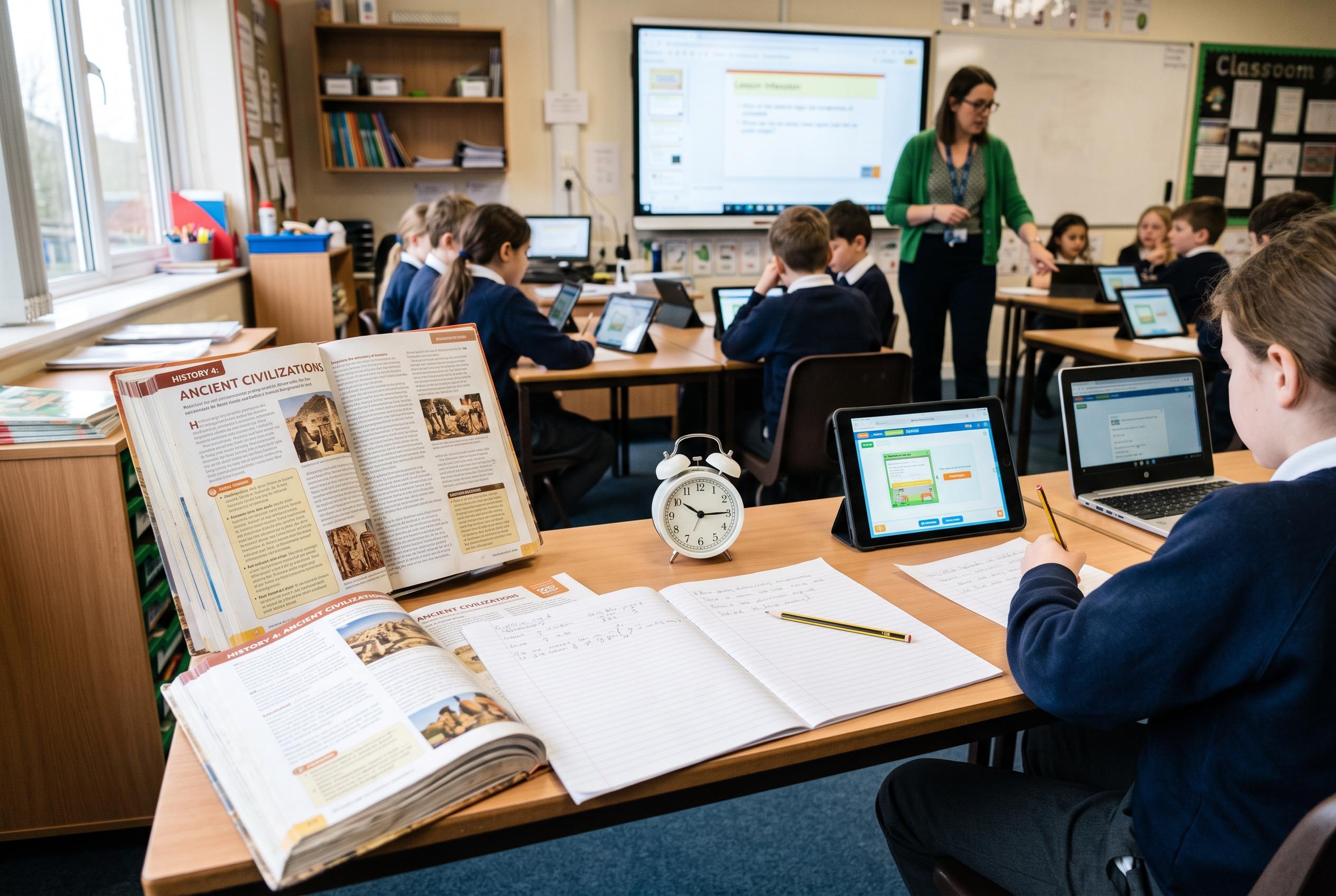

Jared Cooney Horvath challenges the widespread adoption of digital devices in schools, raising concerns about their impact on children’s cognitive development and learning habits amidst growing scepticism and ongoing debate.
Jared Cooney Horvath has become one of the most visible critics of classroom screens, arguing that the rush towards laptops, tablets and learning apps has gone far beyond what the evidence supports. The neuroscientist and former teacher says the problem is not technology itself, but the way schools have come to rely on it as a default rather than as a carefully chosen tool. In a report cited by Digital Trends, he links that shift to weaker learning habits and a broader decline in how children retain knowledge. The Guardian has also reported on the concerns behind his book, “The Digital Delusion”.
Horvath’s central claim is that education has become too dependent on devices at the same time as broader progress in health and learning has slowed. He points to long-term drops in IQ scores in parts of the West and says school time has not produced the gains many expected. He also argues that the edtech market has grown into a huge business, which he sees as one reason schools have embraced digital tools so quickly.
The Covid-19 pandemic accelerated that change. Many schools adopted laptops and online platforms more aggressively during remote learning, and a lot of them did not scale back afterwards. Horvath has cited international assessment data suggesting that heavy screen use is associated with weaker results, while the book itself presents practical advice for families and educators who want to create more attention-rich learning environments. Publishers and booksellers describing the work say it is aimed not only at schools but also at parents trying to decide how much screen use is healthy at home.
Not everyone in education accepts his conclusions. Rose Luckin of UCL has said edtech was oversold without enough hard evidence, but she has also noted that moderate device use may be linked with better results than avoiding screens altogether. Dylan Wiliam, another UCL education expert, has stressed that the evidence so far shows correlation rather than causation. Daisy Christodoulou of No More Marking has argued that schools became too comfortable with unproven technology, even if she remains more hopeful about its future use. The disagreement leaves a more practical question than a philosophical one: when does screen use help children learn,and when does it start to get in the way?
Disclaimer: This content is for informational purposes only and is not intended to be a substitute for professional medical judgment, advice, diagnosis, or treatment.