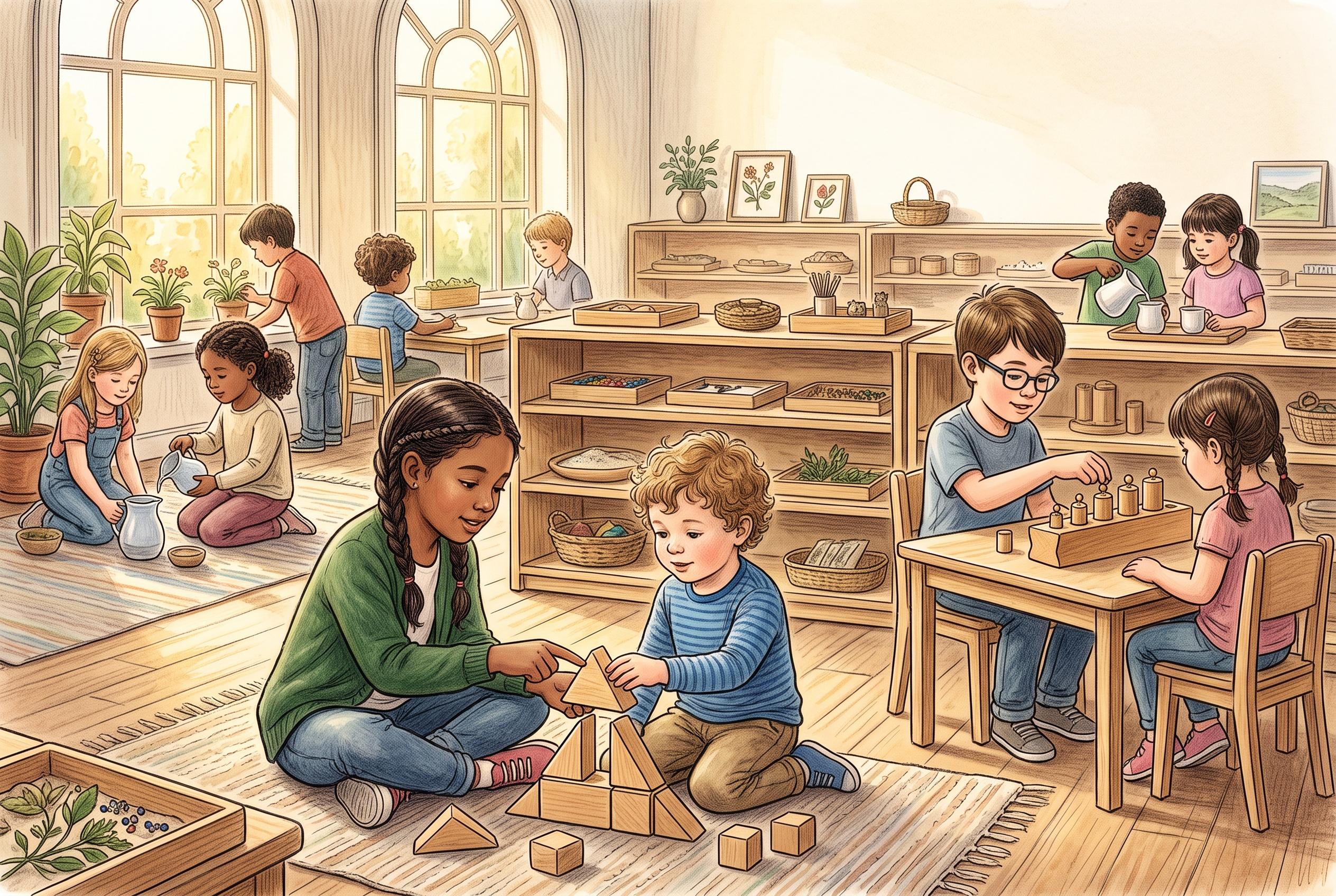

Montessori classrooms group children across age spans, promoting social skills, leadership, and personalised growth through a structured three-year cycle, challenging traditional notions of age-based learning hierarchy.
At back-to-school night, one of the first things parents notice in a Montessori classroom is the age range. A three-year-old may be carefully carrying a tray, while an older child reads aloud to a younger classmate or tidies a table with quiet purpose. According to Montessori materials, that mix is not a quirk of scheduling but a core part of the method: children are grouped across a span of years so they can move through the classroom as beginners, learners and leaders.
That structure usually follows a three-year cycle, with Primary spanning roughly ages three to six, then Elementary groupings that continue the same principle at later stages. The child is meant to begin as the youngest, grow into the middle position, and eventually become the oldest. Montessori educators say that progression is central to the classroom’s purpose, because it gives children time to settle, practise, contribute and eventually lead.
The value of that continuity is practical as well as social. As Tim Seldin has written for Montessori.org, mixed-age classrooms mirror real communities, where people take on different roles over time rather than remaining fixed in one category. The same guide stays with the child for several years, which allows the adult to understand not only academic progress but also temperament, concentration, friendships and responses to challenge. The first year is often about learning the routines and culture of the room; the second is when confidence tends to grow; and the third is when many children begin to use what they know to support the group.
Younger children benefit from constant exposure to more experienced peers. As Montessori.org explains in its article on mixed-age classrooms, children learn a great deal by watching others prepare work, use tools correctly and return materials with care. That observation often leads to imitation, and imitation becomes practice. What can look like play is often a child absorbing sequence, movement and social expectations, then trying them with striking concentration.
Older children gain as well, and not only because they get to help. Sophia Carter, writing for Montessori Theory, notes that teaching younger classmates can strengthen older children’s own understanding. When a child explains a process, the child has to organise ideas, use clear language and take another person’s point of view. Montessori educators also argue that this builds patience, empathy and confidence. In that sense, helping is not a distraction from learning; it is part of it.
The classroom’s leadership culture is therefore different from a typical hierarchy. Tim Seldin describes leadership as arising from competence, not from age alone. An older child may show a younger one how to roll a mat, carry water, or find a place for materials after work is finished. That kind of authority is quiet and earned. It also supports discipline, because children are learning self-control through real responsibility rather than through constant adult direction.
Parents sometimes worry that mixed ages will leave younger children overwhelmed or older children bored. Montessori writers address both fears directly. Younger children usually find the presence of older classmates reassuring rather than intimidating, because they can observe before they attempt. Older children are not left to coast; they continue to receive work that stretches them, while the responsibility of helping others often deepens their own learning. In a strong Montessori environment, the classroom becomes a place where each child can advance at an individual pace without being labelled ahead or behind.
That same logic is why the three-year cycle matters so much. Maria Rodriguez has written for Montessori.org that children move through distinct roles over time, and each stage brings a different kind of growth. By the end of the cycle, a child who once watched others may be the one showing a newcomer how the room works. For families, that can be the clearest sign that the system is working: the child is not only learning facts and skills, but also learning how to belong, contribute and care for other people.
Disclaimer: This content is for informational purposes only and is not intended to be a substitute for professional medical judgment, advice, diagnosis, or treatment.