

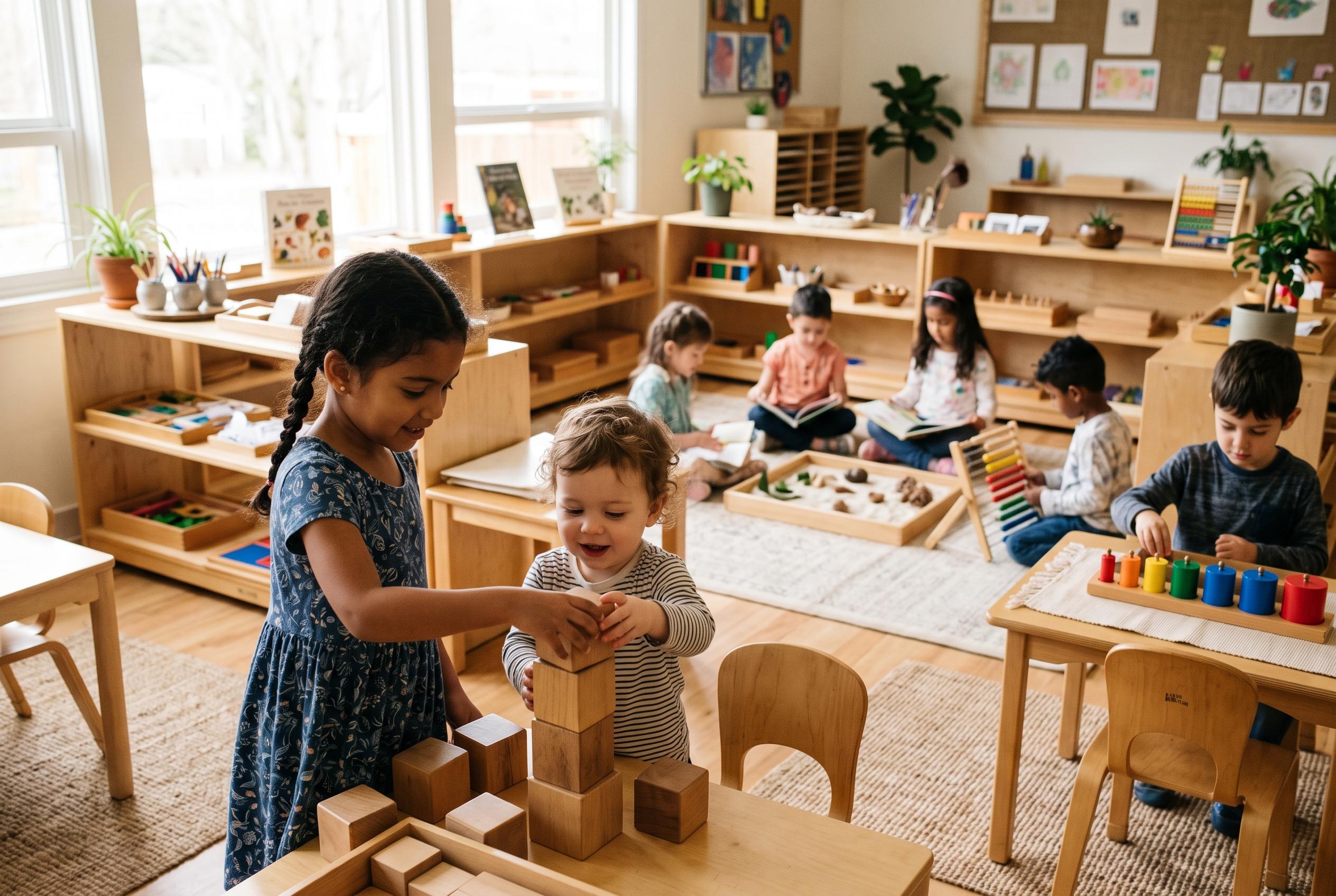

Montessori schools challenge traditional age-based learning by promoting mixed-age classrooms that enhance social skills, confidence, and tailored development, reflecting real-world community dynamics.
A Montessori mixed-age classroom can look unusual at first glance. To many parents, the idea of a three-year-old sharing a room with five-year-olds prompts obvious concerns: should children not be grouped by age, pace and stage? Montessori schools argue that the arrangement is not a compromise, but a deliberate part of how children learn best.
In a typical Children’s House, children from about three to six years old stay together for several years in the same prepared environment. Adults do not expect all children to do the same work at the same time. Instead, they observe closely, offer lessons when a child is ready and adjust expectations to suit individual development. The point is not to make younger children catch up or older ones slow down, but to let each child progress at a natural pace.
For younger children, the classroom offers a constant stream of visible possibility. A three-year-old who watches an older child read, write, pour water or care for a material is seeing a future version of themselves in action. Montessori educators say that this kind of everyday observation matters because it makes growth concrete. The child does not just hear that they will learn these things one day; they see it happening in front of them.
The older children gain something just as important. Once they are among the more experienced members of the room, they are often asked to explain a task, show where a material belongs or help a younger child complete an activity. That experience can strengthen confidence and reinforce their own understanding. Educational researchers have long noted a similar effect: teaching others often deepens a child’s grasp of a skill, a pattern sometimes described as the protégé effect.
Supporters of mixed-age classrooms also point to the social climate they create. According to Montessori writers, children in these settings tend to compare themselves less and collaborate more, because there is no expectation that everyone should be at the same stage. Research summaries cited by Montessori sources suggest that younger children benefit from exposure to older peers’ language, while mixed-age groups often show more sharing, helping and cooperation than age-segregated classrooms.
The model also reflects how children live outside school. Families, neighbourhoods and communities are not sorted by birth year, and Montessori education tries to mirror that reality. Older children naturally guide younger ones, while younger children look up to those only a little further ahead of them. That balance can encourage patience, empathy and a more practical sense of leadership, because help is offered as part of community life rather than as a special assignment.
Parents often worry that older children may spend too much time helping others and too little time advancing themselves. In a well-run classroom, that should not happen. Montessori lessons are sequenced so that older children continue to meet fresh academic challenges, while peer support remains occasional and purposeful. The adult guide remains responsible for each child’s progress, classroom order and emotional support.
The structure repeats as children move through the school. The youngest become the oldest, then the mentors, then the younger ones again when they enter the next level. That rhythm continues into elementary and adolescence, where mixed-age groups often remain central to Montessori practice. The result is a school culture that treats development as uneven, social and deeply human, rather than as a race through fixed milestones.
Disclaimer: This content is for informational purposes only and is not intended to be a substitute for professional medical judgment, advice, diagnosis, or treatment.



