

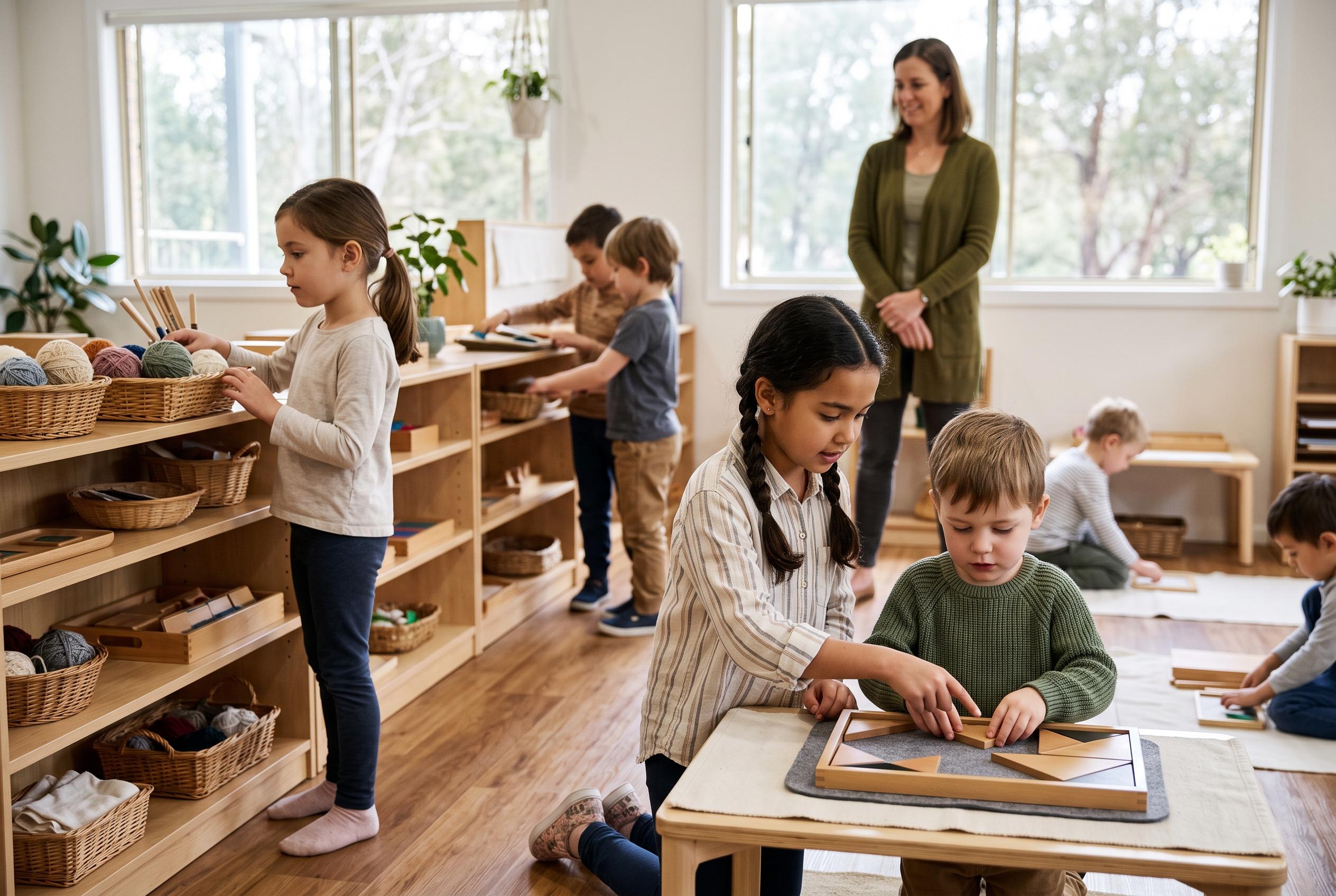

Montessori’s mixed-age classroom model, inspired by natural community dynamics, promotes personalised learning, leadership, and social cohesion among children by blending different ages within the same environment.
A Montessori mixed-age classroom can puzzle parents at first glance. Why place three-year-olds with five-year-olds? Why not group children neatly by birth year, as most schools do? Montessori argues that the answer lies in how children naturally learn, and in how real communities actually work. The model is not a convenience. It is a deliberate feature of the approach, designed to mirror the way children have historically grown up alongside people of different ages. According to the Montessori Foundation, that structure gives younger children visible examples to follow while allowing older children to practise leadership, responsibility and cooperation.
In a typical Children’s House, children between about three and six years old remain together for several years in the same prepared environment. Teachers, or guides, observe closely and introduce materials when each child is ready, rather than expecting the whole class to move in lockstep. Montessori schools say this avoids the false idea that every child should be at the same stage at the same time. Instead, each child follows an individual path within a stable community, with work and expectations matched to development rather than age alone.
That arrangement gives younger children something powerful: a live preview of what they may soon be able to do. When a three-year-old watches an older classmate read, carry out practical tasks, or work calmly with classroom materials, the lesson does not come from adult instruction alone. Montessori writers say the child sees competence in action, close enough to feel attainable. The school environment becomes a place where aspiration is concrete, not abstract, and where observation is part of learning itself.
For older children, the benefit is different but just as important. In mixed-age rooms, they are not simply the biggest children in the class; they are often the children others turn to for help. That might mean showing a younger pupil where a material belongs, demonstrating how to carry an object carefully, or answering a simple question before returning to their own work. Montessori schools say these small moments build confidence and leadership without turning older children into substitute teachers. The adult remains responsible for the classroom, but the child experiences the satisfaction of being trusted and needed.
The structure also strengthens understanding. Educational writers on Montessori’s mixed-age model often note that children learn more deeply when they explain a skill to someone else, because teaching quickly reveals what they truly know and what they still need to practise. The approach also creates a classroom culture in which cooperation is ordinary. Older children model respect and self-control, younger children learn by watching, and both groups gain practice in patience, asking for help and offering it in return.
A common concern is whether the older children lose out academically by spending time with younger classmates. Montessori schools say they should not, because the curriculum is designed to keep challenging each child at the appropriate level. Helping a younger child is an addition to, not a replacement for, a child’s own work. The classroom is intentionally stocked with materials that serve different stages of development, so a child can be stretched in one area while revisiting familiar work in another. Teachers use observation to know when a child is ready for more, when more practice is needed and when a different challenge is appropriate.
The wider effect is social as well as academic. In a mixed-age setting, children repeatedly see that growth is uneven and individual. One child may be far ahead in mathematics but still need help with friendships. Another may read well but struggle with organisation. Over time, that variety becomes normal. Montessori advocates say the classroom therefore helps children live with difference, rather than treating difference as a problem to be fixed. In the longer Montessori arc, the same pattern continues through elementary and adolescence, where multi-age groups support collaboration, research, shared responsibility and practical contribution to the community.
That is why Montessori sees the mixed-age classroom as more than an administrative choice. It is a social structure, a teaching tool and a developmental safeguard all at once. The youngest child can look ahead and imagine what is next. The oldest child can look back and help another person find their footing. And the adults can build a classroom that feels less like a conveyor belt and more like a small, steady community, where children learn not only from lessons, but from one another.
Disclaimer: This content is for informational purposes only and is not intended to be a substitute for professional medical judgment, advice, diagnosis, or treatment.



