

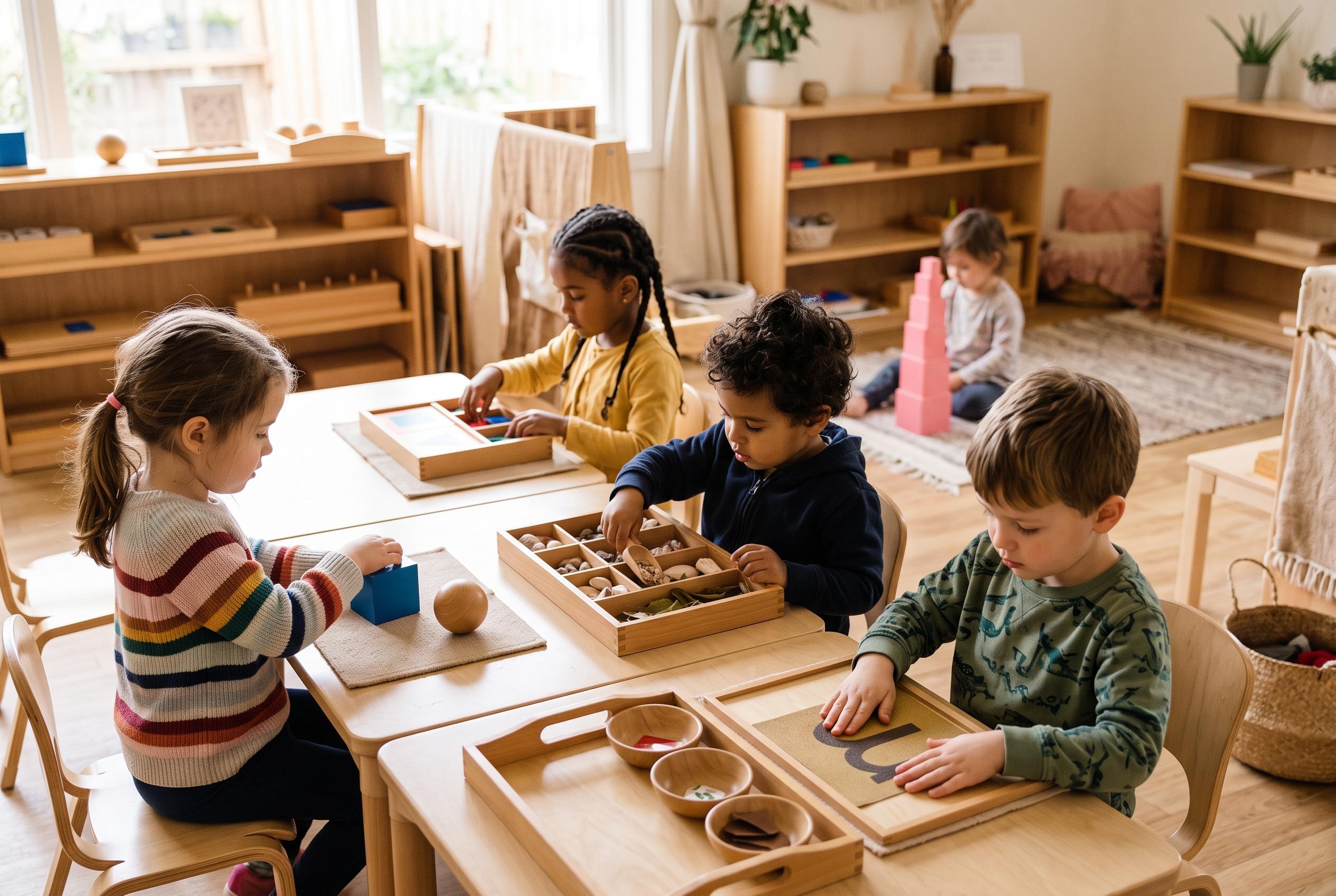

Moving away from traditional paper trails, Montessori education relies on physical materials and continuous teacher observation to foster deeper understanding and more meaningful assessment in early childhood and beyond.
Parents often notice the same thing when they step into a Montessori classroom: there is little sign of the paper trail many schools send home. No worksheet pile, no workbook routine, no weekly folder full of completed pages. That absence can be unsettling at first, but the point of the approach is different. Montessori begins with the idea that children understand best when they can handle ideas in real life before they are asked to represent them on paper.
That is why the method leans so heavily on materials such as the Golden Beads, which let children physically explore place value and the decimal system. Rather than memorising that 10 units make one ten, 10 tens make one hundred and 10 hundreds make one thousand, the child can see and feel the relationships in front of them. The same principle runs through early childhood education more broadly: babies and toddlers build knowledge through movement, repetition and sensory exploration long before they ever meet formal academic tasks.
Montessori educators describe this as moving from the concrete to the abstract. Children use their hands to grasp quantity, shape, language and sequence before they are expected to rely on symbols alone. A child might build a word with movable letters before writing it neatly with a pencil, or explore size and proportion through sensorial materials before encountering geometry in a more formal way. The hand, in this model, is not a distraction from thinking; it is what helps thinking begin.
That does not mean paper is absent. It simply arrives when it is useful, not as a proof of worth. Children in Montessori settings do write, draw, keep records, solve equations and make reports, especially as they move into the elementary years. The difference is that written work is treated as one tool among many, not as the main evidence that learning has happened. A child may spend a long time working intensely with materials and leave no visible paper trail at all, even though real learning has taken place.
Teachers, meanwhile, rely on close observation rather than stacks of marked sheets. They watch how a child handles a task, whether instructions can be carried out independently, and whether a concept is understood well enough to be used in a new situation. If a child struggles, the teacher can respond immediately with another lesson, a new challenge or more practice. In other words, assessment happens continuously, through the child’s work itself, rather than being postponed until a worksheet comes home.
As children grow older, the materials recede and abstraction takes over. The Montessori Foundation’s curriculum scope and sequence describes a progression through practical life, sensorial work, language, mathematics, science, history, geography, the arts and more, with each stage preparing the next. By adolescence, the work may involve research, presentation, calculation, design and community responsibility rather than the familiar worksheet model. The aim is not to avoid paper altogether, but to make sure it appears only when it genuinely deepens understanding. For parents, the better question is not how many pages came home, but what the child can explain, apply and carry forward after the page is gone.
Disclaimer: This content is for informational purposes only and is not intended to be a substitute for professional medical judgment, advice, diagnosis, or treatment.



