

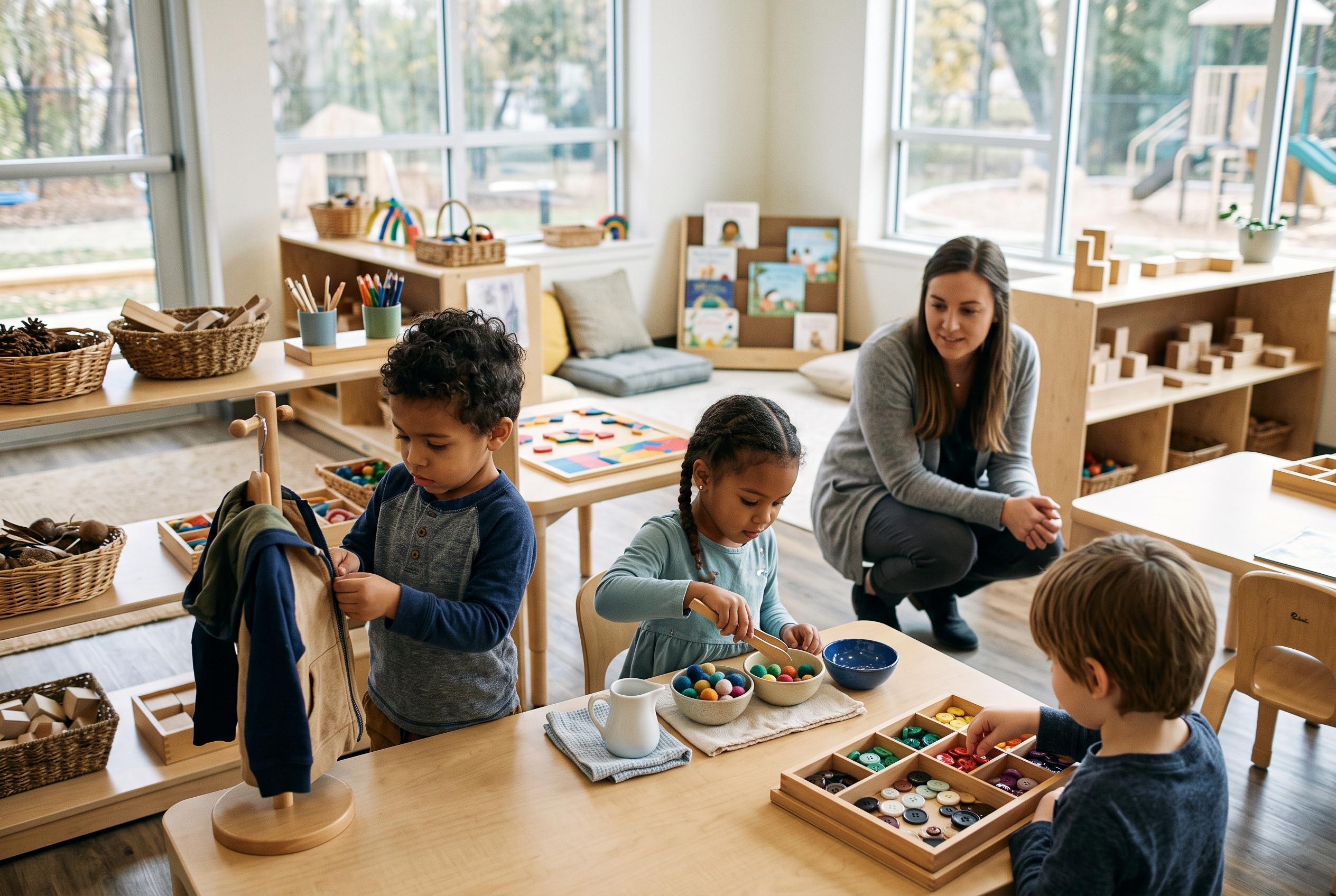

Recent studies reveal that while today’s preschoolers demonstrate advantages in pattern recognition and symbolic reasoning, they may lack key practical and independence skills valued in Soviet childhood, highlighting a complex shift in childhood development.
Many people assume Soviet-era children were sharper, tougher and more capable than today’s. That belief rests partly on memory: larger school curricula, a heavier emphasis on facts and drills, and a childhood that often demanded more independence. But psychologists who compared preschool children from the 1970s with those studied between 2015 and 2020 found a more complicated picture. On some measures, modern children did better; on others, their predecessors had the edge.
The first problem in any such debate is definition. Intelligence is not just memorising poetry, reciting tables or using a smartphone quickly. Psychologists usually look at several abilities at once: logic, attention, memory, spatial reasoning, language, pattern recognition and the ability to solve practical problems. That makes simple claims that one generation was “smarter” than another difficult to support.
Researchers at Moscow State University of Psychology and Education compared two groups of children aged six and seven, using either the same or closely comparable methods across eras. They examined 156 children from the older dataset and 236 from the more recent one. The tasks did not test school knowledge. Instead, they measured how children handled shapes, models, systems and regularities. On the overall scale used in the study, modern children scored higher on average: 11.45 points compared with 10 for children from the 1970s. That is not an IQ score, but it was a statistically significant difference.
The strongest modern results came in tasks linked to schemes and systems. Contemporary preschoolers were better at spotting patterns, understanding how parts fit together and navigating abstract models. The authors also found that these children outperformed peers from both the 1970s and the 1990s in those areas. In practical terms, today’s children seem more comfortable with symbolic and structural thinking, even if that does not make them universally “smarter” in every sense.
The older group, however, did better in a different kind of task. When asked to match objects to a sample, children from the 1970s scored 25.36 points, against 23.93 for the modern group. That points to stronger sensory abilities: the capacity to notice shape, detail and physical properties accurately and compare them with an external standard. Researchers also looked at perceptual modelling, or the ability to build a mental image of an object from its parts, and found no meaningful difference there. One possible explanation is that children now spend more time with screens and less with real objects, though that remains a hypothesis rather than a proven cause.
This shift fits a broader pattern identified in Russia and elsewhere: the Flynn effect, the long-running tendency for younger generations to perform a little better on intelligence tests than older ones. A large Russian study of more than 267,000 adults found that people born between 1983 and 2000 improved by about 0.19 IQ points per birth year, or roughly 3.2 points over the full period. That does not mean a child born in 2000 is automatically more intelligent than one born in 1983, and the study examined adults who chose to take an online test. Even so, the data do not support the idea of a general decline in cognitive ability.
Where the Soviet childhood appears to have held a clearer advantage is in independence. Researchers from the Higher School of Economics have noted that children in Russia and other countries are spending less time moving around on their own. They start travelling independently later, are escorted more often and spend less time outdoors without adults. That kind of freedom trains a different set of skills: orientation, decision-making, responsibility and the ability to deal with unexpected situations. It may be one reason older children often seemed more mature, even if that maturity was not the same as higher test performance.
Play has changed too. Russian psychologists who compared children’s role-play with data collected about 55 years earlier found that complex imaginative games are less common now. That matters because free play teaches children to follow rules, regulate themselves and work towards a shared goal. Games such as “war”, shop, building sites or space travel force children to negotiate roles and invent storylines, which in turn develops communication and thinking skills. Today, much of that open-ended time is taken up by ready-made entertainment.
Screens are part of the story, but they have not made children uniformly less capable. In 2023 and 2024, Russian children aged five to seven spent around 10 to 11 hours a week watching screens passively, with another four to five hours on more active digital activities. A recent Russian review of meta-analyses found that heavy screen exposure is associated with weaker development in language, communication and emotional understanding. But that is a correlation, not proof of direct harm, and the content matters. Educational programmes designed for the right age can support vocabulary growth; endless short-form scrolling is a different matter.
The same caution applies to claims that modern children are brilliant at handling information simply because they have smartphones. A Higher School of Economics study of more than 30,000 ninth-graders in 21 regions found that many struggled to search for information, judge its reliability and combine it into something useful. Most scored below a basic level, and only just under a third reached it. Yet the opposite complaint also fails under scrutiny. In the PIRLS 2021 international reading assessment, Russian fourth-graders scored 567 points, putting them among the world leaders in reading comprehension, with about 89% reaching at least a middle level.
The school environment itself has changed as well. Soviet education was built around a structured body of knowledge, with an emphasis on facts, rules and formulas. But it would be wrong to reduce it to rote learning alone. By the 1960s and 1970s, reforms were already trying to move children away from pure memorisation and towards solving problems independently. Today’s school, at least in theory, asks a different question: not simply what a child knows, but whether that child can apply knowledge in an unfamiliar setting.
Taken together, the evidence suggests that the answer to “which child is smarter?” depends on what kind of smart you mean. If intelligence is measured through pattern recognition, logic and work with schemes, modern children have a modest advantage. If the focus is on handling real objects, managing everyday independence and inventing their own play, the older model of childhood still looks stronger. The differences between families, schools and individual children, however, are often larger than the differences between generations. In other words, the debate is less about a winner and more about two childhoods that trained different minds in different ways.
Disclaimer: This content is for informational purposes only and is not intended to be a substitute for professional medical judgment, advice, diagnosis, or treatment.



