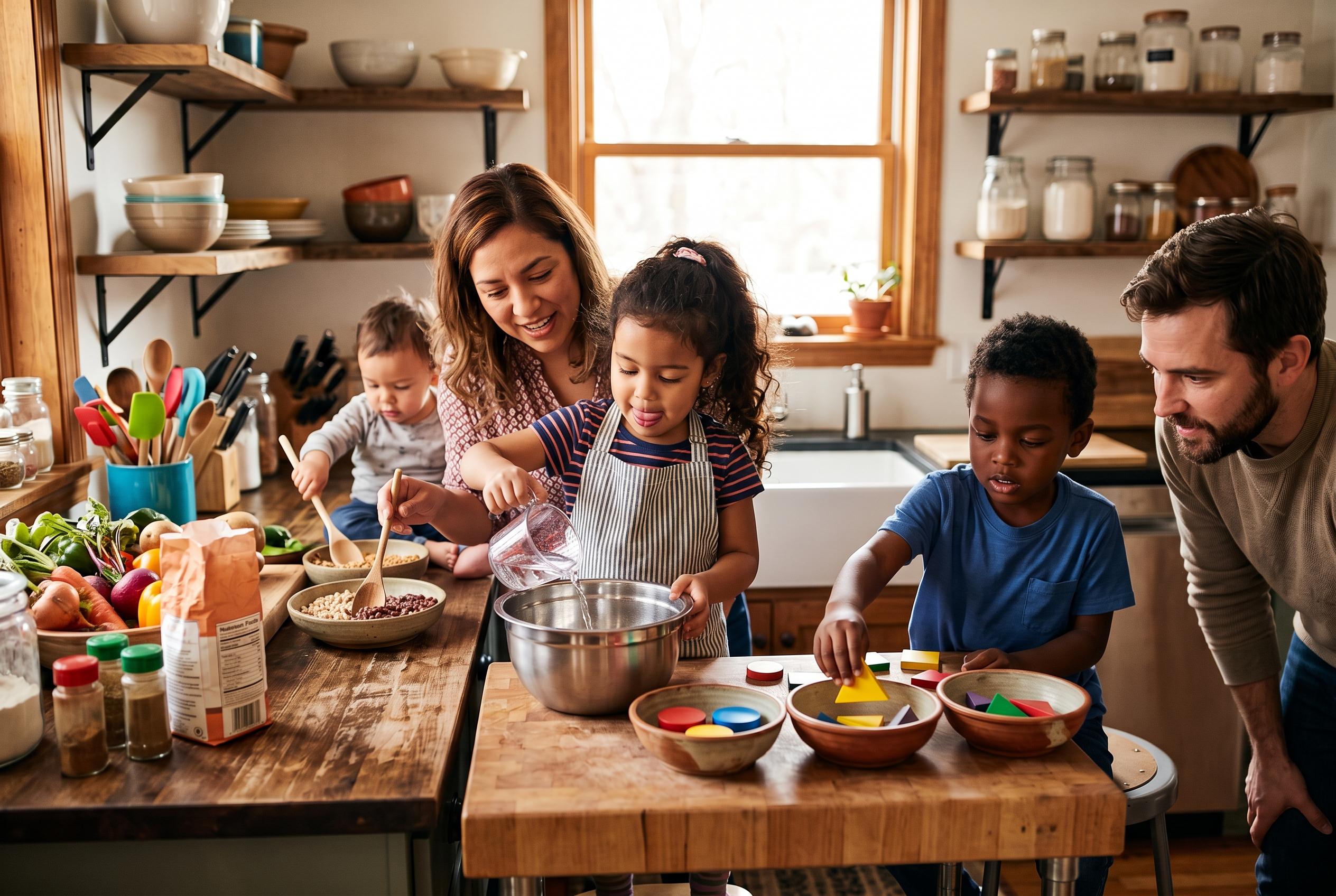

Innovative kitchen-based activities are transforming how young children develop fundamental maths skills, turning everyday routines into engaging, hands-on learning experiences that go beyond traditional classroom methods.
Kitchen work can do more than get dinner on the table. For young children, it can turn numbers into something they can see, touch, pour, sort and count. Activities such as spotting dot patterns, handling measuring cups and following simple recipe steps help children build number sense in a way that feels natural rather than forced. Research-based classroom resources on subitizing show that recognising small groups instantly is a key early math skill, while guides on measuring cups and volume stress how physical tools help children connect numbers to real quantities.
One of the simplest ways to start is with subitizing, or recognizing small sets without counting one by one. In the kitchen, that can mean arranging raisins, blueberries or chocolate chips in familiar patterns on a baking sheet, much like dots on a die. Teachers’ materials on subitizing describe this as a foundation for number fluency, and parents can use the same idea at home by asking children to say how many items they see before they begin counting. The goal is not speed alone, but helping children understand that small groups have a visual shape as well as a number.
Measuring is another strong starting point because it makes volume concrete. Guides on standard measuring cups note common sizes such as 1 cup, 1/2 cup and 1/4 cup, and explain how those amounts relate to tablespoons, teaspoons and fluid ounces. That kind of comparison gives children an early sense of fraction ideas and proportional thinking. Pouring water, rice or flour from one cup to another also helps them see that two smaller amounts can equal one larger amount, which is a much more memorable lesson than a worksheet.
The kitchen also offers easy practice with order, grouping and matching. A child can help set the table by placing one fork, one plate and one napkin for each person, reinforcing one-to-one correspondence. They can sort crackers or fruit into equal snack bowls to learn fair sharing, or follow a short recipe in numbered steps to understand sequence. Educators often link these early tasks to later concepts such as division, ordinal numbers and logical reasoning because they show that math is not just about totals; it is also about relationships and order.
More advanced kitchen play can build number sense in subtler ways. A muffin tin creates a simple grid for counting in rows and columns, which introduces array thinking and early skip counting. Comparing the size of pancakes or cookies helps children separate size from number, while watching a timer count down gives them a practical sense of reverse counting and time passing. Even unpacking groceries can become a lesson when a child compares weight and quantity, learning that a larger package does not always mean a heavier one or a greater count. Together, these small routines turn everyday cooking into a low-cost, hands-on math lab.
Disclaimer: This content is for informational purposes only and is not intended to be a substitute for professional medical judgment, advice, diagnosis, or treatment.