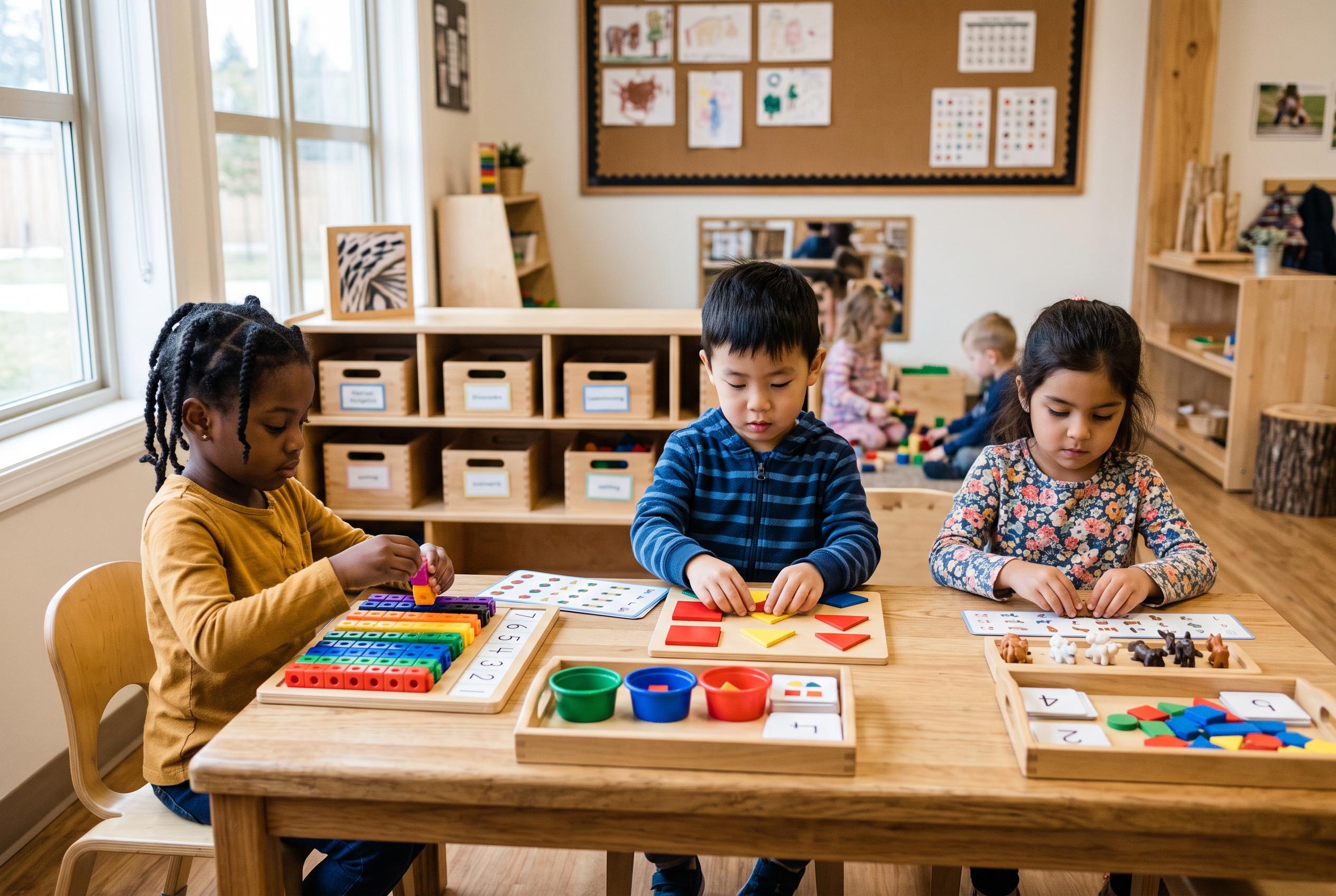

New models of kindergarten maths centres emphasise structured routines combined with choice, aiming to streamline transitions, boost independence, and enhance learning outcomes without sacrificing organisation or curriculum alignment.
Kindergarten maths centres often collapse under their own management. The most striking idea in this classroom model is that the teacher tries to prevent that by narrowing choice rather than scripting every move: pupils are sorted into colour-coded groups, a visual wheel gives each group two centre options, and the adult uses that freed-up time to pull children for separate, data-led small-group teaching. That broader principle is echoed elsewhere. Lucky Little Learners pitches independent centres as a way to cover strands from addition and subtraction to shape, measurement, skip counting and place value while the teacher works with a group, and Hello Learning argues that independence improves when pupils have some control but know exactly how the routine works.
The classroom routine itself is deliberately simple. Children first check whether they have any unfinished work from the previous session, complete that before starting anything new, and only then look to the wheel to decide where to go. The centre groups are not fixed teaching sets but flexible skill groupings that change with need, while teacher-led groups are called separately during centre time. That sits somewhere between full free choice and a traditional rotation. Creative Kindergarten describes a looser model in which pupils stay at an activity for as long as they wish and move on when ready, but says the first month of school is spent explicitly teaching that routine. Oxbox Teaching makes a similar point in practice: pupils may revisit the same activity repeatedly or move on quickly, and both patterns can still be productive.
What this approach is really trying to solve is the dead time created by transitions. Instead of moving the whole class from station to station on a timer, pupils finish one task and choose another from within a limited menu. In that version of maths centres, there is no real “early finisher” because a child completes an activity, not the whole centre. Creative Kindergarten argues that this kind of set-up removes the need to track timers, rotations and groups. But other teachers are more cautious. Big Ideas for Little Hands says assigned rotations can be the better starting point early in the year because they let children concentrate on the task before the burden of choice is added, and warns that partner work in a particularly chatty class can make small-group instruction harder to hear and manage.
The actual activities matter just as much as the management system. In this classroom, the core offer includes maths tubs or baskets, “maths the room”, ten-frame and graphing work, sensory or light-box activities and QR-code technology tasks. Lucky Little Learners gives a more itemised picture of what independently run centres can look like, from “Heart Hopscotch” for number recognition to shape-sorting “cookies”, addition-to-10 cards in “Happy Harvest” and pattern strips in “Pair Patterns”. Oxbox Teaching describes comparable “Write the Room” tasks in which pupils find cards around the classroom, count objects and record totals, sometimes extending the work to “one more” and “one less”. The point is not novelty for its own sake, but repeated formats carrying different mathematical content.
That is why the strongest supporting advice is less about decoration and more about accessibility. Hello Learning recommends self-checking games, matching puzzles, answer banks, QR codes and answer keys so children can correct themselves instead of queuing for the teacher. The same source suggests accountability devices such as exit slips, weekly checklists, reflections or recording sheets handed in at the end. Big Ideas for Little Hands adds a practical organisational layer: if materials are stored in pencil cases, pencil boxes or resealable bags that children can open, close and understand at a glance, they can get started faster and tidy up with less adult intervention. In the wheel-and-basket model, the same logic sits behind recurring activity types and consistent visual cues.
Another tension running through these approaches is whether choice should ever be completely open-ended. Oxbox Teaching says free choice works best when centres are tightly matched to the curriculum being taught. In its Eureka-aligned example, Module 1 is split into eight topics with three or four centres for each, producing 25 activities that still feel varied because the formats differ. Alongside “Write the Room”, there are “Count and Sort” tasks in versions up to totals of three, eight and 10. The site also argues that centre time can preserve the benefits of play, including problem-solving, turn-taking, vocabulary growth, creativity and fine-motor development, without drifting away from the lesson sequence.
More structured classrooms go further still. First Belle describes a guided-maths model built around a weekly “Main Menu” telling pupils what each station is, what materials to use and where to hand work in. Children move at their own pace, but they are still expected to complete named stations such as “Teacher’s Choice”, “Math Facts” and “Spiral Review”, with “Challenge/Extension” kept for those who move quickly and need something richer. One regular task, “Number of the Day”, is used to rehearse number sense, computation and estimation before notebooks are spot-checked. That is a useful corrective to the more laissez-faire versions of centre time: freedom can reduce friction, but it usually works best when somebody can still see what has been done.
Taken together, these teachers are making a similar argument in different ways. Successful maths centres are not built on endless rotation charts or on total freedom; they depend on a routine that children can remember, materials they can use without help, and a level of choice that is real but contained. Some classrooms may need assigned rotations first, some may rely on a wheel, and others may run on a weekly checklist or menu. Yet the common ingredients remain the same: curriculum alignment, predictable structures, visible organisation, and enough independence for the teacher to teach. The management trick is not to control every step, but to design the room so pupils can take the next one by themselves.
Disclaimer: This content is for informational purposes only and is not intended to be a substitute for professional medical judgment, advice, diagnosis, or treatment.