

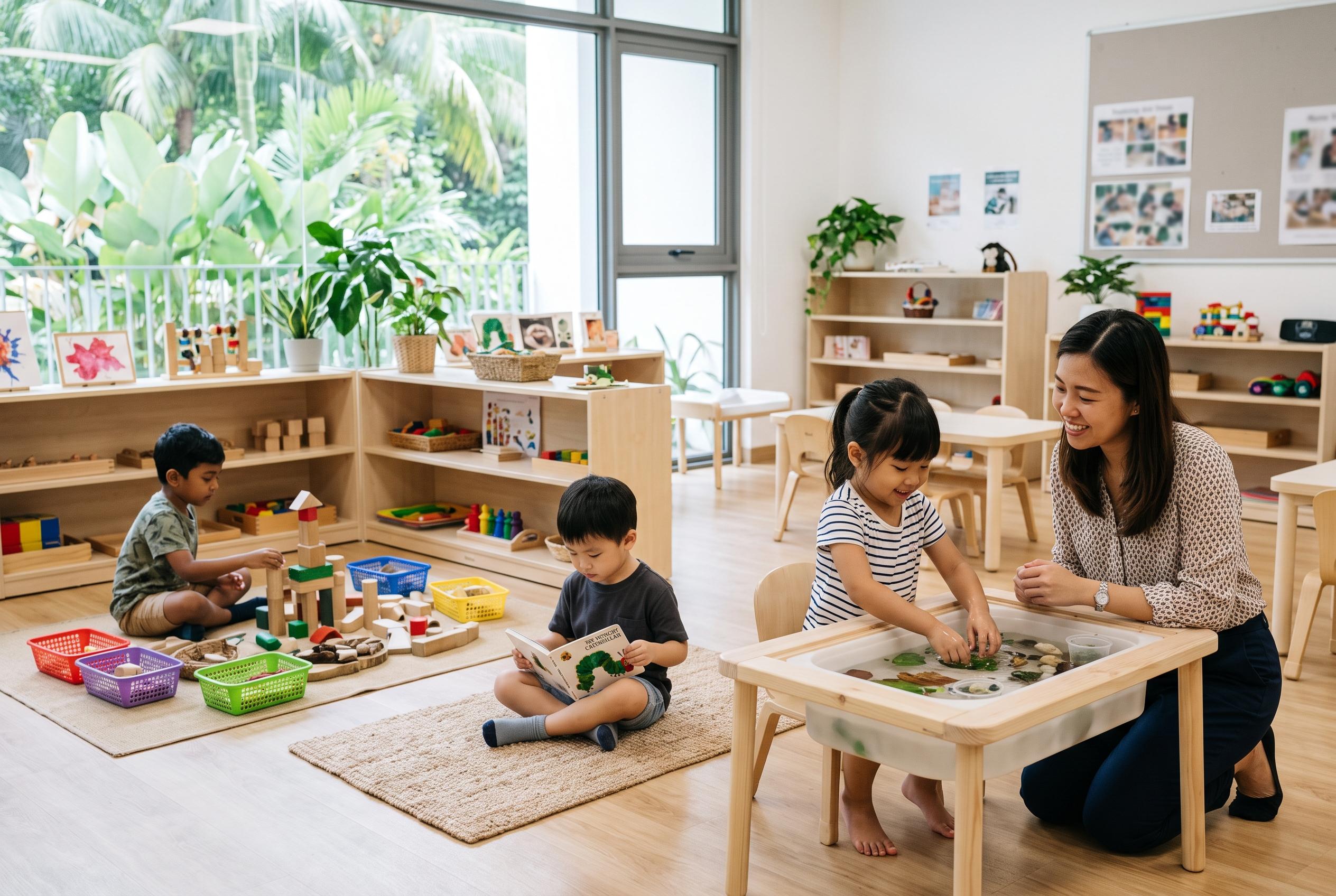

Choosing the right preschool in Singapore requires assessing the child’s needs, teaching philosophy, environment, and educator quality, children flourish where those elements align, not necessarily where they advertise the loudest.
Choosing a preschool is one of the first big education decisions many parents make, and in Singapore the range of options can make that choice feel daunting. What matters most is not finding a school with the flashiest marketing, but one that fits a child’s temperament, the family’s routine and the kind of early learning parents want. A confident decision usually starts with the child, not the brochure.
That means looking first at needs rather than labels. Some children thrive in busy, highly social settings; others settle better in smaller groups with more individual attention. Some love songs, stories and movement, while others are happiest building, observing and exploring. The Early Childhood Development Agency advises parents to weigh curriculum, accreditation, educators, location, fees and the child’s own needs when choosing a preschool, and that practical checklist remains a sensible place to begin.
Singapore’s preschool landscape is broad, with options ranging from larger operators to academically focused centres, Montessori-style programmes, play-based settings and blended approaches that combine structure with exploration. Guides from WhitePages, Singapore Sole Parent, E-Bridge and AIS all point to the same basic principle: the teaching philosophy should match the child, not simply the parent’s idea of what a good school looks like. A school that promises early literacy and numeracy may suit some children well, but school readiness is wider than worksheets and formal drills.
A strong curriculum should be easy for parents to understand. Look for a balanced programme that supports language, early literacy, numeracy, physical development, creativity, social-emotional growth and practical independence. According to ECDA’s guidance, quality signals such as SPARK certification can be helpful, while the Health Promotion Board’s Healthy Preschool Accreditation can offer another indication that a centre takes children’s well-being seriously. Even so, accreditation should be treated as one sign of quality, not the final answer.
Children’s Cove offers one example of a blended model. Its published curriculum information describes programmes from infant care through kindergarten, with learning built around curiosity, reasoning and experimentation. The school’s C.O.V.E. Approach is presented as a way of encouraging confidence and independent thinking, while its Building Blocks curriculum covers areas including language, numeracy, motor development, discovery, creative expression and social-emotional learning. For parents, the key question is not whether any one school is the best in Singapore, but whether its approach suits their child’s way of learning.
The adults in the room matter as much as the programme on paper. During a visit, parents should notice how teachers speak to children, how they respond to distress or conflict and whether they seem patient, warm and attentive. The environment also deserves close inspection: can children reach books and materials safely, is there space for both movement and quiet play, and does the centre feel calm rather than crowded? Practical questions about settling-in, communication, allergies, medication, fees and transition to Primary 1 can reveal far more than a website ever will.
Ultimately, the right preschool is not necessarily the most expensive, the most academic or the one with the longest list of awards. It is the one where the curriculum, educators, surroundings and daily routines work for both child and family. If a visit leaves parents feeling that the school is safe, thoughtful and responsive, and if their child seems comfortable there, that is usually a better guide than any glossy claim.
Disclaimer: This content is for informational purposes only and is not intended to be a substitute for professional medical judgment, advice, diagnosis, or treatment.



