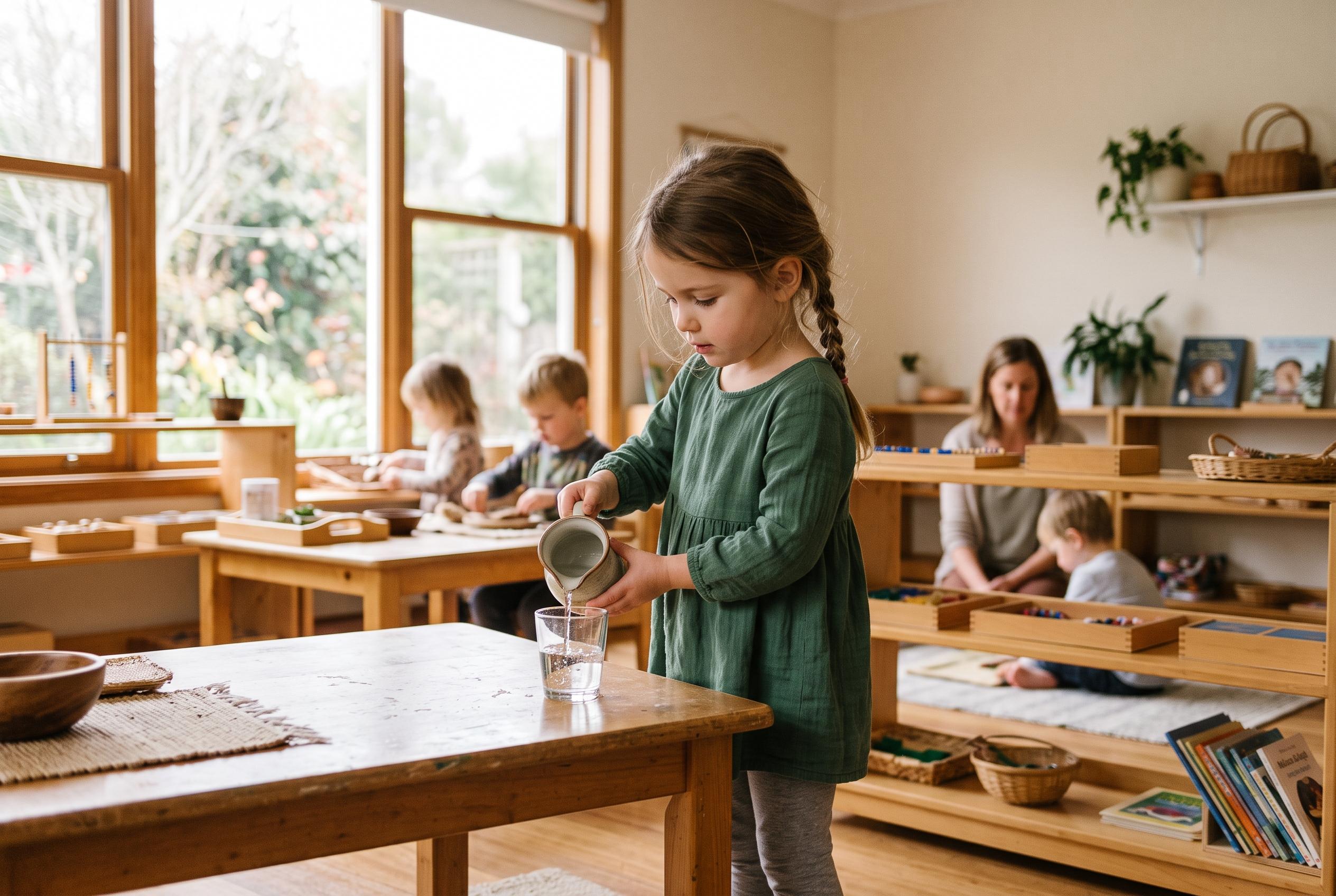

Montessori education emphasises a balance of purposeful activity, social structure, and calm adult guidance to cultivate independence and self-management among children, transforming the classroom into a shared community of learning.
In a well-run Montessori Children’s House, the room is busy without being chaotic. Children move with purpose, talk to one another, return materials to their places, and help care for the shared space. The atmosphere is not silent; it is orderly, lively and increasingly self-managed. According to Montessori.org, that balance is what many educators mean by a “normalised” classroom.
The key idea is that the room belongs to the children, not the teacher. The adult prepares the environment, chooses the materials, and introduces the routines, but over time children are expected to take on more of the daily work themselves. That might mean rolling a rug, carrying a tray carefully, wiping a spill, or putting a lesson back exactly as it was found. These are not small extras. They are how children learn ownership, competence and respect for the community.
Montessori writing on the Children’s House stresses that freedom only works when it sits inside a clear social structure. Young children do not arrive knowing how to wait, interrupt politely, move around another child’s work, or offer help without intruding. Those habits have to be taught directly, often through short Grace and Courtesy lessons that show children how to live together. The result is not obedience for its own sake, but a shared code that lets independence flourish.
That is also why experienced Montessori guides tend to speak less and observe more. Excessive adult chatter can make children dependent on constant correction, while calm, precise direction helps them manage the room for themselves. A teacher who says “Walk” or “She is working” is not withdrawing authority. Instead, the adult is making expectations clear without taking over the child’s role.
The same principle applies when children disagree. Montessori.org argues that adults sometimes over-help socially, stepping in too quickly to interpret, judge or resolve ordinary conflicts. Yet many of those moments are part of the curriculum. Children learn from small negotiations: waiting for a turn, saying they want to work alone, asking to join a group, or telling a peer to stop. When safety allows, those exchanges should be handled by the children as much as possible.
Another central point is that classroom order depends on the environment as much as on behaviour. A calm group needs enough engaging work, carefully sequenced lessons, protected work time and materials that are complete and attractive. It also needs adults who are emotionally steady. Montessori teachers have long argued that hurried, noisy or irritated adults set the tone for the room, while a measured adult helps children settle into concentration.
That concentration is the foundation of the whole approach. Montessori.org describes it as essential to independence, self-discipline and the growth of personality. A child deeply absorbed in meaningful work is not merely completing an activity; the child is building coordination, perseverance and confidence. For that reason, the most effective classrooms are not the quietest ones. They are the ones where children can return to work after small disturbances, help one another naturally and increasingly manage the life of the room on their own.
Disclaimer: This content is for informational purposes only and is not intended to be a substitute for professional medical judgment, advice, diagnosis, or treatment.