

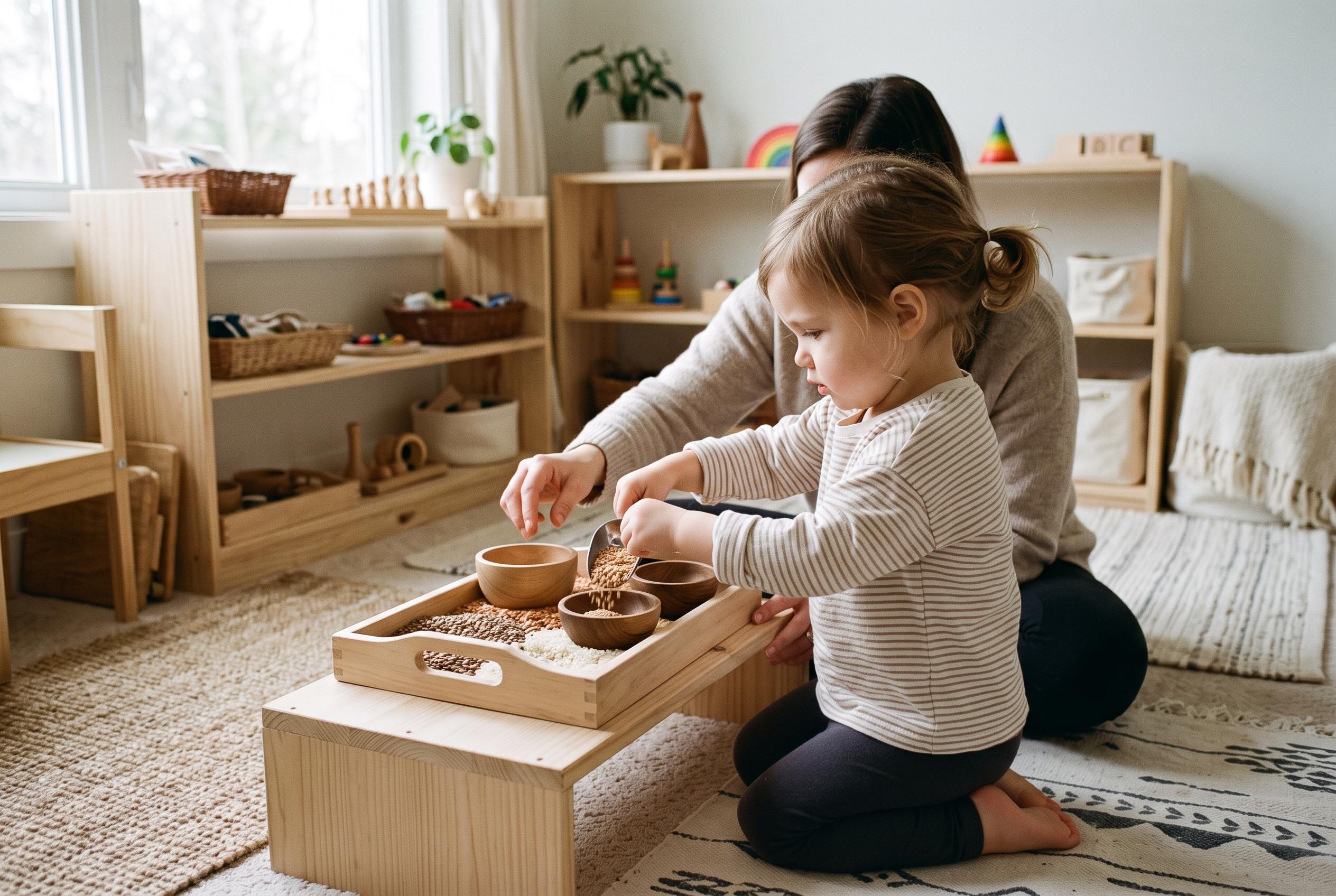

As parents face busy lives and increased screen use, experts emphasise the importance of tactile, hands-on play guided by Montessori principles to foster children’s independence, focus, and imagination without reliance on screens.
When the day is busy and a tablet is close at hand, many parents fall back on screens because they work quickly. The harder question is what that convenience costs. Child development groups and Montessori educators broadly agree that young children learn most effectively through direct, hands-on experience, not passive viewing. Austin Montessori School says children benefit from real materials and human interaction, while the Montessori Foundation recommends keeping screen use minimal, particularly for infants and toddlers.
That does not mean every family needs a perfect, screen-free home. The point is to make tactile play easy enough to choose in the ordinary rush of family life. Childcare.gov says daily play is essential from infancy through the school years because it helps children develop physically, socially and intellectually, and it should not be displaced by screen time. HoneySprouts makes a similar case, noting that simple, low-preparation activities can turn screen-free play into a default rather than a special project.
Age matters as much as the activity itself. A one-year-old needs short, sensory experiences: looking in a mirror, scribbling with chunky crayons, filling and emptying containers, or stacking blocks. A two- or three-year-old may stay longer with sorting, matching or pretend play, while preschool children are often ready for simple puzzles, story-building and early number or letter games. These stages reflect a basic truth of early learning: children stay engaged when the task matches their development rather than their adults’ hopes.
Montessori-style ideas can help without requiring a full Montessori household. The Montessori approach favours child-sized materials, limited choices and activities that children can complete on their own. That structure is meant to support concentration, independence and confidence. According to Austin Montessori School and the Montessori Foundation, technology is not the enemy; rather, screens should come later and should never crowd out direct work with the physical world.
One useful variation is vertical play. A magnetic wall board or similar upright surface changes the angle of activity, which can make it easier for children to see patterns, build scenes and practise letters or numbers. It may also reduce the sprawl and frustration that come with pieces scattered across the floor. For families looking at products, safety and durability matter: non-toxic materials, recognised toy-safety standards and pieces that are sturdy enough for small hands are sensible features to check before buying.
The home set-up matters almost as much as the toy box. A simple play corner, a small number of rotated toys and storage that children can use independently can make screen-free time much easier to maintain. Play does not need to be elaborate to be effective, and the most successful routines often rely on a few repeatable habits: a basket for each set of materials, regular tidying and brief stretches of independent play while a parent is nearby. Guidance from Childcare.gov and Montessori sources supports that kind of low-friction approach.
The challenge, of course, is that some days simply do not go well. Children will still ask for screens, reject the toy that worked yesterday or seem bored with everything on offer. That is not evidence that hands-on play has failed. It is a reminder that attention develops gradually, and that boredom can sometimes be the pause before imagination kicks in. For families trying to cut back without turning the house into a battleground, the best strategy is often the simplest one: offer a few good materials, keep expectations realistic and let real-world play do its work over time.
Disclaimer: This content is for informational purposes only and is not intended to be a substitute for professional medical judgment, advice, diagnosis, or treatment.



