

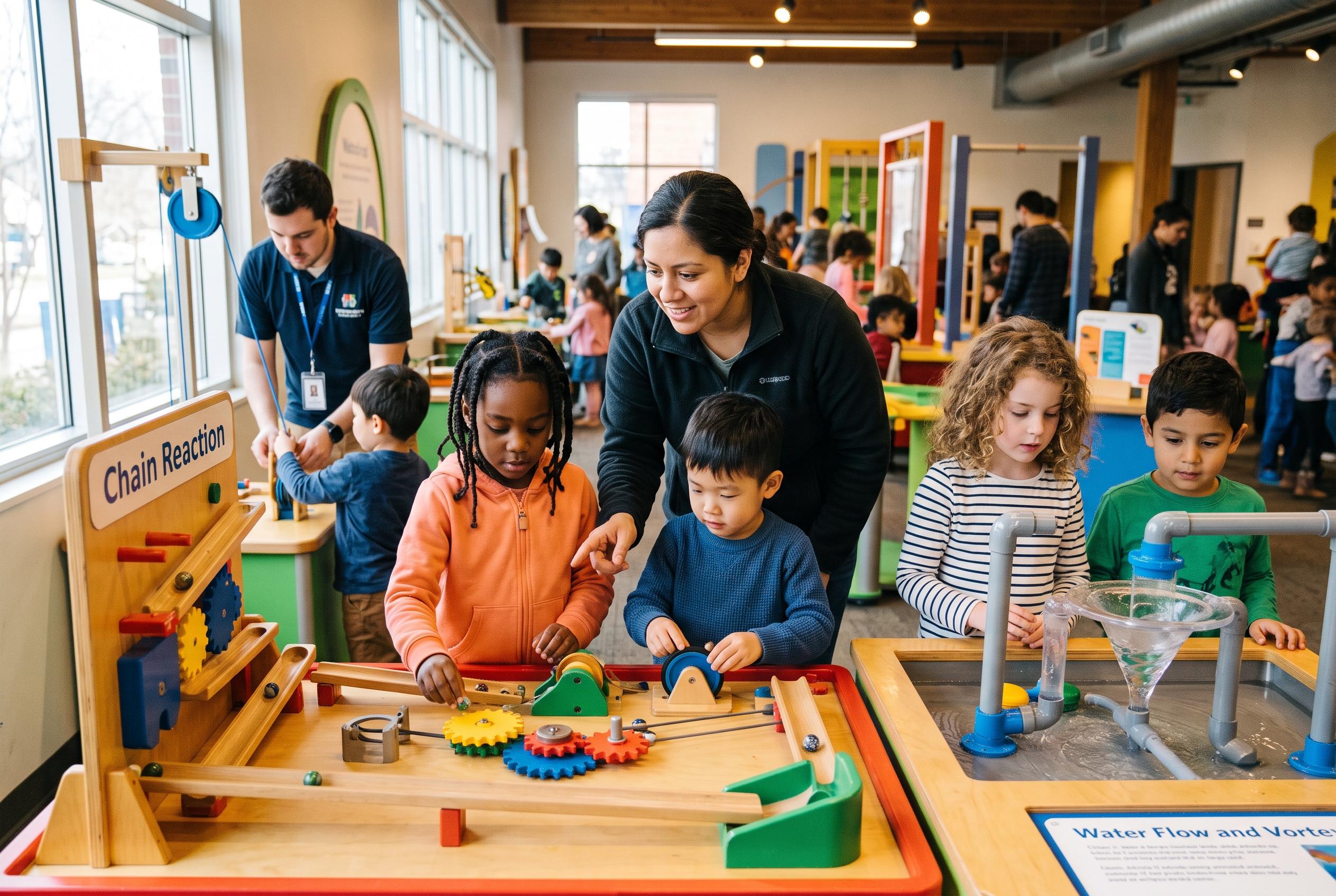

Researchers are urging museums to use guided play and hands-on exhibits to help children aged three to eight develop curiosity, confidence and early scientific thinking.
Children’s museums and science centres are being urged to do more than entertain very young visitors: they are increasingly being asked to help lay the groundwork for science, technology, engineering and mathematics learning. The article in Wiley’s Curator argues that the value of those settings lies in their ability to combine hands-on exploration with playful discovery, giving children aged three to eight a chance to build curiosity, confidence and early problem-solving habits in ways that feel natural rather than formal. The Association of Children’s Museums has likewise said that STEM belongs in children’s museums because it can strengthen skills and habits of mind when it is delivered through age-appropriate, engaging experiences.
At the centre of the paper is a broader idea of play: not as something separate from learning, but as a mode of learning itself. The authors draw on research showing that play is intrinsically motivated, socially shaped and often driven by curiosity rather than instruction. They also place their argument within a “spectrum of play” framework that distinguishes between free play, guided play and more directive playful instruction. In this view, guided play offers the most promising bridge for museums: children retain agency, but adults or exhibit designers can still shape the environment around a learning goal. A recent review of STEM learning for children aged zero to eight found that early experiences work best when they are developmentally suitable, interactive and not overly abstract, which supports the paper’s emphasis on guided exploration.
The paper also links playful engagement to the science and engineering practices that underpin modern STEM education. Rather than treating science as passive information transfer, the authors argue that young children can begin to ask questions, test ideas, observe patterns, use simple models and explain what they notice through exhibit-based activity. That approach echoes the National Research Council’s well-known framework for active science learning and aligns with broader efforts, including the interPLAY project led by the Association of Children’s Museums and Oregon State University, to understand how exhibit design can better support early learners. Technology can also play a role, though the article’s wider message is that digital tools work best when they deepen interaction rather than replace it. Recent reviews of digital and technology-enhanced STEM learning for young children have reached a similar conclusion.
The practical significance is clear for museum educators and exhibit designers. If play and STEM are treated as separate priorities, exhibits may either feel too loose to teach anything or too structured to feel like play. But if they are designed together, museums can create experiences that invite children to manipulate materials, investigate real-world phenomena and build early reasoning skills without pressure or formal assessment. The study’s framework, observation tool and reflection guide are intended to help institutions do exactly that, giving children’s museums and science centres a way to design exhibits that support curiosity, communication and early scientific thinking at the same time. That aim also fits wider calls for inclusive, multimodal early STEM learning, in which children with different abilities and learning styles can engage through sensory-rich and varied forms of participation.
Disclaimer: This content is for informational purposes only and is not intended to be a substitute for professional medical judgment, advice, diagnosis, or treatment.



