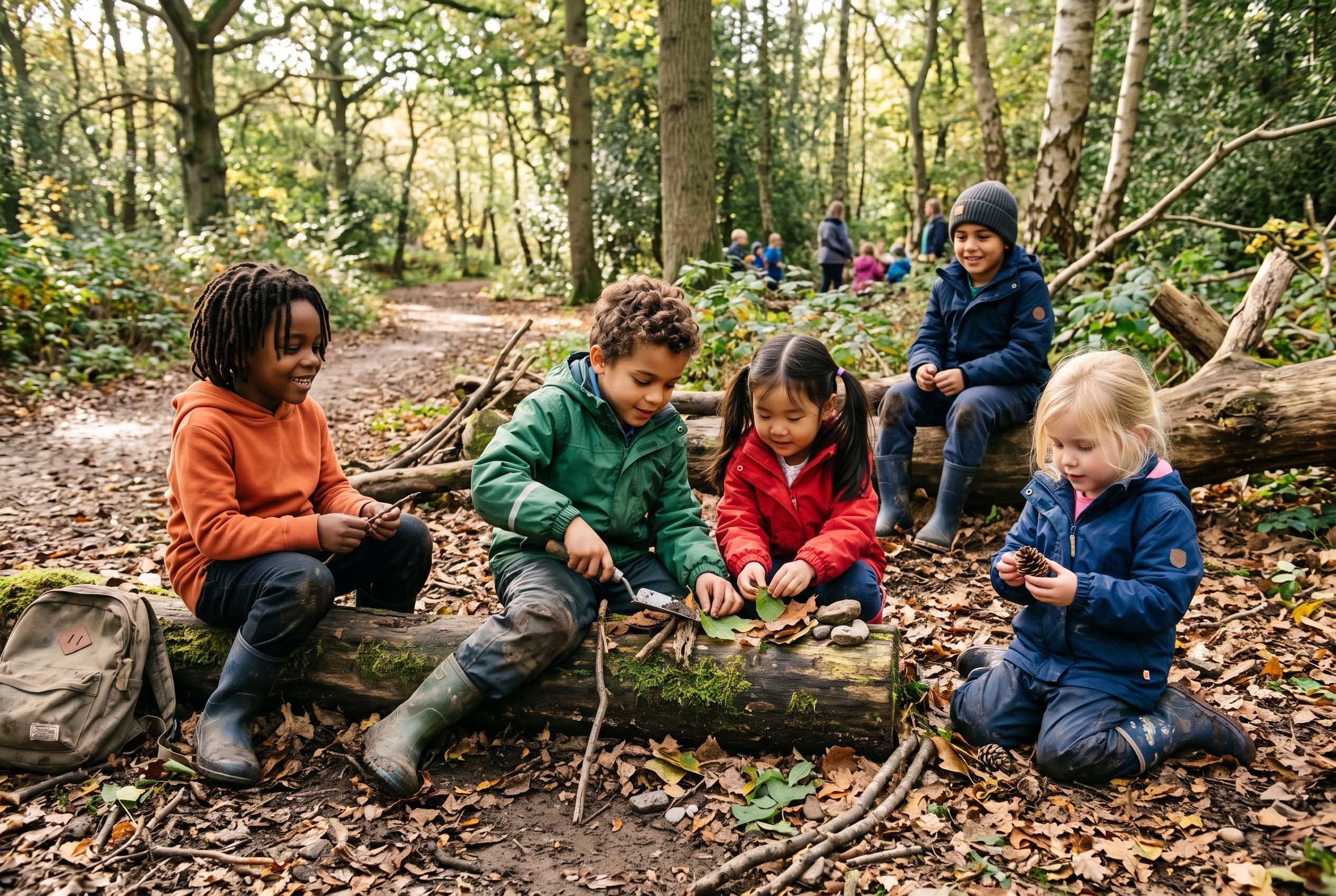

Growing global interest in Forest School approaches demonstrates significant benefits for children’s cognitive, social, and emotional growth, despite some limitations and safety concerns.
Forest Schools are gaining attention as an alternative to the conventional classroom, built on the idea that children learn well when they are free to explore the outdoors. Instead of relying solely on desks, worksheets and whiteboards, the approach uses natural settings such as woods, parks, gardens and beaches to encourage observation, movement and problem-solving. The model began in Scandinavia and spread to Britain in the 1990s before appearing in countries including the US, Canada, Germany, New Zealand, Japan and India.
At its core, Forest School is less about a specific place than a way of teaching. Sessions are usually regular rather than occasional, and they are led by children’s curiosity as much as by a teacher’s plan. Educators act more as facilitators than instructors, allowing pupils to experiment, make mistakes and learn through doing. Common activities include building shelters, identifying plants and insects, birdwatching, journalling, outdoor art and supervised campfire cooking, with lessons in maths, science, language and engineering often woven into a single task.
Research has begun to back up what many practitioners have long argued. A systematic review published in 2023 found that preschool children attending Forest School showed stronger cognitive function, better balance and motor coordination, and improved well-being and connection to nature than children in more traditional indoor settings. An ethnographic evaluation published in 2024 reported gains in personal, social and emotional development, verbal communication and early maths skills among 3-year-olds taking part in Forest School sessions. Separate research summaries hosted by Forest Schools Education also point to improvements in resilience, confidence, independence and problem-solving.
The appeal is also visible in India, where the model is still relatively new but expanding. Roots Forest School uses the Forest School approach as part of its wider philosophy, while BHUMA-The Forest School and VANALOK in Bengaluru both emphasise nature-based learning, sustainability and environmental stewardship. Their presence suggests a growing appetite for education that places outdoor experience, ecological awareness and hands-on learning at the centre rather than the margins.
Still, the approach is not without limits. Weather can be harsh, outdoor programmes are not available everywhere and some families worry about the balance between nature-based learning and more traditional academic work. Safety is another concern, since Forest Schools typically accept managed risk rather than eliminating it altogether. Yet supporters argue that this is part of the point: children build confidence by climbing, carrying, measuring, observing and collaborating in real environments, not just in theory.
For many families, Forest School is attractive because it treats curiosity as a starting point, not a distraction. It can suit children who enjoy movement, independence and hands-on discovery, though it is not ideal for every learner. And even without enrolling in a specialist programme, parents can borrow the idea at home through gardening, nature walks, scavenger hunts, birdwatching and outdoor storytelling. The broader message is simple: some of the most durable lessons in childhood are learned not indoors, but in contact with the world beyond the classroom.
Disclaimer: This content is for informational purposes only and is not intended to be a substitute for professional medical judgment, advice, diagnosis, or treatment.