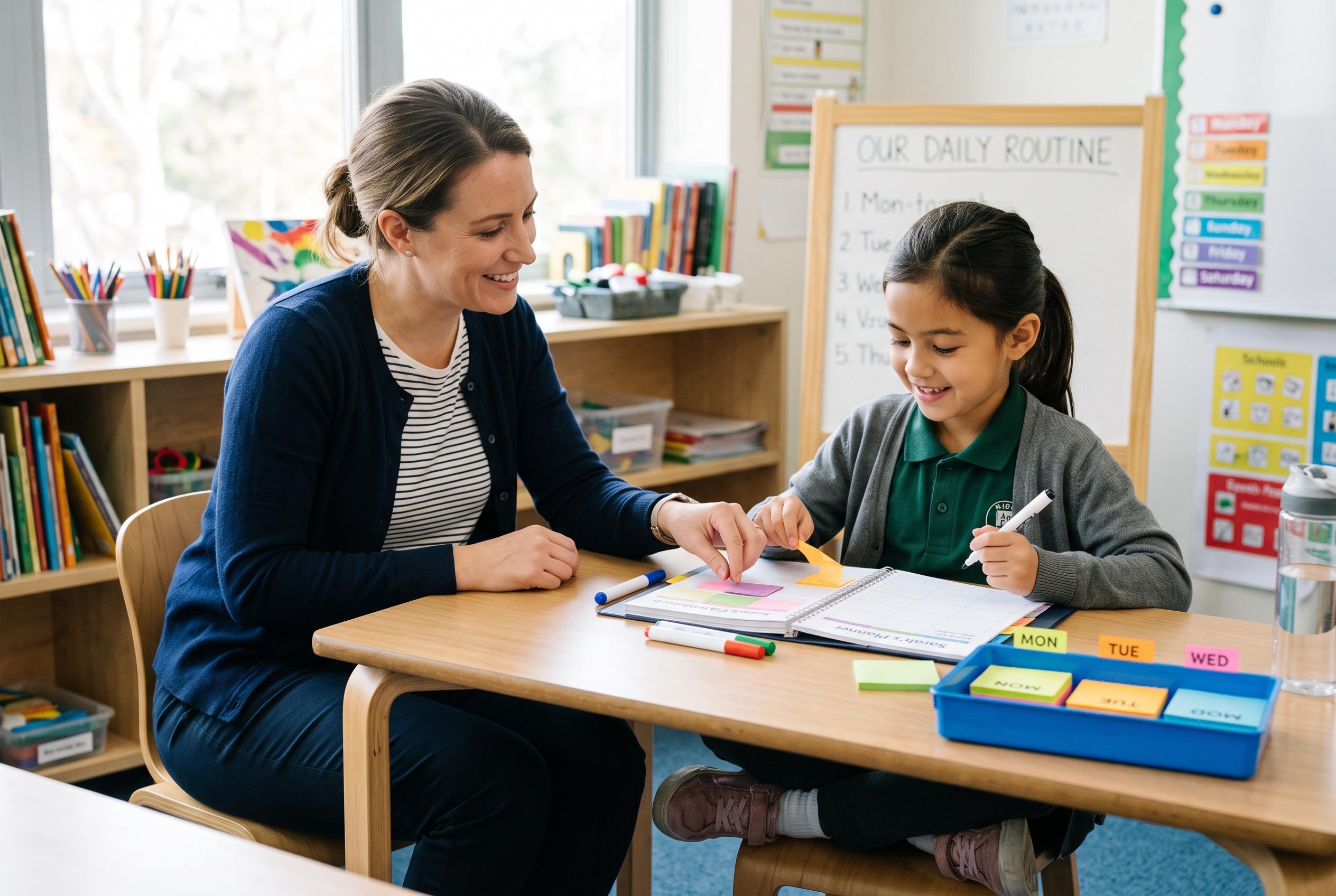

Teachers are encouraged to prioritise building trust, routines, and executive function skills in the initial weeks, which can lead to better learning outcomes throughout the year.
In the first weeks of school, many teachers feel pushed to do everything at once: review past learning, test current levels, set rules, decorate the room and move on with the curriculum. But Reilly Mask argues that the real work at the start of the year is less about coverage and more about creating the conditions in which students can learn at all. For her, that means focusing on executive function skills such as asking for help, tracking progress and deciding what comes next.
Mask’s perspective was shaped by years spent teaching in an alternative high school setting, where many students had learned to see school as unfamiliar or unsafe. Rather than assuming students already knew how to seek help, she says teachers should make those behaviours visible and practised. In one class, she handed a student the marker and let her explain a lesson to a classmate, turning a simple reteach into a moment that built confidence as well as understanding.
That emphasis on community is echoed by other education writers who say the first month of school should be used to build trust between students, not just between teacher and pupil. Articles from FA Academy, Lesson Draft and Scholastic all stress that classrooms function better when students feel known, connected and comfortable enough to take academic risks. They also warn that generic icebreakers are rarely enough; what matters more is sustained routines that help children actually collaborate, talk and support one another.
Mask also points to classroom systems that give students ownership. Her Friday routine asked pupils to check their work against a class chart, reflect on their progress and choose the kind of support they needed, whether that meant a one-to-one check-in or independent work. The point, she says, is to teach students how to manage learning for themselves. In that sense, spending the first month on relationships, responsibility and self-management is not time lost from the curriculum; it is the foundation that makes the rest of the year possible.
Disclaimer: This content is for informational purposes only and is not intended to be a substitute for professional medical judgment, advice, diagnosis, or treatment.