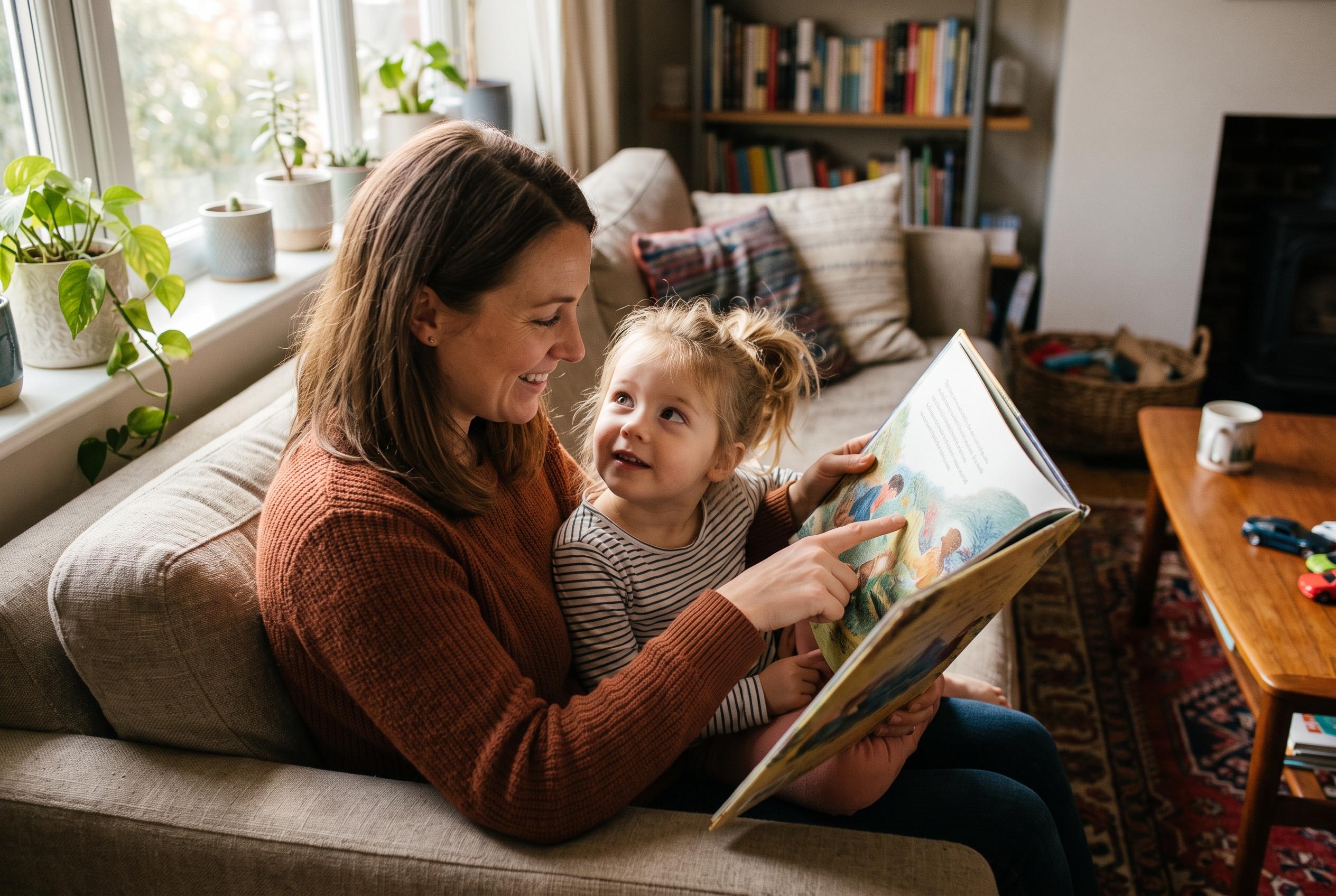

Research indicates that the effectiveness of shared reading extends beyond book ownership, emphasising interactive routines that foster language development and a love of reading in children from birth onwards.
Many parents focus on filling a child’s room with books, yet the bigger difference may come from how those books are used. Research on shared reading suggests that the most powerful gains come not from ownership alone, but from regular, back-and-forth reading with an adult. A 2020 meta-analysis of randomised trials found that shared-book interventions improved children’s expressive and receptive language, although the overall effect was modest rather than dramatic.
The American Academy of Paediatrics says shared reading should begin at birth and continue through at least kindergarten, because it supports language, early literacy and the parent-child bond. That does not mean a baby must sit through a full story. For the youngest children, reading can simply mean naming pictures, pointing out objects or letting them turn pages. As children grow, the same routine can become richer: asking what might happen next, talking about characters and linking the story to everyday life.
The most effective approach is often conversational rather than performative. Studies on dialogic reading have found that when adults pause to ask questions, invite predictions and follow the child’s lead, children can learn more words than they do from passive listening alone. The Institute of Education Sciences has also noted that shared reading works best when adults actively direct attention to illustrations, explain unfamiliar words and connect the text to a child’s own experiences.
Choice matters too. Children are more likely to engage when the book reflects their interests, whether that is dinosaurs, football, space, animals or comics. The American Academy of Paediatrics recommends access to high-quality, age-appropriate and culturally diverse books, including in the languages spoken at home. Research on the home literacy environment also suggests that children’s interest and engagement are important parts of building vocabulary, knowledge and reading confidence.
That is why reading can start to feel like a habit only when it remains enjoyable. Turning it into a test, a quota or a homework task can drain the pleasure from the experience. A better goal is to make books part of ordinary family life: a short daily routine, a conversation rather than a lecture and a chance for children to feel that books belong to them. Over time, that sense of ownership may matter more than the number of volumes on the shelf.
Disclaimer: This content is for informational purposes only and is not intended to be a substitute for professional medical judgment, advice, diagnosis, or treatment.