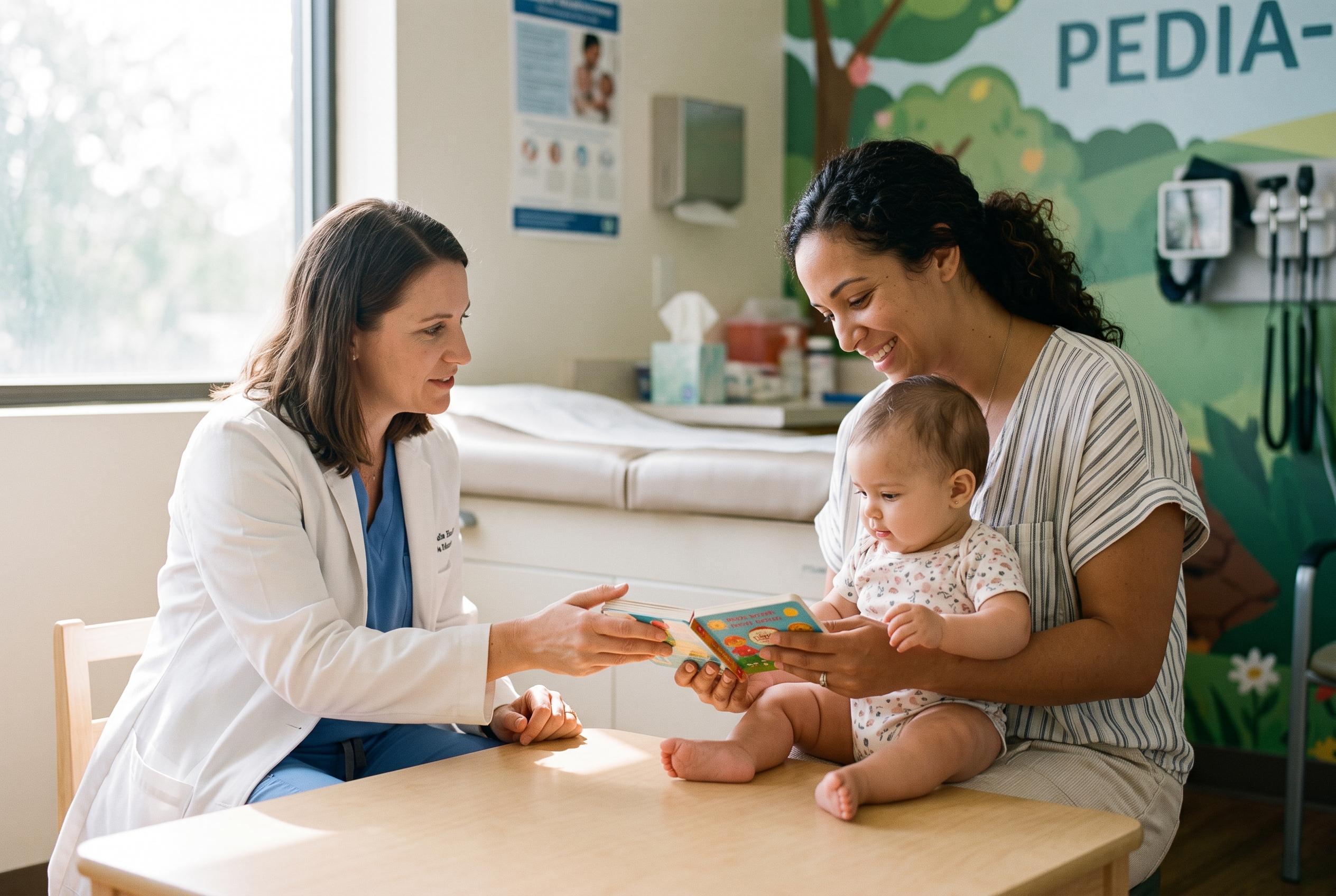

A new initiative in Florida highlights how introducing books during baby visits can foster responsive interactions, enhance relational health, and instill lifelong literacy habits from the earliest stages of life.
A well-child visit in Florida recently showed how early shared reading can shape more than language. Dr Rocio Martinez-Ange introduced a book to a family’s two-month-old baby and demonstrated that, at this age, reading can mean pointing to pictures, singing, laughing or simply following the infant’s gaze. At a later appointment, the mother said the family’s five-year-old had copied the interaction at home and started reading to the baby. Martinez-Ange called it a full-circle moment, a small sign that even the youngest children can help set new family routines in motion.
That kind of exchange sits at the heart of Reach Out and Read’s Building Connections Begins at Birth initiative, which aims to bring its model into the earliest baby visits. The programme, supported by the Louis Calder Foundation, is now operating through five affiliates in seven states and is working towards 40,000 well-child visits and 40,000 books. The idea is straightforward: talking, singing, sharing books and responding to infants are not extras, but part of healthy early development.
At Bright Pediatrics in Catoosa County, Georgia, Dr Alexandra Townes said parents often begin using the book before the appointment is even over. She said caregivers of newborns through five-month-olds are often eager to open the book and interact with their child right in the examination room. With four-month-olds, she sometimes pairs reading with tummy time, the short periods babies spend on their stomachs to support motor development. Books designed for that purpose can provide high-contrast images, faces and mirrors that give infants something to focus on while a caregiver talks and responds nearby.
The approach also fits naturally into routine preventive care. The American Academy of Pediatrics’ Bright Futures schedule already organises well-child visits by age and weaves developmental advice into each appointment. Reach Out and Read adds a concrete tool to that guidance: a book that clinicians can use to observe how a baby looks, reaches and responds, while giving families something practical to take home. Alyssa Brunstein, programme director for Reach Out and Read in New Jersey and Delaware, describes a clinician handing a book to a caregiver who assumes it will be collected again, only for the provider to say, “No, this is for you.” The point, she said, is that the book belongs to the family.
The wider effort has grown from earlier work supported by the foundation in Florida, Georgia and New Jersey, first as Beginning at Birth and later under the Building Connections Begins at Birth name. The expansion matters because it tests how the model can adapt across different clinics and communities while keeping the core idea intact. Alex Calder, executive director of the foundation, said the work brings something practical to families at a moment of real possibility and shows how ordinary routines can help parents understand what their child is capable of. Reach Out and Read says the programme is also helping build evidence around early relational health, or the quality of the back-and-forth between caregiver and child in the first months of life.
For families, the lesson can be surprisingly simple. A baby does not need to understand every word on the page for reading to matter. The value is often in the shared attention, the familiar voice and the responsive exchange. In one Pennsylvania clinic, Dr Sharon Sutherland recalled a father arriving for a visit with his 20-month-old daughter and a phone in the child’s hand. When Sutherland offered a book, the girl set the phone aside, became absorbed in the pages and began babbling. Her father’s reaction was telling: “She tries to read to us.”
Disclaimer: This content is for informational purposes only and is not intended to be a substitute for professional medical judgment, advice, diagnosis, or treatment.