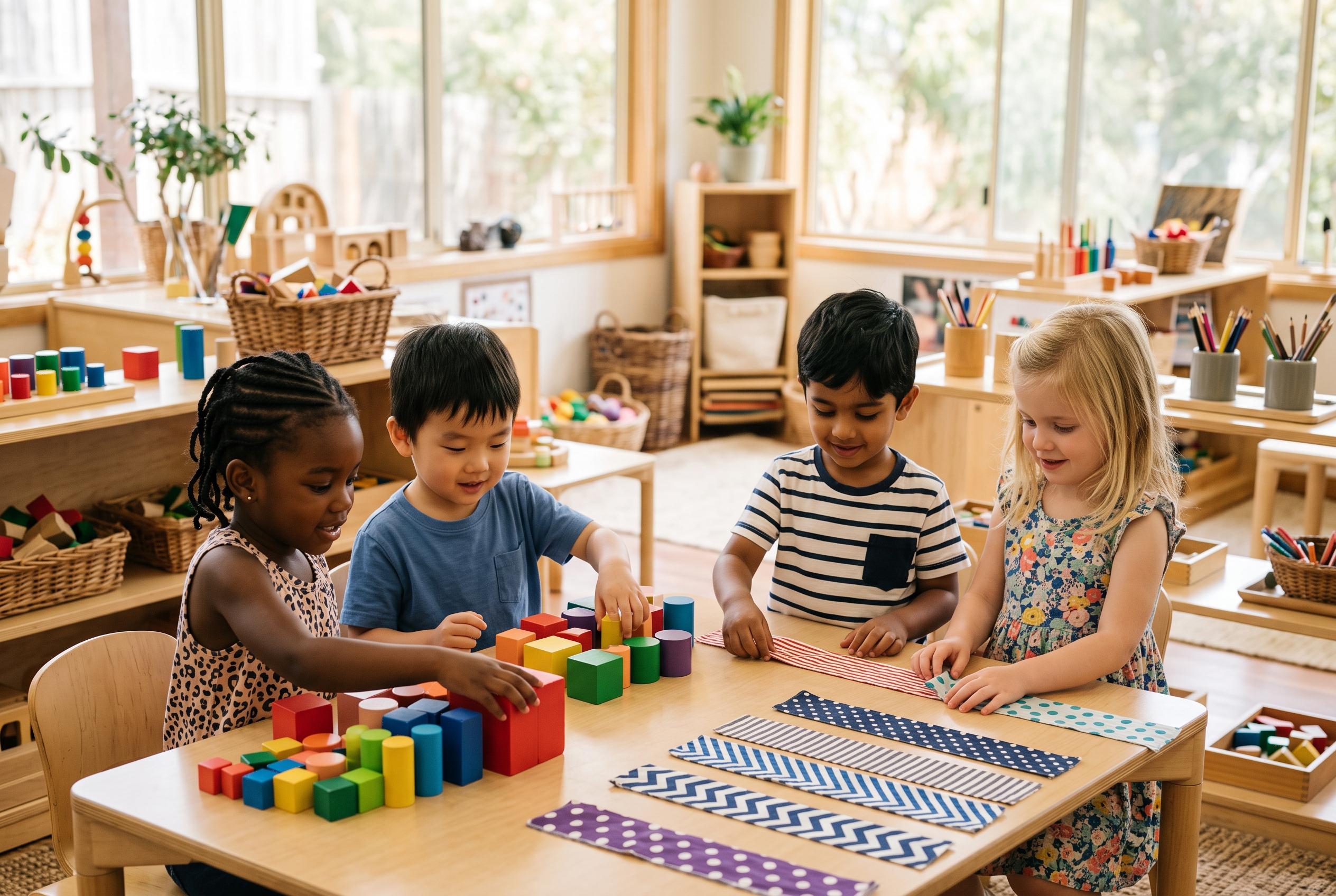

Research and expert guidance emphasise that preschoolers develop essential mathematical understanding through everyday activities like comparing, sorting, and pattern recognition, rather than rote number drills, paving the way for long-term academic success.
Preschool mathematics is best understood as a broad set of everyday thinking skills, not a race to recite bigger numbers. Children may learn more from comparing snack portions, fitting blocks together or noticing a repeating pattern than from chanting number words alone. The stronger foundation is built when adults connect counting to real objects and simple problems, helping children understand what quantities actually mean.
According to early learning guidance from GreatSchools, Kindercare and Scholastic, the core skills at this stage include counting, recognising small numbers, understanding more and less, sorting by attributes, spotting shapes, and noticing patterns. GreatSchools also points to basic spatial ideas and simple time concepts as part of school readiness, while ABCmouse frames number recognition and pattern awareness as useful preparation for kindergarten.
That wider view matters because number words and number sense are not the same thing. A child may be able to say “one, two, three, four, five” without yet grasping that five objects make one group. Practical activities such as handing out three spoons, taking one cracker away, or comparing two piles of toys make the connection clearer and more useful. The emphasis should be on small, meaningful sets that children can see, touch and move.
Comparison is another important part of early mathematical thinking. Children learn a great deal when they decide which tower is taller, which basket has fewer blocks or which container holds more water. These conversations can happen naturally during play, but adults should avoid turning every moment into a quiz. Sometimes the most helpful move is simply to describe the relationship: one pile is bigger, one stick is longer, one shape fits where another does not.
Patterns, shapes and sorting are equally valuable. A child who claps, stomps, claps, stomps is already working with pattern rules. A child who groups cars with cars and animals with animals is practising classification. And a child stacking blocks is exploring size, balance, position and fit. As several parenting guides note, these are not separate lessons so much as parts of ordinary play that build mathematical language and reasoning together.
Measurement can also begin in very informal ways. A shelf may be too low for a box, a ribbon may be longer than a toy car, or a rug may take seven footsteps to cross. Children do not need formal units at first; they need chances to compare and test. Even in activities like pouring water or filling containers, the focus should be on ideas such as full, empty, more and less, while keeping safety firmly in view.
The evidence base supports this everyday approach. The lead article cites a widely used analysis of six longitudinal datasets showing that mathematics skills at school entry are strong predictors of later academic success, and a separate longitudinal study linking kindergarten number competence with later achievement growth. Those findings suggest that early mathematics matters, but they do not prove that pushing formal worksheets or advanced number work at preschool age leads to better outcomes. The more sensible response is to keep mathematics concrete, playful and closely tied to ordinary life.
Disclaimer: This content is for informational purposes only and is not intended to be a substitute for professional medical judgment, advice, diagnosis, or treatment.