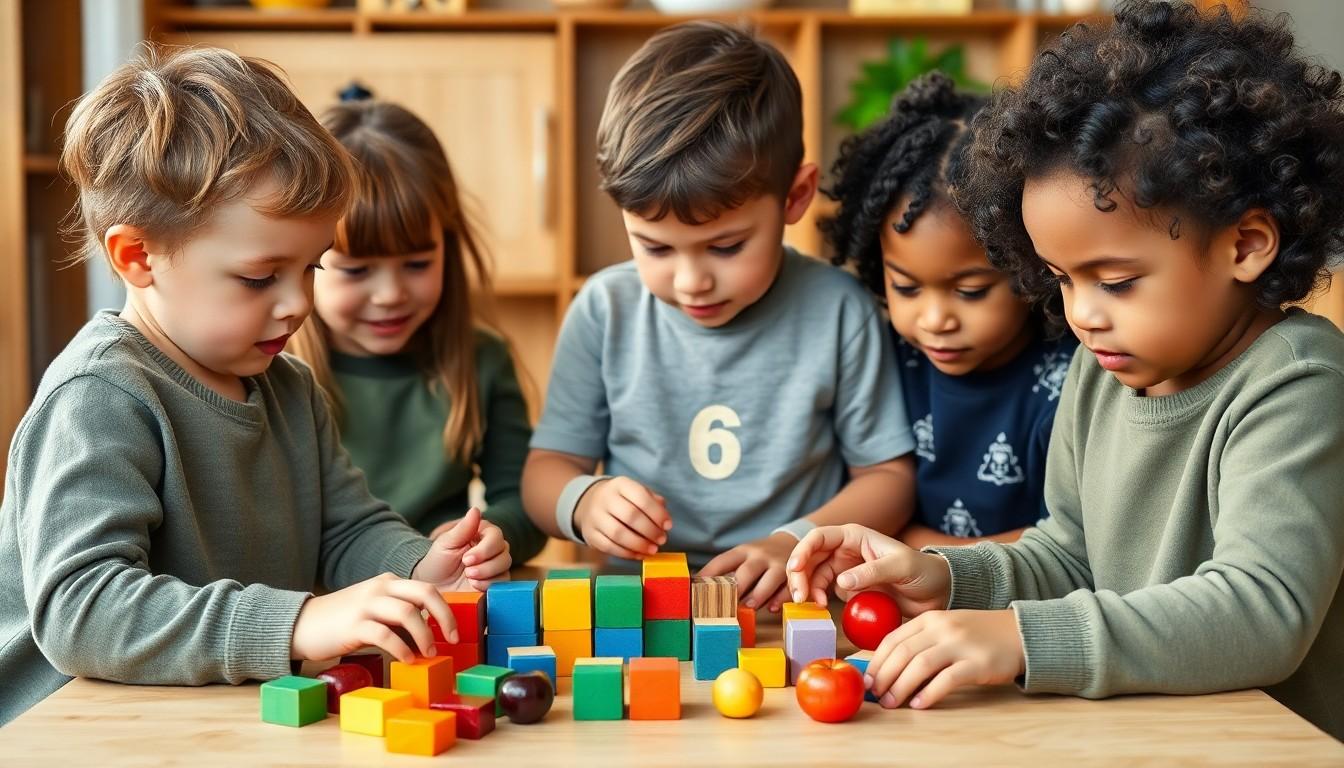

Yemimah King highlights how integrating numeracy into daily routines and environments through play can strengthen young children’s mathematical understanding, emphasizing the importance of informal, everyday learning experiences over formal instruction.
Yemimah King, an assistant professor of early childhood education at Georgia State University, has argued that the years before formal schooling are among the most receptive for building lasting knowledge, particularly when adults design learning around play rather than instruction alone. In a keynote at the Cognia Early Learning Institute, she told centre owners, directors, coaches and teachers that young children’s mathematical understanding can be strengthened when language, routine and environment are used deliberately. Broader research on play-based learning echoes that view, linking guided and free play with cognitive, social and emotional development, while the Institute of Education Sciences has said it can also help children build collaboration, communication and critical thinking skills.
King’s central argument is that mathematics need not be confined to formal lessons or worksheets. She said learning becomes more durable when leaders shape the everyday experiences children already encounter, a message that aligns with guidance from HeadStart.gov and the American Academy of Pediatrics on the developmental value of play. In her telling, the goal is not to replace structure, but to weave numeracy into the rhythms of a child’s day so that counting, comparison and spatial language feel natural rather than imposed.
She described three practical settings for this approach: people, patterns and places. “People” refers to the back-and-forth of conversation, where adults can enrich vocabulary, follow children’s interests and introduce words such as “many” or “similar”. “Patterns” are built into arrivals, clean-up, meals and transitions, which can be used to discuss ideas such as “longer”, “above” and “repeat”. “Places” involve the physical environment itself, where materials and room layout can prompt counting, comparing and the use of terms such as “diagonal”, “corner”, “wide” and “narrow”. Guidance from the University of the Sunshine Coast’s Starting Blocks resource and the Child Encyclopedia on Early Childhood Development similarly stresses that play-based learning is most effective when adults intentionally shape spaces, routines and interactions.
For King, the broader point is that mathematical competence can grow in the ordinary moments of early childhood, not only in specialist instruction. She framed these as “everyday math language moments”, arguing that children learn best when numeracy is visible at home and in the classroom, reinforced through conversation and repeated in familiar routines. That view sits comfortably with the wider body of early years research: play is not a diversion from learning, but one of its most effective vehicles.
Disclaimer: This content is for informational purposes only and is not intended to be a substitute for professional medical judgment, advice, diagnosis, or treatment.