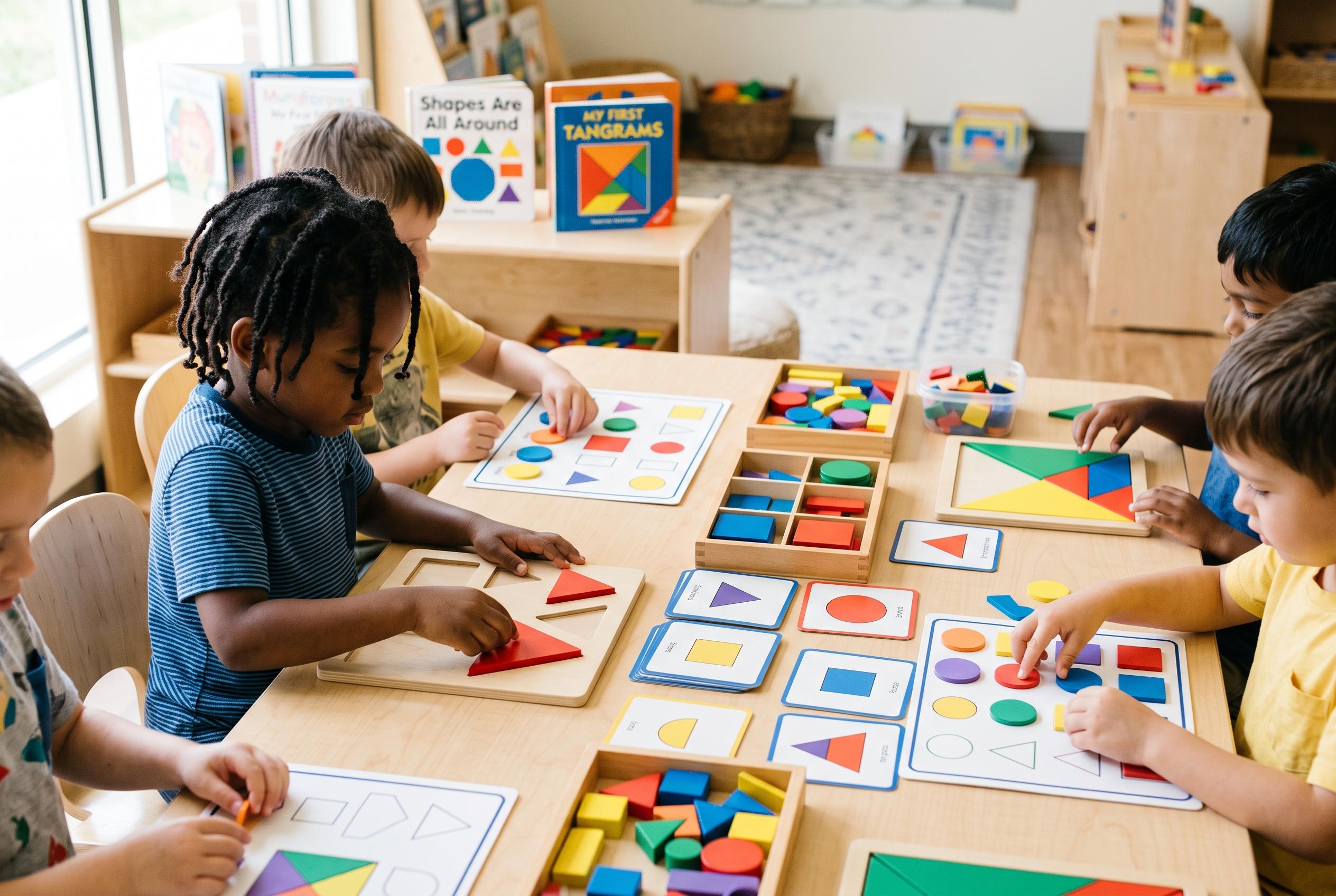

Interactive and hands-on shape activities enhance young children’s geometry skills, spatial reasoning and fine motor abilities, making early learning both fun and effective without relying on worksheets.
Shape activities for preschool and kindergarten can do far more than teach children to name a circle or a square. When young learners build, trace, sort, hunt, match and stamp shapes, they begin developing early geometry, spatial reasoning and fine motor skills at the same time. That makes the topic a natural fit for home learning, classroom routines and small-group centres.
For younger children, the best starting point is usually a short list of familiar 2D shapes: circle, square, triangle and rectangle. As children grow more confident, they can look more closely at straight and curved lines, corners, sides and the ways shapes can combine to form new designs. Other resources for preschool learning, including guidance from SplashLearn and Preschool Learning Online, also point to the value of shape hunts, sorting tasks, nature walks, playdough work, art and puzzles as practical ways to make geometry feel concrete.
One of the simplest ways to teach shapes is to bring them into everyday observation. Children can search for circles on clocks and plates, rectangles in books and windows, or triangles in signs and slices of fruit. Sorting sets of blocks, paper cut-outs or pattern pieces by shape helps them notice similarities and differences, while tracing around lids, cups and templates strengthens both recognition and hand control. Preschool Learning Online also highlights songs and movement activities as a useful way to keep shape learning active and memorable.
Hands-on making activities can deepen understanding further. Children can form shapes with playdough, craft sticks, straws, pipe cleaners or LEGO bricks, then count sides and corners or compare one shape with another. They can dot around an outline with counters, place objects in sensory bins to sort by shape, or print patterns with sponges and blocks. SplashLearn notes that these kinds of activities are especially effective because they link shape recognition with spatial awareness and creative play.
Shape learning also connects easily with early maths and STEM. Children can make simple repeating patterns, sort shapes by the number of sides, and build towers, bridges or houses while talking about which shapes fit together best. That process supports classification, comparison, problem-solving and the kind of spatial thinking children need later for science, design and engineering.
For parents and teachers looking for variety, ready-made printable packs can provide quick centres, reusable games and structured practice. But the larger lesson is straightforward: children do not need worksheets to learn shapes well. They learn best when they can touch, build, compare and explore shapes in the world around them.
Disclaimer: This content is for informational purposes only and is not intended to be a substitute for professional medical judgment, advice, diagnosis, or treatment.