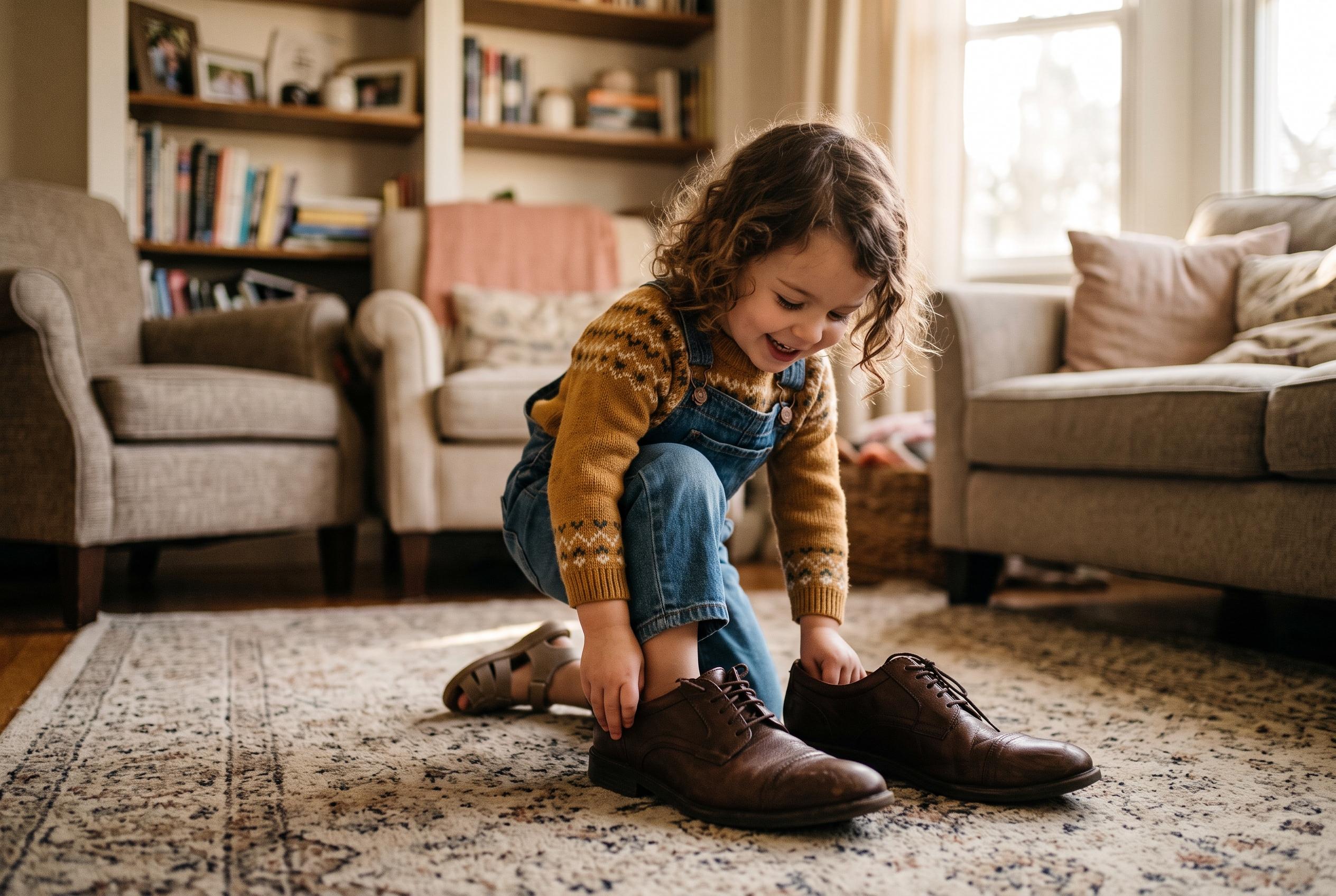

Psychologists highlight the importance of children dressing up in adult shoes as a vital part of understanding the world, promoting cognitive and emotional growth through imitation and imaginative play.
A child clomping around in a parent’s oversized shoes can look like a bit of comic relief, but psychologists say it is also a familiar form of learning. Between about two and five years old, children increasingly turn to symbolic play, in which everyday objects stand in for something else and ordinary routines become part of an imagined story.
In that kind of play, shoes can mean going to work, shopping, travelling or simply copying the adults who are closest at hand. The point is not the footwear itself but the chance to rehearse roles, movements and habits seen in daily life. Psychologist Javier de Haro has described this behaviour as part of early childhood’s effort to understand the adult world through imitation and invention.
The gesture should not be treated as a psychological test. A child who slips on a parent’s shoes one day may move on to a handbag, a spoon-as-stethoscope or a make-believe office the next. What matters more is the play itself, which researchers have long linked to cognitive and emotional development, and to the child’s growing ability to organise experience into a simple narrative.
Recent work published in Frontiers in Psychology adds that adults are not just onlookers: parental involvement helps toddlers stretch their symbolic abilities, while older siblings can push play to a more advanced level. Other studies have also found that symbolic play remains fairly stable across different settings and with different play partners, suggesting it reflects a reliable early skill rather than a one-off trick.
That is why specialists advise adults to let the scene continue, as long as it is safe. A clear floor, no unstable heels and a few minutes of undisturbed play are usually enough. Asking where the child is going, without correcting the story, can keep the fantasy alive. In the end, the oversized shoes are less a curiosity than a small stage on which children practise balance, language and the first outlines of identity.
Disclaimer: This content is for informational purposes only and is not intended to be a substitute for professional medical judgment, advice, diagnosis, or treatment.