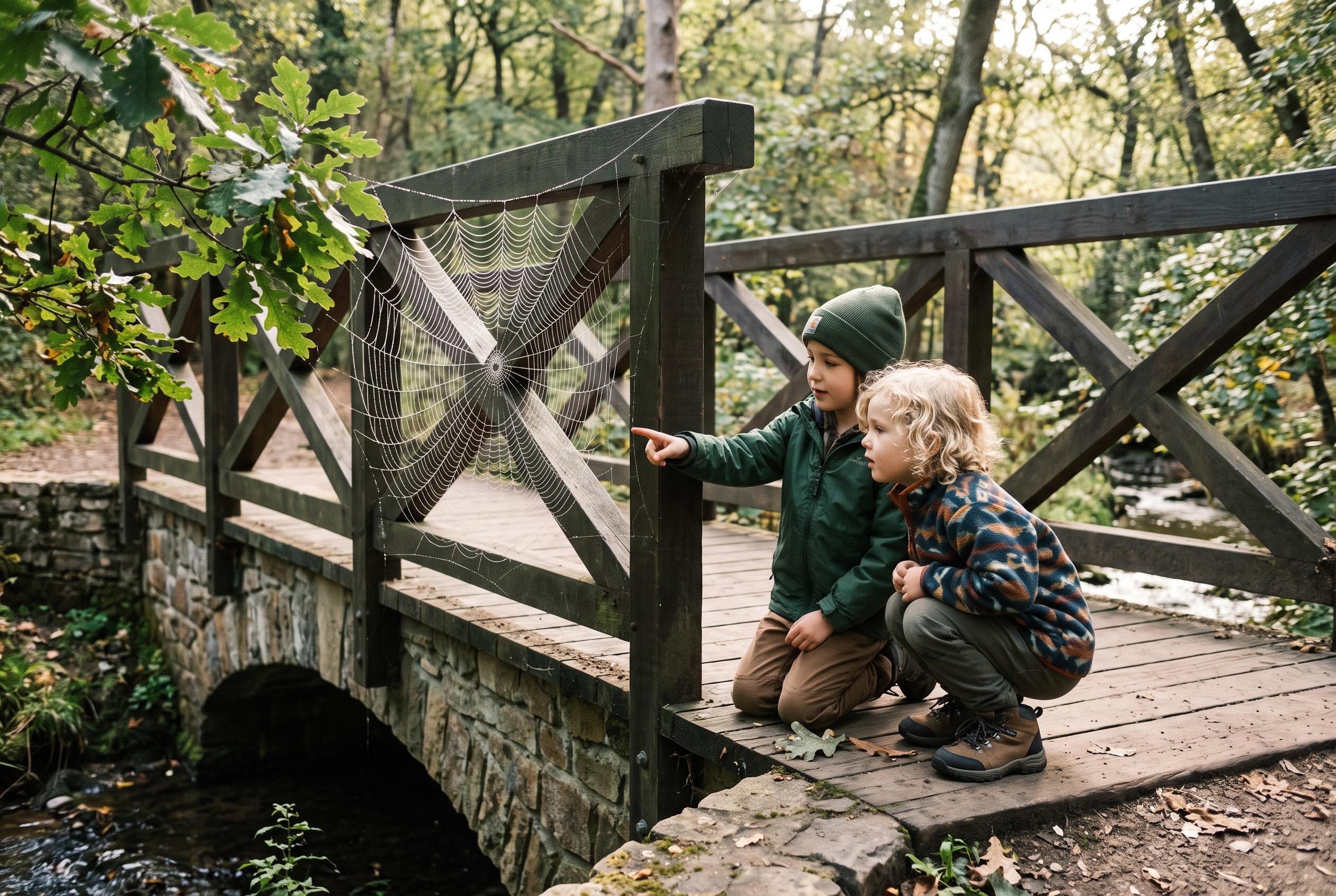

Children exploring outdoors find unexpected lessons in geometry and engineering within spider webs, revealing nature’s own architectural principles and inspiring STEM learning.
Children learning outdoors often find mathematics where adults least expect it. In a classroom garden or playground, a spider’s web can become a lesson in shape, structure and observation, turning a passing glance into a close study of lines, angles and patterns.
That is the scene described in the lead essay, where children gather around webs they believe were made by “Walter”, a spider from their books. They notice spirals, frames and radiating strands, and they begin using the language of geometry almost without prompting. One child spots triangles hidden in what first looks like a circle; another recalls that the outer frame and spokes are not sticky, so the spider can move safely while building. The conversation is informal, but the learning is precise.
Their ideas also connect with real engineering. Educational resources on bridge design explain that triangles are especially strong because they spread force more evenly than simple four-sided shapes, which is why they are common in trusses and towers. A Minnesota STEM resource makes the same point for young learners, showing how triangles, arches and rectangles each affect stability in different ways. In that sense, the children’s comparison of a web to a bridge is more than a metaphor: it reflects a basic principle shared by nature and construction.
Research on spider webs adds another layer. A scientific paper in the Proceedings of the National Academy of Sciences describes webs as structures held in tension, with geometry playing a central role in their balance and resilience. Other maths and science educators also point to the catenary curve, the hanging shape found in cables and some webs, as a useful way to understand how forces are distributed. For children, that complexity can be distilled into a simple discovery: the shapes they see in nature are not only beautiful, but purposeful.
Disclaimer: This content is for informational purposes only and is not intended to be a substitute for professional medical judgment, advice, diagnosis, or treatment.