

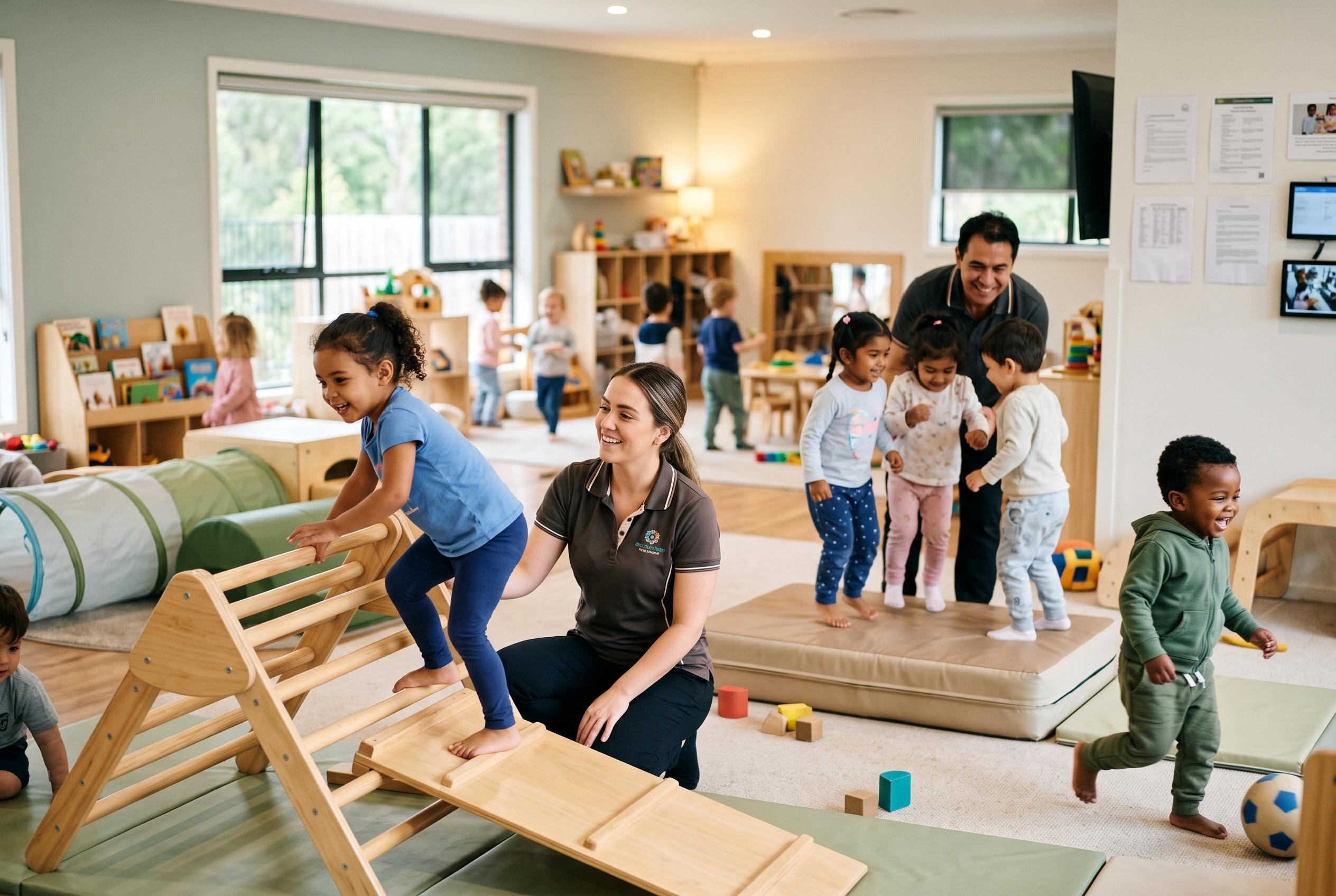

An Australian trial found that training and accreditation improved staff practices and some children’s activity levels, but limited uptake meant no overall population-level effect.
An Australian trial has found that a training-and-accreditation model can improve some childcare practices around active play and recreational screen use, but only where services fully took part. The study, published in JAMA Network Open, looked at the Activated Outside School Hours Care programme, which was designed to help before- and after-school care services line up with national guidance on screen time and physical activity. According to the programme’s backers, the aim was not to change children directly, but to embed healthier routines into policies, staffing and day-to-day operations.
Researchers ran the cluster-randomised trial between August 2022 and December 2024 across services in Western Australia, South Australia and New South Wales. In all, 197 childcare services were allocated to either the programme or usual care, and the combined sample covered about 10,000 children. Services in the intervention arm could access four online staff training modules and, if they met policy and training requirements, could gain accreditation after their screen-time and physical-activity policies were assessed against the guidelines.
The main outcome was whether services met those guidelines for recreational screen time and opportunities for movement before and after school. In the intention-to-treat analysis, which counted services regardless of how fully they engaged, the programme did not produce a statistically significant improvement in overall adherence. It also did not show a clear effect on children’s observed screen time or moderate-to-vigorous physical activity, the term used for movement that makes children breathe harder and raises their heart rate. However, staff in the intervention group did show stronger physical-activity-promoting behaviours by 12 months, including encouraging active play and leading games, and services also improved the availability of equipment that supports movement.
The picture changed among the smaller group of services that completed accreditation. JAMA Network Open reported that accredited services were more likely to align with the full set of guidelines, mainly because they improved after-school screen-time practice. Those services also showed better staff behaviours and, during before-school care, children recorded higher levels of moderate-to-vigorous physical activity than children in the control group. Even so, the findings were not uniform: the study did not find significant effects on the physical-activity schedules themselves, nor on observed recreational screen use.
The limits of the programme’s reach appear to have shaped the overall result. Only 48% of intervention services achieved accreditation, and the authors said that this restricted uptake likely explains why the intervention did not shift outcomes at a population level. They also cautioned that the accredited services were not a random subgroup: they were more often metropolitan, larger and school-run, which makes it difficult to know how much of the improvement was caused by the programme rather than by pre-existing differences. The trial did not track individual children over time, observed only one before-school and one after-school session at each time point, and used an added screen-availability measure that had not been independently validated.
Disclaimer: This content is for informational purposes only and is not intended to be a substitute for professional medical judgment, advice, diagnosis, or treatment.



