

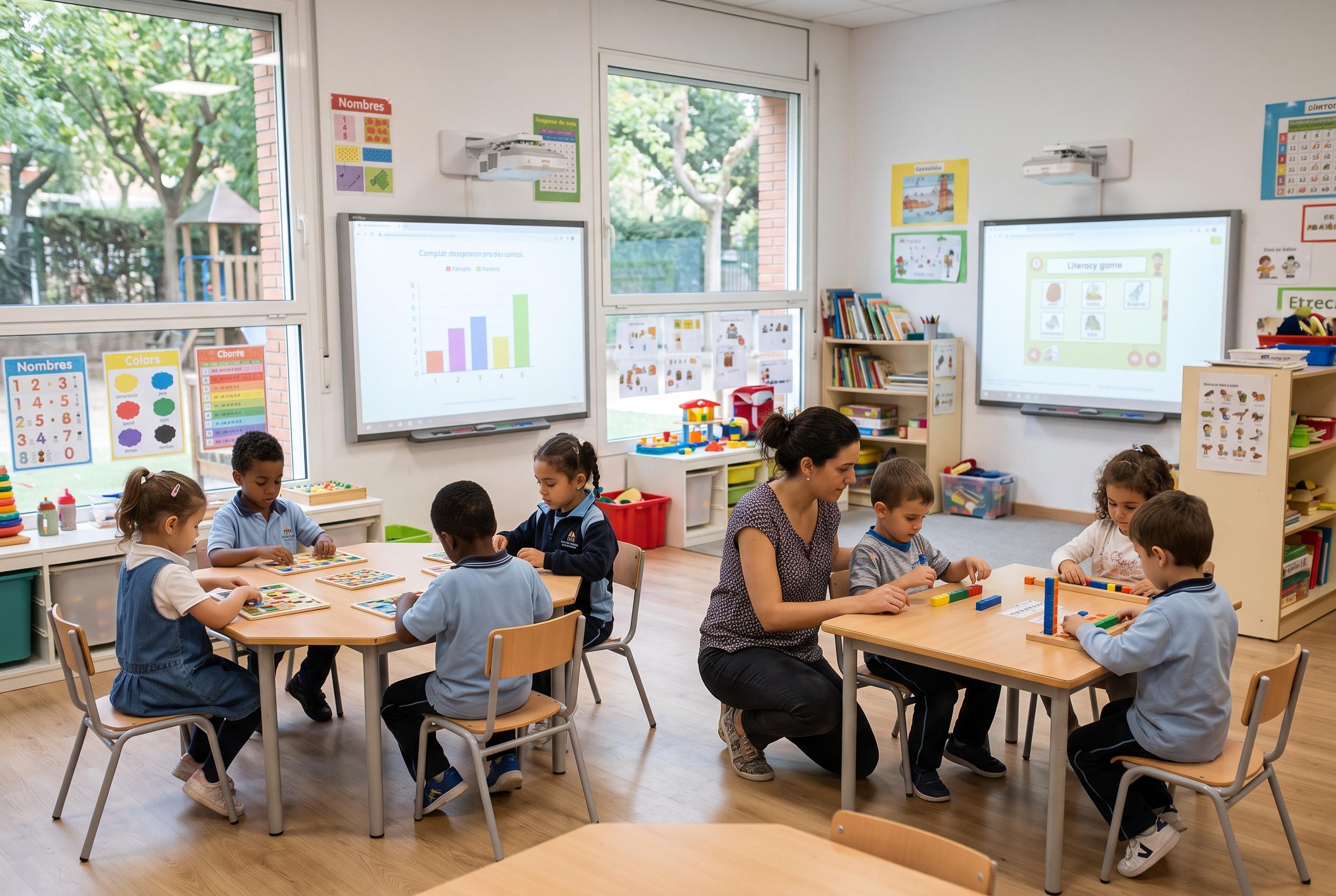

The region has abandoned plans to remove interactive whiteboards from infant classrooms, citing European funding rules, but will restrict their use to approved educational content.
Catalonia has reversed course on a plan to remove interactive screens from early-years classrooms, acknowledging that the devices cannot simply be taken out without risking the loss of European funding. Instead, the regional education department now says the whiteboards will stay in place but their use will be tightly limited, with internet access restricted to approved educational material.
The change marks a notable shift from the tougher line set out in June 2025, when Catalonia introduced rules that curbed mobile phones, smartwatches and other digital devices in schools, including a push to remove screens from infant education. Those whiteboards were installed across Catalan schools less than a year earlier after the region bought 32,000 interactive screens for €88 million, using Next Generation EU funds. According to the latest guidance, the government now wants a “pedagogical, restricted, and safe” model rather than a blanket withdrawal.
In a new document titled “Educational Whiteboards in Early Childhood Education”, the department says digital boards should not be a permanent presence in the classroom. They should be used only when they clearly support shared learning, including conversation, oral language, joint observation, creativity, listening and collaborative work. The guidance also calls for a special “Infantil” user profile with limited functions, blocking free browsing and allowing access only to authorised tools, mainly from EDU365 and the department’s own activity library. Functions such as a whiteboard tool, audio player, calculator and timer would remain available, but in a more controlled form.
The move comes as pressure grows on education authorities across Spain to rethink classroom technology. The campaign group Aixeca el cap has urged the Catalan parliament’s education committee to speed up efforts to reduce screen use, arguing that banning phones in secondary schools is not enough and calling for an immediate review of all digital devices supplied to pupils. Catalonia’s latest adjustment also fits a broader policy trend: other regions, including Aragón, have recently tightened rules on school technology, while Catalonia itself is preparing wider digital-wellbeing measures that could further reshape how artificial intelligence and screens are used in education.
Disclaimer: This content is for informational purposes only and is not intended to be a substitute for professional medical judgment, advice, diagnosis, or treatment.



