

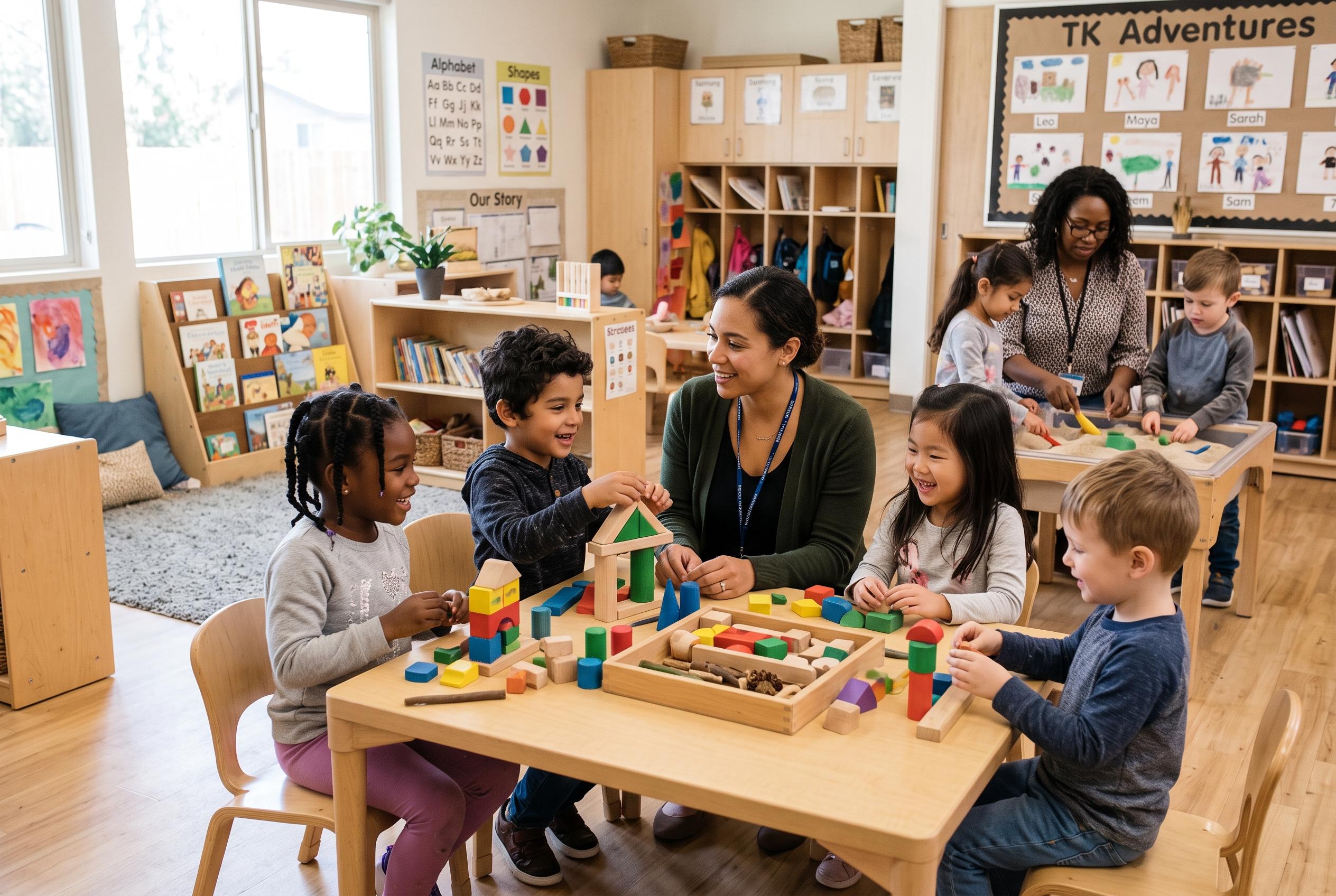

UC Berkeley researchers say transitional kindergarten delivered the biggest long-term gains for lower-income children when paired with state preschool and better-funded primary schools.
UC Berkeley researchers say California’s transitional kindergarten programme has delivered its biggest gains for children from lower-income families, particularly when it is paired with state preschool and stronger school funding. In a new research brief published on Thursday, the team found that the first cohort to enter TK more than a decade ago kept making academic progress well into primary school, with some children from poorer households gaining the equivalent of around seven additional months of learning in reading and maths by third grade.
The findings add weight to the argument that TK works best as part of a longer early-education pathway rather than as a stand-alone fix. Rucker Johnson, an economist and public policy professor at UC Berkeley, said the evidence points to “a trifecta of public policies” , TK, the California State Preschool Programme and more equitable school funding , working together to speed children’s development. Austin Land, a policy analyst and co-author of the study, said the benefits were strongest for children who had already spent a year in the state’s preschool system before moving into TK.
California created transitional kindergarten to reduce an advantage that wealthier families often had long before children reached formal schooling. Under the state’s old Dec. 2 kindergarten cut-off, some children who were still 4 were entering school a year earlier than others, while families with more resources could afford to delay entry through private preschool. By moving the cut-off to Sept. 1 and offering a bridge year for children who were nearly 5, lawmakers hoped to give more children a stronger start. The Berkeley researchers say the gains are real, but they also argue that TK on its own is not enough to level the field.
The study’s authors say the strongest results came when TK was combined with the California State Preschool Programme, which is free for income-eligible 3- and 4-year-olds and is designed around play, small classes and family support. They also said the benefits were larger when children later attended better-resourced primary schools. That pattern, they argued, suggests that early investment has a multiplying effect rather than simply adding one benefit on top of another.
The findings also come against a mixed backdrop for California’s early-childhood system. While TK is now available to all 4-year-olds, enrolment in the state preschool programme has fallen since the Covid-19 pandemic. Land said only about 18% of eligible 3-year-olds are enrolled, despite the programme’s wider expansion in recent years. Johnson said California should now focus on strengthening that earlier stage, while also doing more to support dual language learners, who make up a large share of the state’s young children. He said classrooms should be built around the children who enter them, not the other way round.
Disclaimer: This content is for informational purposes only and is not intended to be a substitute for professional medical judgment, advice, diagnosis, or treatment.



