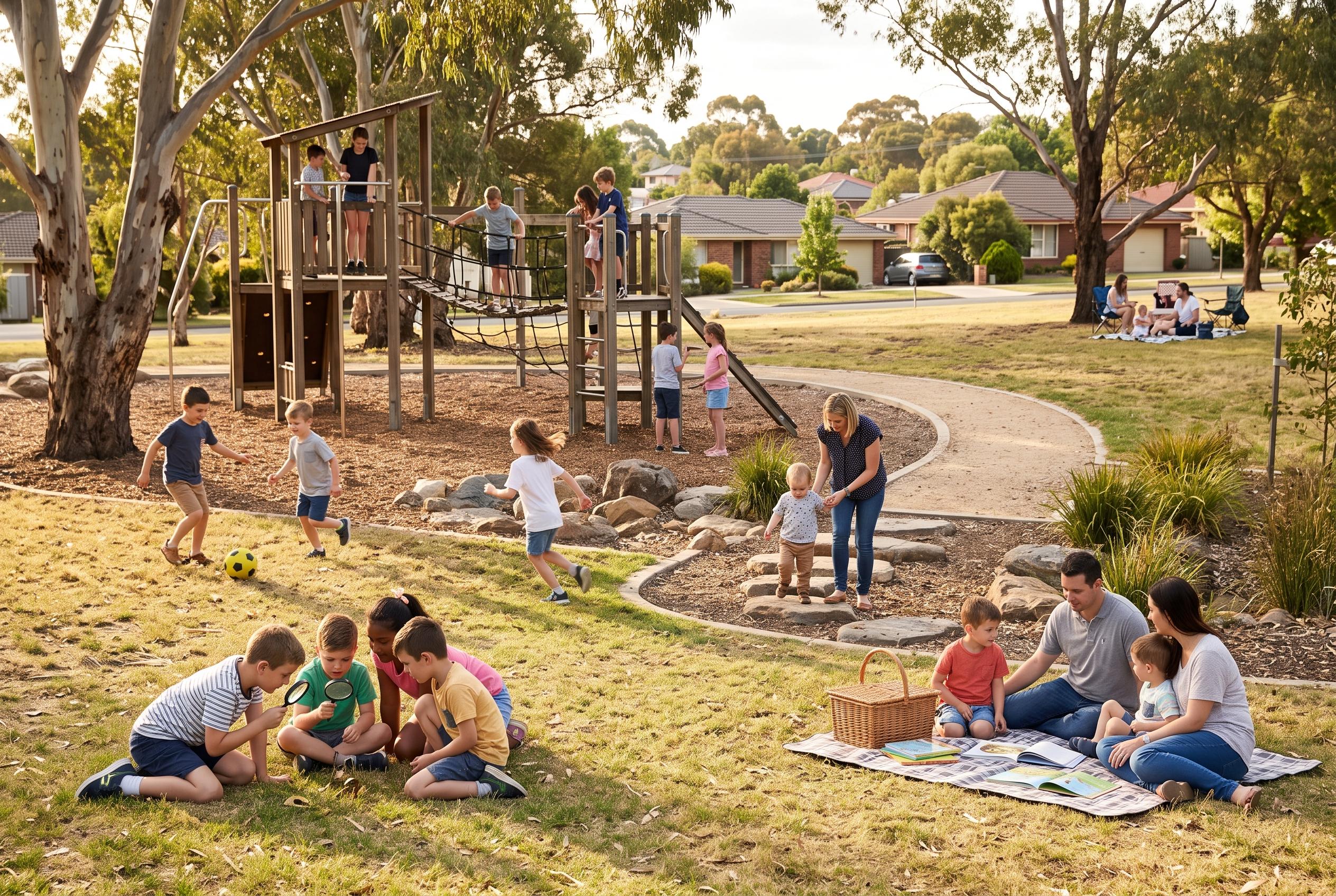

New Australian guidelines emphasise the importance of outdoor activity, healthy sleep, and screen time balance for children, revealing the unexpected health benefits of outdoor play beyond exercise.
Parents often know that outdoor play is good for children. What is less often clear is how much movement young people actually need and why time outside matters so much. In Australia, the answer is set out in the 24-Hour Movement Guidelines, which combine exercise, screen time and sleep because the three affect one another across the day.
For babies up to 12 months, the guidance calls for activity several times a day through supervised floor play, at least 30 minutes of tummy time spread through the day, no sedentary screen time and plenty of sleep. Toddlers aged one to two should get at least three hours of varied physical activity daily, including energetic play. For children aged three to five, that rises to three hours a day, with at least one hour of running, jumping, climbing or dancing. From age five to 17, the recommendation is at least 60 minutes of moderate to vigorous activity each day, plus bone- and muscle-strengthening activity on at least three days a week.
That may sound like a lot, but it does not have to mean organised sport or constant supervision. A child who has room to move, climb, swing or simply wander around outdoors is already meeting part of that need. Health authorities in Western Australia and the federal Department of Health both stress that the guidelines are about the overall balance of the day, not a single structured workout.
One of the less expected benefits of outdoor play is eyesight. Research has linked regular time outside with a lower risk of short-sightedness in children, and a commonly cited threshold is around 13 hours a week, or just under two hours a day. Experts say the key factor appears to be bright light rather than exercise itself, which means the benefit still applies whether a child is running, reading or sitting in the shade. Even on cloudy days, outdoor light is far brighter than indoor light.
The advantages do not stop there. Time outside helps regulate the body clock, which can make it easier for children to fall asleep and sleep more soundly. It also supports coordination and strength through climbing, hanging, balancing and swinging in ways indoor spaces rarely match. Just as importantly, outdoor play gives children room to judge risk, solve small disputes, take turns and negotiate rules without an adult directing every move.
For families, the Australian climate offers an advantage for much of the year. In hotter weather, the safest approach is to plan outdoor time before 10am or after 3pm, and to use shade, sunscreen and hats. In colder months, boots and raincoats can turn a gloomy afternoon into usable playtime. Placement matters too: equipment that children can see from inside the house is more likely to be used than something tucked away at the back fence.
What tends to draw children outdoors is not the equipment itself, but the invitation to play in a space that feels like theirs. Swing sets remain a reliable favourite because they combine movement and sensory input. Cubby houses encourage imaginative play. Sandpits hold younger children for long stretches. Trampolines pack in vigorous activity without needing much space. Water play, mud kitchens, climbing frames and playgrounds all serve the same basic purpose: they give children a reason to go outside, which is exactly what the movement guidelines are designed to encourage.
Disclaimer: This content is for informational purposes only and is not intended to be a substitute for professional medical judgment, advice, diagnosis, or treatment.