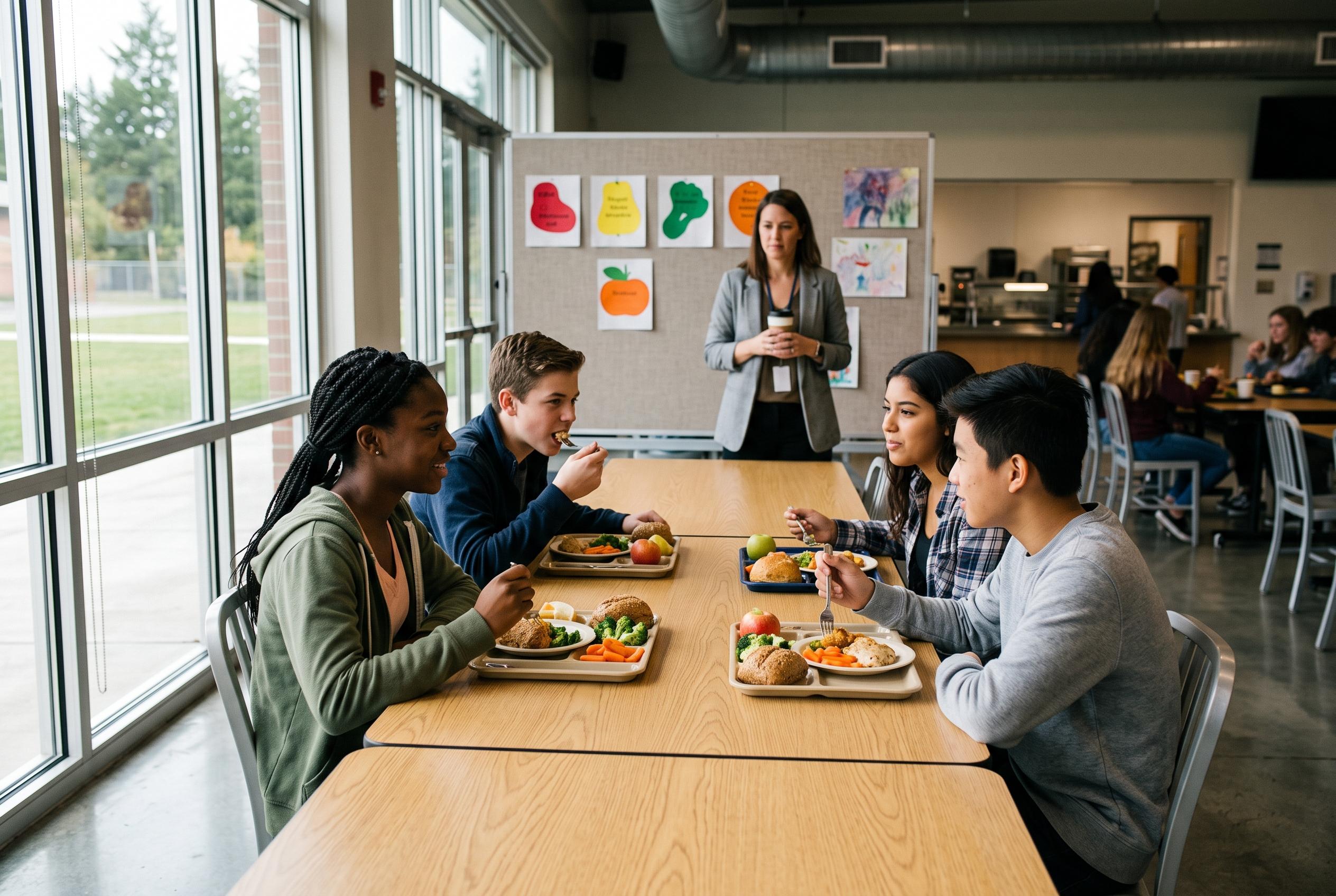

As more American schools provide free meals to students, the proportion offering essential nutrition education declines, exposing a fragmented approach to fostering lifelong healthy eating habits amidst growing financial strains and policy shifts.
As pupils return to class this autumn, American schools are widening access to free meals even as the teaching that might help children use those meals well remains thin. The contradiction is plain in the numbers. The School Nutrition Association’s latest survey found that 65.9% of responding programmes served breakfast free to all students districtwide in the 2025-26 school year, and 59.0% did the same for lunch. Yet the Centres for Disease Control and Prevention says pupils still receive less than eight hours of required nutrition education a year, well short of the 40 to 50 hours the agency says are needed to change behaviour.
That expansion has not removed the financial strain on districts that still charge. In the association’s 2025-26 survey, 92.2% of programmes that did not offer meals free to all students reported unpaid debt, compared with 23.3% of those that did. The median debt among reporting districts slipped to $6,000, but total reported debt rose above $25m and the 90th-percentile figure climbed to $86,660. Some states have decided the answer is to stop billing families altogether. In January 2025, Kathy Hochul proposed free breakfast and lunch for every child in New York, saying: “The research is clear: good food in the lunchroom creates good grades in the classroom.” That plan was enacted in May 2025, and by 26 June 2026 the governor said 396 million free meals had been served to 2.7 million students. When the proposal was first unveiled, the Associated Press noted that at least eight states already operated universal school meals programmes; the association’s more recent tally puts the number with permanent state funding at nine.
The pressure on school food departments runs beyond debt. The association found that median full-price breakfast charges in 2025-26 were $1.90 in primary schools and $2.00 in both middle and high schools, while median lunch charges were $3.00, $3.20 and $3.25 respectively. About 69.6% of directors said federal reimbursement did not cover the cost of lunch, and 63.1% said the same for breakfast. Just over half, 51.3%, described the financial outlook three years ahead as a serious concern. That squeeze hardened after the US Department of Agriculture ended the Local Foods for Schools programme in March 2025, removing about $660m that schools and childcare providers had used to buy from nearby farmers and producers.
Classroom time has been squeezed almost as badly as kitchen budgets. CDC data shows the share of schools requiring instruction on nutrition and dietary behaviour fell from 84.6% in 2000 to 74.1% in 2014. The agency argues that food teaching should not be boxed into a single health lesson: children can count with fruit and vegetables in early years classes, learn fractions by measuring ingredients, study plant growth in science and discuss cultural food traditions across the curriculum. The point is not decorative. Research cited by the CDC indicates that students are far more likely to alter eating habits when schools provide 40 to 50 hours of instruction rather than a scattering of isolated sessions.
The programmes now being cut were often the ones that made those lessons real. Reuters reported in September 2025 that schools, food banks and charities were winding down work previously financed through SNAP-Ed. In Milwaukee, Lisa Kingery, chief executive of FoodRight, said her organisation had been teaching more than 1,200 public school students each year how to identify and cook fresh food. “When we cut SNAP-Ed, we’re cutting kids off from the skills they need to be healthy,” she told Reuters. In the agency’s video reporting, Kingery said the classes used “fire” and “knives” and gave children several weeks of hands-on learning that changed how they ate and how they connected with food.
Public-health guidance suggests the solution is not simply to rewrite menus from Washington. The CDC says schools should make meals appealing and culturally appropriate, train nutrition staff properly, and ensure meal service and payment systems work efficiently. It also says pupils should get at least 20 minutes of seat time after receiving lunch. About half of districts, the agency says, do not require or recommend that minimum. In that model, the cafeteria is not separate from the curriculum but an extension of it, a place where children can see what a balanced meal looks like and try unfamiliar foods before they become a regular part of the menu.
That operational detail matters because the rules are getting tighter. Federal standards are already phasing in product-based caps on added sugars in cereals, yoghurt and flavoured milk, with a broader weekly cap due in the 2027-28 school year. The School Nutrition Association says concern is most acute about the 2027 requirements, particularly further sodium cuts and the rule limiting added sugars to less than 10% of weekly calories. Directors say they need more funding, more staff and more scratch-cooking capacity to comply. The politics are moving in the opposite direction. The Associated Press reported in March 2025 that Republican spending-cut proposals included tougher income verification and changes that critics said could make it harder for schools to provide universal free meals without applications.
What emerges is not a single failing system but a patchwork one. Some states are broadening access and treating school meals as part of family affordability policy. Elsewhere, districts are still collecting debt, raising prices and losing the education programmes that might help children build healthier habits for life. The strongest thread running through the reporting is that meals and lessons work best together: reducing stigma by feeding everyone, then reinforcing that access with practical, repeated teaching about how food affects health, mood and learning. Without stable funding for kitchens, staff and classroom time, schools will keep being asked to solve a public-health problem with fragments of a policy rather than a coherent whole.
Disclaimer: This content is for informational purposes only and is not intended to be a substitute for professional medical judgment, advice, diagnosis, or treatment.