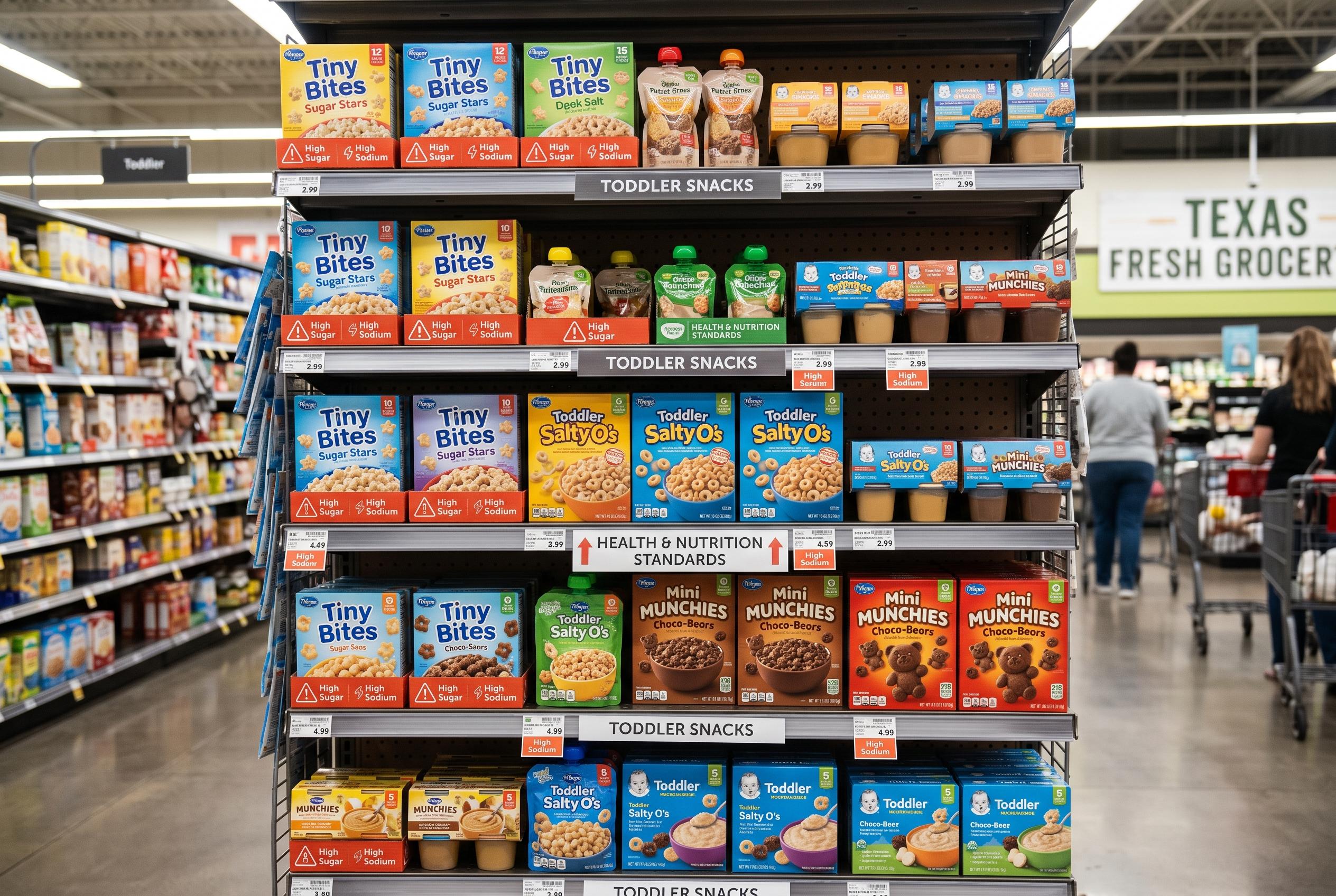

A new audit of toddler foods on Texas supermarket shelves highlights the dominance of heavily processed products, many of which fail to meet basic nutrition standards, raising concerns for parental choices and public health policies.
A new audit of toddler foods on Texas supermarket shelves suggests that heavily processed products dominate the category and that many fall short of basic nutrition standards.
Researchers examining 2,783 items in 21 grocery stores in Austin found that 81% were classed as ultra-processed under the NOVA system, according to a study published in the journal Nutrients and described by the University of Texas at Austin. Nearly half of the products failed to meet at least one World Health Organization nutrient benchmark for foods marketed to children aged 6 months to 36 months.
The findings matter because the products are often wrapped in child-friendly branding and health claims that can give parents a false sense of security, researchers said. Erin A. Hudson, a science policy fellow at the University of Texas at Austin and one of the study’s authors, said parents should read ingredient lists and nutrition labels closely rather than assuming that a product sold for babies or toddlers is automatically suitable.
The audit found that 17% of products missed the WHO target for sugar, 25% exceeded sodium limits, 11% fell below recommended fat levels and 12% did not meet energy-density guidance, according to the report. Items with the weakest profiles included fruit snacks, oat bars, savoury snacks and ready-to-eat meals, which often carried higher amounts of sugar, salt or calories. The researchers also noted that ultra-processed items were more likely to contain more sugar than less processed alternatives.
The study adds to a wider body of research showing that ultra-processed foods are already common in young children’s diets. A separate U.S. analysis published in Public Health Nutrition found that ultra-processed foods made up 45% of energy from complementary foods and beverages consumed by infants and toddlers, while a Brazilian study reported that almost all children in its sample had eaten at least one ultra-processed food by 12 months. Taken together, the research suggests that the first years of life remain an important window for stronger labelling, clearer marketing rules and more guidance for parents trying to choose healthier packaged foods.
Disclaimer: This content is for informational purposes only and is not intended to be a substitute for professional medical judgment, advice, diagnosis, or treatment.