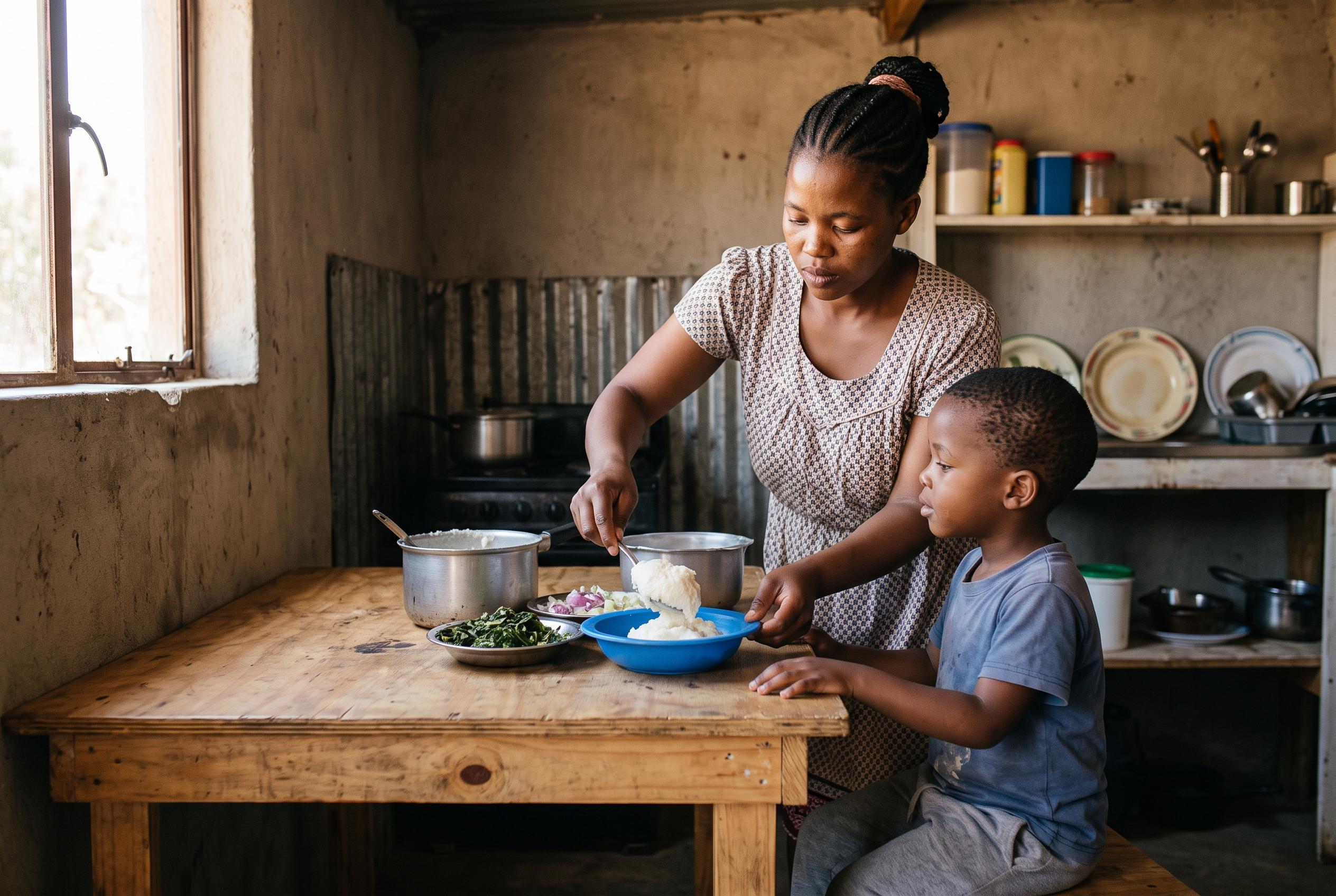

A new analysis reveals how scarce resources force many South African households to rely on unbalanced meals, risking long-term health impacts for vulnerable populations, particularly children.
For many South African families, what is on the dinner table is less about choice than survival. A new Health-e News series, analysed by registered dietitian and public health nutritionist Helen Donkin of the Association for Dietetics in South Africa, shows how quickly a single meal can fail to meet basic nutritional needs when money, water and electricity are scarce.
The series looked at seven photographed meals from households facing hunger, with portion sizes estimated from the images and nutritional content drawn from the South African Food Data System. Donkin said low-cost food is not automatically the problem; the issue is that the cheapest meals often deliver bulk rather than balance, leaving families short of protein, fibre and micronutrients even when stomachs are full.
One of the starkest examples is the story of Zinzi, a 32-year-old mother from Lenasia South who sells chicken feet and, at times, sex to feed her three children. Daily meals in her home often amount to pap, sometimes shared between her toddler and two sons. Daily Maverick reported that her youngest daughter was hospitalised with malnutrition, underscoring the pressure on households where food is constantly rationed.
Donkin said pap with spinach offers energy and some nutrients, but remains limited in overall quality. She also stressed that the most vulnerable period comes early in life, from conception through a child’s second birthday. Poor diet in that window, she said, can have lasting effects on growth and development.
Another family in Limpopo is forced to make an even smaller budget stretch. Sekhwele Mnisi, a 66-year-old widower near Burgersfort, has about R1,500 a month to feed six people, according to Health-e News. That works out to roughly R50 a day, while the household also pays for water, paraffin, candles and firewood because it has no running water or electricity. When food runs out, Mnisi tells his children to drink water and have faith.
The meal photographed for analysis in that household was pap and bread. Donkin said it is filling and high in carbohydrates, but weak on other essentials. She warned that a full stomach does not mean adequate nutrition, and that repeated diets based on a narrow range of cheap staples can contribute to South Africa’s broader malnutrition problem, where hunger, deficiencies and overweight can exist in the same community, and sometimes in the same home.
Food insecurity also forces painful trade-offs among older relatives. In the Eastern Cape, a grandmother known as Toti lives with five adult children and six grandchildren. When supplies run low, adults skip meals so younger children can eat. Donkin said the chicken-and-bread meal photographed for the series provides energy and some protein, but lacks the range of foods needed for a healthier diet, particularly vegetables, fruit, legumes and dairy.
The analysis found more hope in meals with greater variety. A dish of rice, scrambled eggs and fried vegetables from a household in Embo, near Durban, offered more diversity than several of the others, though it still lacked fruit, legumes and dairy. Donkin said variety matters because it helps supply a wider spread of nutrients and supports gut health.
The strongest example of a balanced plate came from a school in Nyakallong, Free State, where a meal of samp, beans, pumpkin and tomato-and-onion relish was described as one of the most complete in the series. For some pupils, a school meal is the main meal of the day, and that makes consistency as important as quality. Donkin said children who rely on feeding schemes need regular access to nutritious food, not just an occasional good plate.
Community responses can help, but only to a point. In Tsetse Village outside Mahikeng, a food stokvel allows members to buy groceries in bulk, while at the Thuthukani Centre in Lenasia South, residents grow vegetables for their own kitchens. Donkin said such efforts can improve diets by adding fresh produce, but warned that the burden of fixing food insecurity cannot fall on families alone. Healthy eating still costs time, money or both, and many households simply do not have either.
Disclaimer: This content is for informational purposes only and is not intended to be a substitute for professional medical judgment, advice, diagnosis, or treatment.