

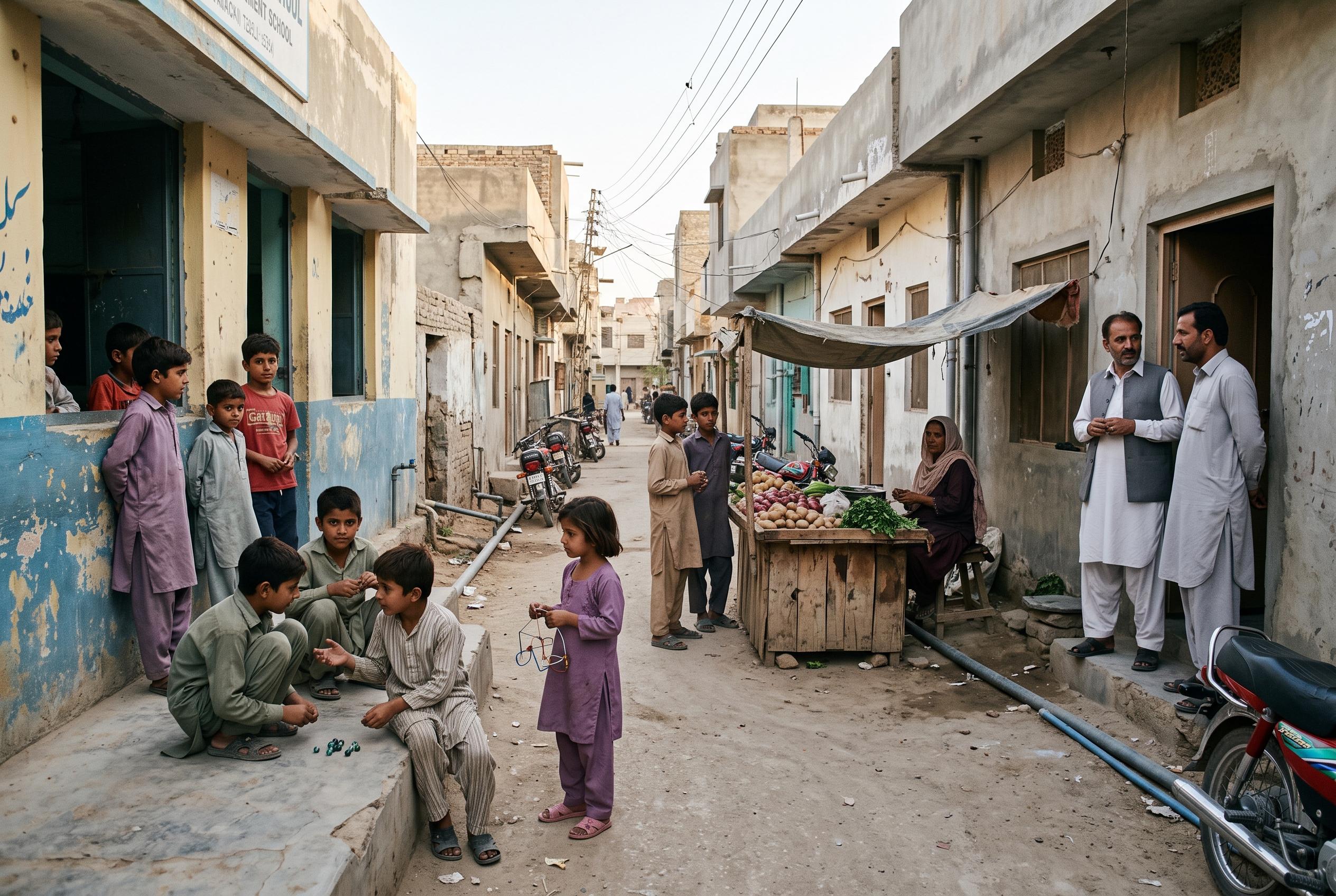

A study of more than 37,000 children links Pakistan’s 2008–10 wheat subsidy reforms to reduced growth, poorer later educational outcomes and lower measures of civic participation.
Pakistan’s cuts to wheat subsidies more than a decade ago did more than raise prices, according to a new study in Frontiers in Public Health. Researchers say the reforms, pushed through as part of efforts to stabilise the economy, were followed by measurable losses in child growth in the districts most dependent on subsidised wheat, along with weaker later educational outcomes and reduced civic participation.
The study centres on what its authors call “nutritional lock-in”, the idea that food policy can leave lasting biological effects that shape not only health but also the capacity of communities to hold leaders to account. That argument builds on Pakistan’s long history of intervention in wheat markets. Reporting in 2008 showed the coalition government had already begun slashing subsidies on food, fuel, electricity and fertiliser under pressure from international lenders, while the country was also grappling with shortages and volatile wheat prices. Research on the wheat sector has since found that government intervention has often favoured consumers and traders, even as farmers have faced policy-induced taxation.
To assess the effects of the 2008 to 2010 subsidy changes, the authors used district-level exposure to the public distribution system and compared child outcomes before and after the reforms. Their sample covered more than 37,000 children across 120 districts, using data from multiple waves of Pakistan’s Demographic and Health Survey. The researchers report that the parallel-trends assumption held up in testing, strengthening their claim that differences in nutrition were tied to the subsidy shock rather than pre-existing district trends.
The main result is stark: children in the most exposed districts recorded a fall in height-for-age, a standard measure of stunting, of roughly 0.28 standard deviations after the reforms. The study says that translates into about 1 centimetre of lost height by age five. A sibling comparison produced a similar estimate, suggesting the pattern was not simply the product of household background. The effect was strongest among children exposed in the first two years of life and among the poorest households, which were least able to compensate by buying other foods.
Dietary patterns appear to help explain the findings. In the hardest-hit districts, families reduced their intake of pulses, dairy, fruit and vegetables while relying more heavily on wheat flour. The study also links the nutritional shock to later educational outcomes, finding that poorer early-life growth was associated with weaker mathematics performance in later years. The authors are careful to note that this schooling result is correlational rather than strictly causal, but they say it points to the wider human capital costs of food policy choices.
The study also extends its analysis to civic life. Using women’s empowerment measures as a proxy for civic capacity, the authors found lower scores in districts more exposed to the subsidy cuts on indicators including household decision-making, mobility, rejection of violence, media access and community participation. They say these declines suggest that poor nutrition may erode the social and informational resources needed for political engagement, although they acknowledge that the data do not directly measure voting or other forms of electoral behaviour.
The broader policy message is that subsidies should not be judged only on immediate fiscal savings. Pakistan still spends heavily on wheat support, yet stunting remains widespread, the study notes. The authors argue that reforms need nutritional safeguards so that the burden of adjustment does not fall most heavily on children, especially those in the poorest districts. Their conclusion is cautious but consequential: food policy, they suggest, can shape not just what families can afford to eat, but the long-term strength of the society around them.
Disclaimer: This content is for informational purposes only and is not intended to be a substitute for professional medical judgment, advice, diagnosis, or treatment.



