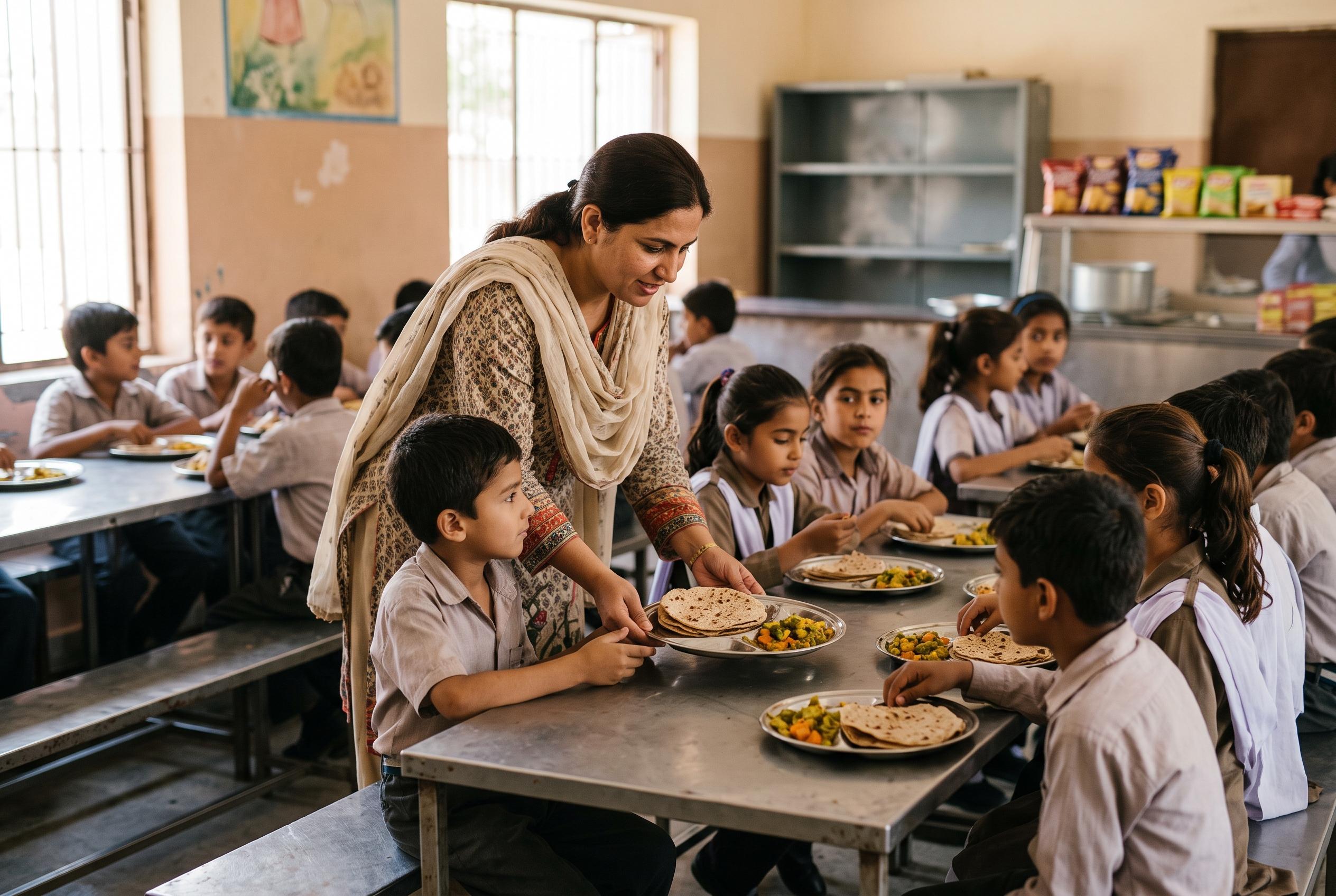

Pakistan begins enforcing stricter food standards, including trans fat limits and school bans on unhealthy snacks, amid debates on affordability and effectiveness of policy measures to combat diet-related diseases.
The argument over what Pakistanis eat is no longer confined to lectures about personal responsibility. Over the past year, officials have begun tightening rules in several corners of the food system, from a national standard capping industrial trans fats across all food categories to renewed school restrictions in Sindh on soft drinks and heavily processed snacks. The shift has gathered extra weight since the World Health Organization published fresh guidance in January 2026 urging governments to treat schools as food environments that can either protect children’s health or undermine it. At the same time, World Bank and FAO data show that access to a healthy diet remains far out of reach for millions, making the policy question not only what people should eat, but what the market makes easiest to buy.
One of the clearest examples of that enforcement problem came in Karachi in April 2025, when the Sindh Food Authority asked the city administration to act on a ban that was already on the books. Dawn reported that the authority reminded the commissioner of Karachi, deputy commissioners and other offices of a notification first issued on 5 September 2018, which barred carbonated soft drinks, energy drinks, poppadoms and coloured or flavoured snacks such as potato crisps from educational canteens. The authority said those products were still being sold “within and outside the premises of educational institutions” and asked officials to ensure “strict compliance” in both public and private schools and colleges. ProPakistani reported that the authority also wrote to the secretaries of School Education, College Education and Local Government, and told institutions to monitor canteens and food courts more closely.
That local crackdown fits neatly with the approach WHO set out on 27 January 2026 in its 106-page guideline on healthy school food environments. The agency said children spend a large share of their day at school, making it a decisive setting for lifelong eating habits and for narrowing health and nutrition inequalities. It warned that foods sold, served or promoted in and around many schools are commonly high in saturated fat, trans fat, free sugars and salt. WHO’s recommended toolkit goes beyond one-off bans: it covers direct food provision in schools, nutrition standards for foods and drinks sold there, and so-called nudging measures that make healthier choices easier. In other words, school policy is meant to shape the everyday setting, not simply deliver another health lesson in assembly.
Pakistan has also moved, at least on paper, against one of the most damaging ingredients in the wider food supply. APP reported on 12 April 2025 that the Pakistan Standards and Quality Control Authority had approved a national standard limiting industrially produced trans fats to less than 2 per cent of total fat across all food categories. That matters because earlier rules introduced in June 2023 applied only to six major categories, leaving gaps in products including widely consumed street foods. APP said the broader standard emerged from co-operation among the health ministry, provincial and federal regulators, WHO and civil-society groups including Pakistan Youth Change Advocates, CPDI and Heartfile. Even so, the same report said the next step would need to be legislation banning partially hydrogenated oils, described as the main source of industrial trans fats.
Affordability remains the complication that can make even sensible health advice sound detached from reality. A World Bank data blog published with FAO statisticians said the latest Cost and Affordability of a Healthy Diet estimates in the 2025 State of Food Security and Nutrition in the World report showed a global average healthy-diet cost of $4.46 per person per day in purchasing-power-parity terms in 2024. Around 2.6 billion people still could not afford that diet. The authors said progress was uneven and that a worsening trend had been observed in the Middle East and North Africa, Afghanistan and Pakistan region. They also set out how the figures are built: using a Healthy Diet Basket, nationally representative retail prices and poverty-line based income data. For Pakistan, the broader World Bank food prices database has put the number unable to afford a healthy diet at about 138.3 million people, or 58.7 per cent of the population, underlining why the issue cannot be reduced to willpower alone.
That is one reason fiscal policy has entered the discussion. According to The News, Pakistan’s health minister used his budget speech on 20 June 2025 to call for a 50 per cent federal excise duty on all sugary drinks, framing it as part of a “prevention is better than cure” approach to non-communicable diseases. He said, “Every single minute, a heart attack is occurring in Pakistan, and we are globally ranked top in prevalence of diabetes. If we failed to take policy measures to support our public health priorities, there would be a public health and economic disaster”. The paper also reported that members of the National Standing Committee on Finance wanted higher taxes on sugary drinks and ultra-processed foods more broadly. Among the claims aired in that debate were that diabetes and its complications cause more than 1,100 deaths a day, that over 300 limbs are amputated daily, and that diabetes management alone costs the country more than $2.6 billion a year. The same report said the ultra-processed food market was valued at nearly $5.7bn in 2020 and projected to reach $6.9bn by 2025.
Taken together, those developments suggest Pakistan is no longer starting from zero on food regulation, but it is still operating through fragments rather than a settled national framework. Sindh’s experience showed that a ban announced years earlier could remain widely ignored without active enforcement. The trans fat standard demonstrated that national rule-making is possible, but also highlighted the unfinished job of banning partially hydrogenated oils and making compliance real. WHO’s latest guidance sets out a broader model for schools, while World Bank and FAO figures show that price and access cannot be treated as secondary concerns. The debate in Islamabad over sugary-drink taxation points in the same direction: if diet-related disease is being driven by what is cheap, ubiquitous and heavily marketed, then the state’s role is not only to advise consumers, but to decide how far it is willing to reshape the conditions in which those choices are made.
Disclaimer: This content is for informational purposes only and is not intended to be a substitute for professional medical judgment, advice, diagnosis, or treatment.