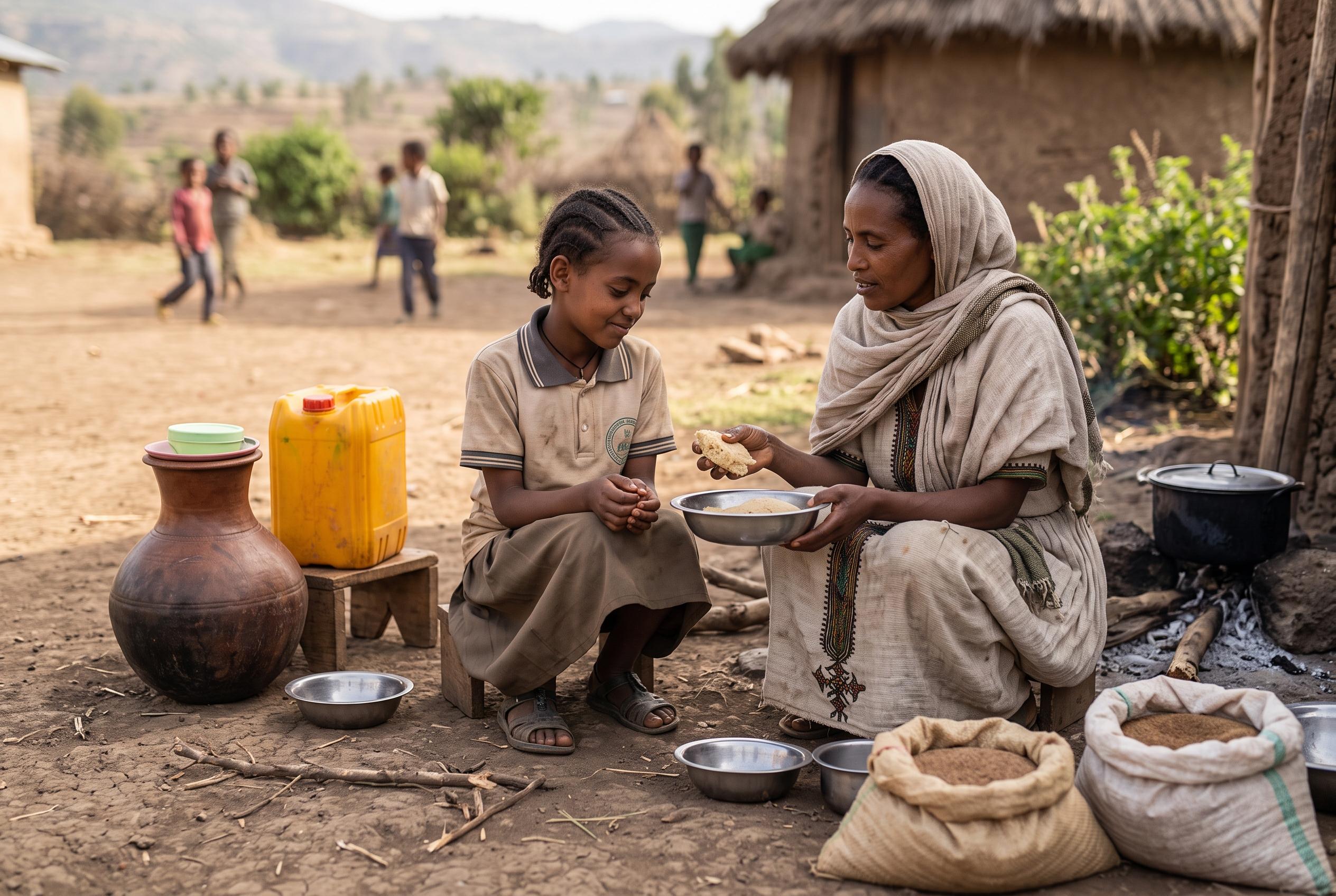

A 2023 survey in Hawela Tula reveals high rates of stunting and underweight among primary school children, emphasising the intertwined roles of diet, household conditions, maternal education, and parasitic infections in the region’s ongoing nutrition crisis.
Nearly a third of primary pupils in Hawela Tula, a largely rural sub-city of Hawassa in Ethiopia’s Sidama region, were found to be either stunted or underweight in a 2023 school survey, adding a nutrition warning to a cluster of recent studies that have also tracked intestinal parasites among children in the same communities. Taken together, the research suggests that poor growth in the area is bound up with more than food alone: hunger, monotonous diets, maternal schooling, crowded households and untreated infections all appear to be working together in a setting that later local papers describe as burdened by helminthiasis and weak health education.
The survey covered 394 children aged 5 to 18 across the sub-city’s three government primary schools between June and December 2023, with a response rate of 94%. It found that 29.4% were stunted and 33.5% were underweight, meaning underweight was slightly more common than impaired linear growth. One child was classified as severely stunted, 14 were severely underweight, and only nine were overweight or obese. The sample was overwhelmingly rural, and the mean age was 11.7 years. The school network and age range match a 2026 infection survey in the same sub-city, which also covered all three primary schools and children aged 5 to 18, underlining how tightly local nutrition and parasite research now overlap.
Older pupils were at distinctly greater risk. Being over 12 more than doubled the odds of stunting and more than tripled the odds of underweight. Children from families of more than five members were nearly three times as likely to be stunted, while having a mother with no formal education roughly tripled stunting risk and doubled underweight risk. Severe food insecurity stood out even more sharply, linked to a threefold rise in stunting and an almost ninefold rise in underweight. Poorer households and those in which the father practised polygamy also faced higher stunting risk. These are not new signals. A 2020 systematic review of Ethiopian primary pupils identified maternal education and age as important correlates of stunting, and a 2015 BMC Public Health study by Mekides Wolde, Alemzewed Chala and Yifru Berhan had already pointed to household conditions, parental education and parasitic infection as key determinants.
The diet data help explain why. Average dietary diversity score was 4.0, with every child eating grains, roots, tubers or plantains, but only about a quarter consuming meat, poultry or fish, just 2% eating eggs, 9.1% nuts and seeds, and 7.2% other fruits in the previous 24 hours. Poor dietary diversity more than doubled the odds of both stunting and underweight. That pattern resembles a 2022 BMC Pediatrics survey in Hawassa’s public hospitals, where 59% of 188 children aged 6 to 59 months had eaten from fewer than four food groups, 70 were admitted with severe acute malnutrition and 41% were stunted. The age groups are different, but the message is similar: thin diets and illness are reinforcing each other well beyond infancy.
Illness was common too. Seven in ten schoolchildren had experienced a health problem in the previous two weeks, including diarrhoea or constipation, abdominal pain, bloating, nausea or loss of appetite, and fewer than half had received deworming treatment. The nutrition study found soil-transmitted helminth infection was associated with stunting, a result that makes sense in a district where school-based parasite control is already routine. A 2024 Scientific Reports paper described Hawella Tula and neighbouring Wondo Gennet as areas around Lake Hawassa with high endemicity of schistosomiasis and soil-transmitted helminths, and reported that 446 children aged 7 to 15 in four primary schools were eligible for praziquantel and albendazole preventive chemotherapy.
Subsequent local studies have strengthened that picture rather than softening it. A 2025 Frontiers in Epidemiology paper on Hawela Tula primary pupils said “insufficient health services and lack of awareness due to absence of effective health education” were helping to sustain intestinal parasite transmission in poor communities. An open-access 2026 survey of Hawella Tula schoolchildren, again spanning all three primary schools and the 5-to-18 age range, similarly treated soil-transmitted helminthiasis and intestinal schistosomiasis as major local burdens. In other words, the new nutrition findings land in a place where infection pressure is already well documented.
The Hawela Tula paper cannot prove cause and effect; it was cross-sectional, and the authors acknowledge recall and social-desirability bias in questions about diet and household conditions. Even so, its message is hard to dismiss because it echoes national and local evidence across different settings. The 2020 review urged greater awareness for mothers with no formal education and “preventing and treating parasitic infection through deworming”, while the Hawassa hospital study described a mix of poor dietary diversity, heavy morbidity and extreme poverty among younger children. For policymakers, that points to a joined-up response: more varied food, more secure household access to it, school health programmes that actually reach children, and parasite control that is treated as part of nutrition rather than a separate campaign.
Disclaimer: This content is for informational purposes only and is not intended to be a substitute for professional medical judgment, advice, diagnosis, or treatment.