

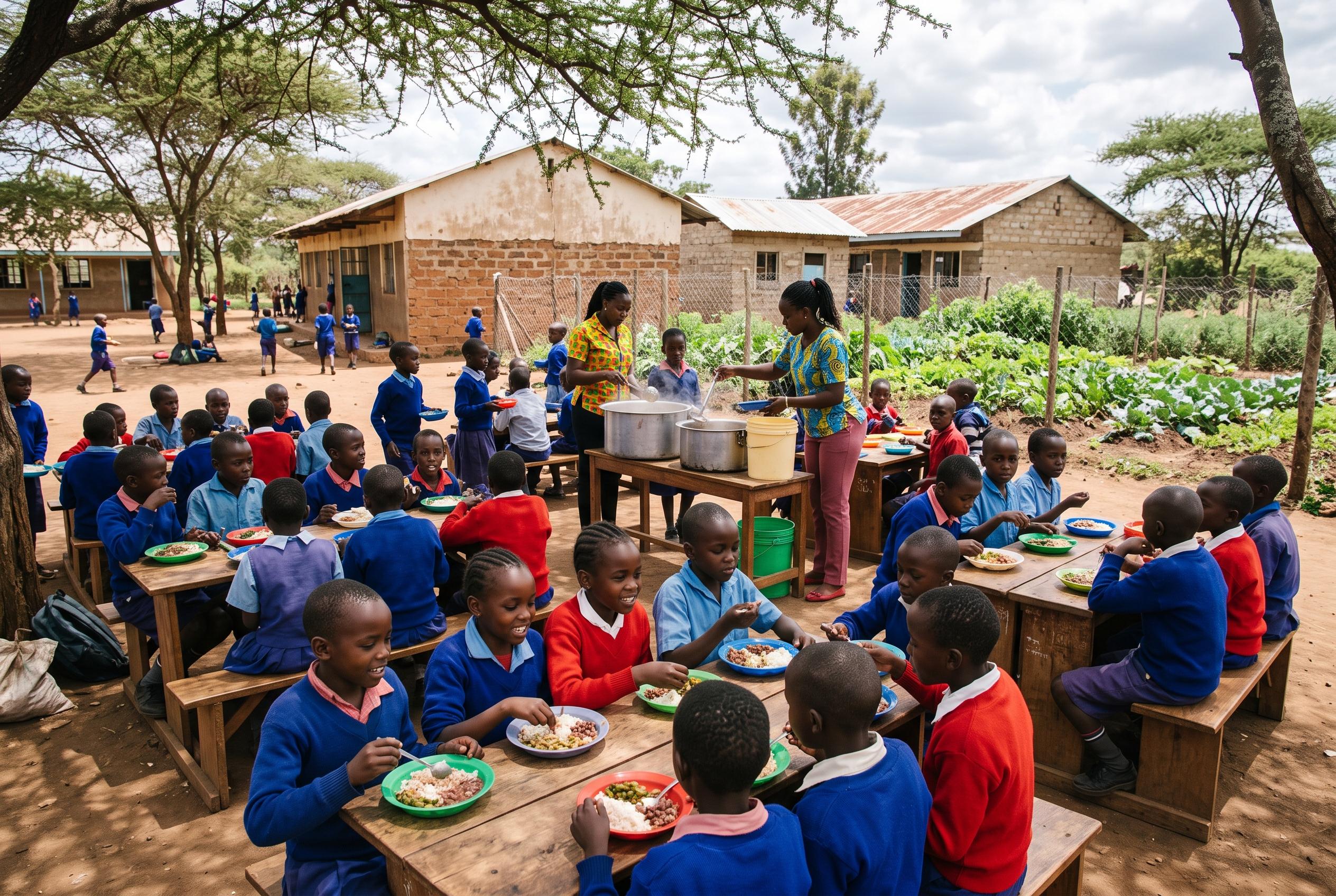

The government’s plan to expand school meals from 2.6 million to 10 million learners by 2030 will require far more funding, wider coverage and a supply system capable of delivering reliably.
Kenya’s pledge to feed 10 million schoolchildren by 2030 is now less a political statement than an operational challenge: can the government raise enough money, widen coverage far beyond the current reach and keep meals flowing reliably enough to make the promise real?
Health Cabinet Secretary Aden Duale renewed the commitment in New York on 24 September, speaking at a high-level child survival and nutrition meeting on the margins of the 81st United Nations General Assembly. According to reporting from The Star, Duale said the programme would expand from about 2.6 million learners to 10 million by the end of the decade, framing the effort as part of a broader push to improve child nutrition and survival. Other Kenyan outlets said he linked the plan to investment in the first 1,000 days of life, when nutrition has the strongest impact on development.
The scale of the ambition is striking, but the budget numbers show why delivery will be difficult. The National Council for Nomadic Education in Kenya says the school meals programme currently serves 2.6 million primary pupils in 26 counties, making it an important safety net in drought-prone areas and a tool for keeping children in school. At the same time, the government’s allocations cited in the lead article remain far below what would be needed to feed 10 million learners every school day, suggesting that expansion will depend on new financing, not simply a larger promise.
The article’s financing estimates underline the gap. Using an indicative cost of KSh20 per child per school day, the lead analysis says feeding 10 million learners for 200 school days would require about KSh40 billion a year, while serving 2.6 million would still cost close to KSh10 billion annually depending on the number of days covered. Those figures are not official budget demands, but they make clear that the programme’s next phase will be judged on whether increased spending is matched by actual meals delivered in classrooms.
Reach is only part of the challenge. The bigger test will be whether the system can handle procurement, storage, transport, food safety and prompt payment to suppliers at a much larger scale. The lead article also points to a growing emphasis on locally produced food, including an agroecology pilot in several counties, suggesting that the feeding programme is being tied not only to child welfare but also to local agriculture and rural livelihoods. If that model is to work nationally, it will need reliable coordination between schools, counties, farmers and national ministries.
The timing gives the pledge wider significance. At the same United Nations meetings, African leaders and development partners warned that preventable child deaths remain a major concern, while the World Health Organisation said on 23 September that 2.8 million children in sub-Saharan Africa still die before age five each year. School meals alone cannot solve that crisis, but they are part of the broader fight against malnutrition, poor attendance and weak learning outcomes. For Kenya, the crucial question is no longer whether the target exists, but whether annual funding, coverage and delivery can be made to grow steadily enough to reach it.
Disclaimer: This content is for informational purposes only and is not intended to be a substitute for professional medical judgment, advice, diagnosis, or treatment.



