

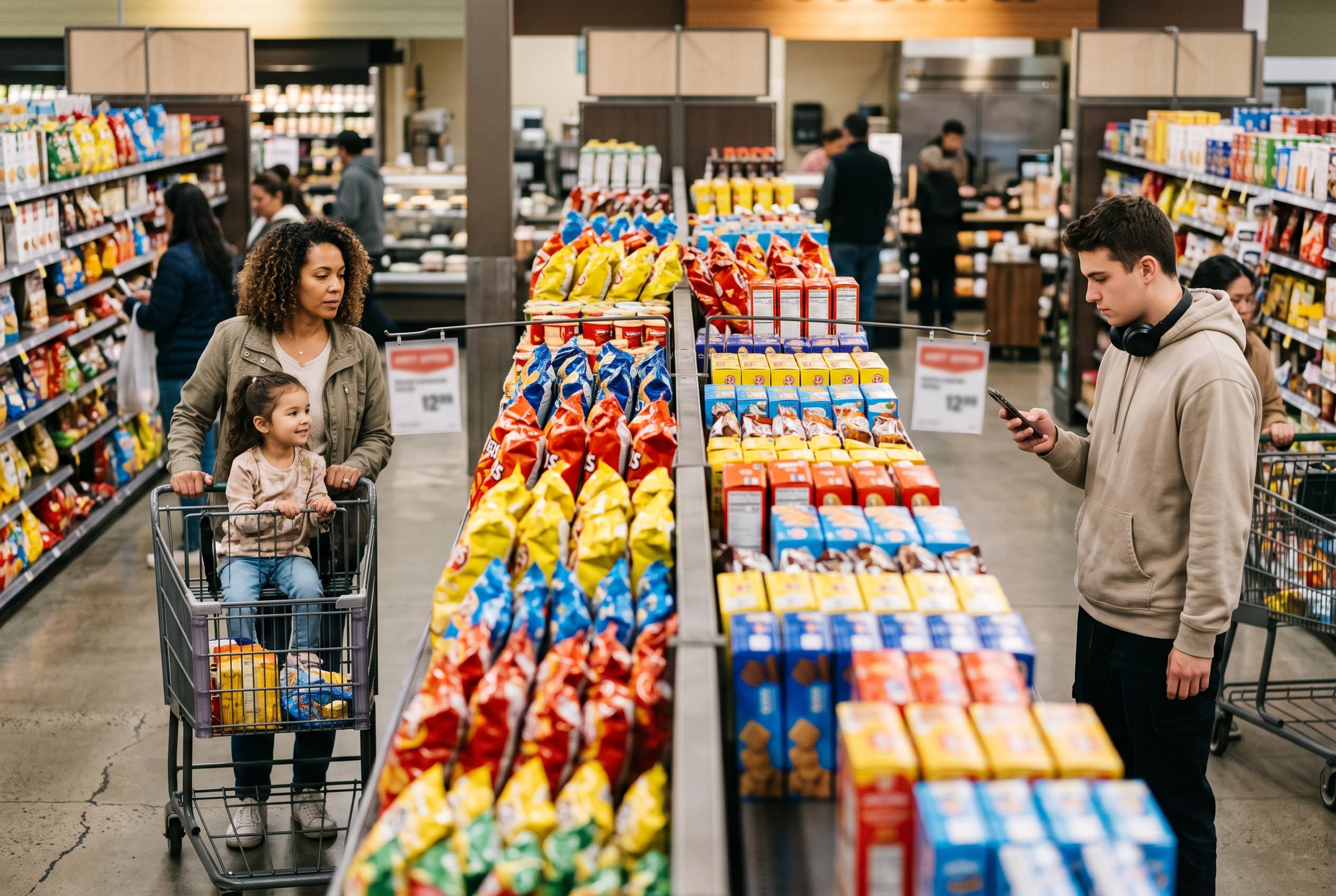

From eye-level displays and multi-buy deals to influencer campaigns and health-sounding claims, food brands use a range of tactics to encourage shoppers to buy and eat more processed products.
Supermarket shelves are built to do more than display food. They are designed to steer choices, lift sales and nudge shoppers towards products that are easy to overeat. Bright colours, cartoon mascots, price promotions and bold health-sounding claims all help processed foods stand out, while brands compete not just on taste but on habit, convenience and emotional appeal.
Food companies know that flavour matters, but so does the way food is engineered. Many ultra-processed products are built around combinations of sugar, salt and fat that make them highly rewarding to eat. In the case of crisps, sweets, soft drinks and packaged snacks, the goal is often to create a product with a familiar taste and texture that encourages repeat purchases. The concern is not simply that these foods are processed, but that some are formulated in ways that make it harder for people to stop eating once they start.
That concern is not merely theoretical. Researchers at the US National Institutes of Health reported in 2019 that volunteers given an ultra-processed diet ate more calories and put on more weight than when they were given a minimally processed menu, even though both diets were matched for calories, sugar, fat and other nutrients. The study did not prove that every processed food has the same effect, but it did suggest that the degree of processing can shape eating behaviour in ways that nutrition panels alone may not reveal.
Packaging is another powerful sales tool. Front-of-pack designs often use bright graphics, aspirational imagery and phrases such as “natural”, “light” or “made with real fruit” to create a healthier impression than the product deserves. A cereal box may highlight whole grains while still containing a large amount of added sugar; a fruit drink may imply freshness even when the fruit content is modest. The important details are often buried in smaller print on the back or side of the pack, where shoppers under time pressure are less likely to look.
Promotions can have the same effect. Offers such as multi-buy deals, oversized bags and family packs make products seem economical, but they also make it easier to eat more than intended. Once extra snacks and sugary drinks are in the house, they are more likely to be consumed. Supermarkets reinforce this behaviour through product placement, putting confectionery near checkouts, pushing high-margin items to eye level and using displays that encourage impulse buying.
Marketing is no longer confined to television adverts or in-store signage. On social media, brands use influencers, short videos, giveaways and limited-edition launches to make products feel trendy and ordinary at the same time. For children and teenagers, who are still forming food preferences, this can be especially influential. The World Health Organisation has warned that marketing high-sugar, high-salt and high-fat foods can shape children’s preferences and increase requests for advertised products.
The effects can be seen in public health policy as well as in consumer research. In Chile, which introduced warning labels and restrictions on marketing unhealthy foods to children in 2016, a study cited by Le Monde found a measurable fall in childhood excess weight after the rules took effect. The Chilean example is often cited as evidence that clearer labels and tighter advertising rules can change buying patterns, especially when schools and child-focused marketing are included in the restrictions.
For households, the practical response is not to avoid every packaged item, but to read labels with more care and treat the front of the pack as advertising rather than evidence. Comparing sugar, salt, fibre and saturated fat across similar products can be more revealing than relying on slogans. Meal planning, shopping with a list and serving snacks into a bowl rather than eating from the packet can all reduce mindless consumption. Cheaper staples such as beans, eggs, vegetables, maize, sweet potatoes and seasonal fruit can also help families build more balanced meals without depending heavily on heavily marketed products.
Public health experts argue that stronger safeguards are needed as well. That includes clearer labelling, tighter rules on marketing to children and more honest claims about what packaged foods actually contain. The broader lesson is simple: food brands are not only selling what is inside the packet, but the idea that the product is convenient, harmless and worth buying again. The more consumers understand those tactics, the better placed they are to decide what belongs in the basket.
Disclaimer: This content is for informational purposes only and is not intended to be a substitute for professional medical judgment, advice, diagnosis, or treatment.



