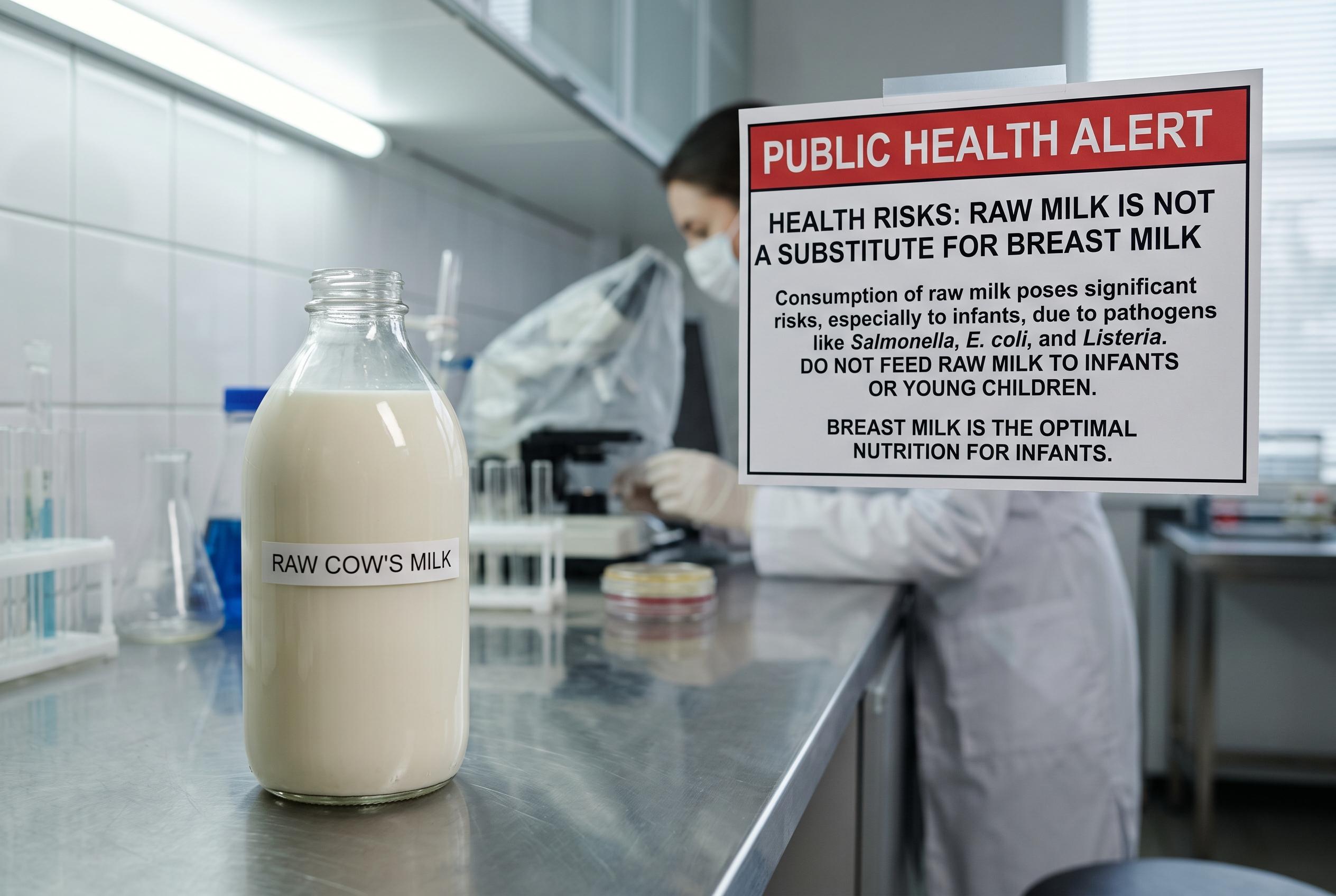

Health professionals caution that the growing social media trend comparing raw cow’s milk to human breast milk is misleading and potentially dangerous, especially for infants, due to differences in nutritional content and contamination risks.
Health experts are warning against a growing social media trend that treats raw milk as if it were comparable to breast milk. The discussion has spread online alongside claims from some wellness influencers that if babies can drink breast milk without pasteurisation, people can safely drink unpasteurised milk from cows or goats. Paediatric specialists say that comparison is fundamentally flawed.
According to the American Academy of Pediatrics, breast milk and animal milk are not interchangeable. Jenny Thomas, a paediatrician and the academy’s incoming breastfeeding section chair, told the group that milk is species-specific: human milk is designed for humans and cow’s milk for calves. She said that means the two differ sharply in protein, mineral and immune content. Lactation consultant Allison Alexander also pointed out that cow’s udders are exposed to dirt and manure in ways that have no parallel with sterile breast-feeding or pumped human milk.
Doctors say the risks are especially serious for infants. The AAP says cow’s milk, whether raw or pasteurised, should not be given to babies under 12 months because of its high sodium and protein levels and its lack of adequate iron. Jenelle Ferry, a neonatologist, said the biggest distinction is immunological, because human breast milk contains antibodies and other immune factors that support early development in ways animal milk does not.
Public health agencies have long warned that raw milk can carry dangerous germs. The US Centres for Disease Control and Prevention says unpasteurised milk can contain Campylobacter, Cryptosporidium, E. coli, Listeria, Brucella and Salmonella, all of which can cause severe illness, particularly in young children, older adults, pregnant women and people with weakened immune systems. The Food and Drug Administration says it documented 202 outbreaks linked to raw milk between 1998 and 2018, causing 2,645 illnesses and 228 hospitalisations.
Experts also caution that the danger is not limited to the person drinking it. The AAP says a breastfeeding mother who becomes ill after consuming raw milk could expose a baby to harmful pathogens through close contact and potentially through breast-feeding-related care. The agency and other public health bodies continue to recommend pasteurised dairy products as the safer choice, describing pasteurisation as a basic food-safety step that greatly reduces the risk of milk-borne disease.
Disclaimer: This content is for informational purposes only and is not intended to be a substitute for professional medical judgment, advice, diagnosis, or treatment.