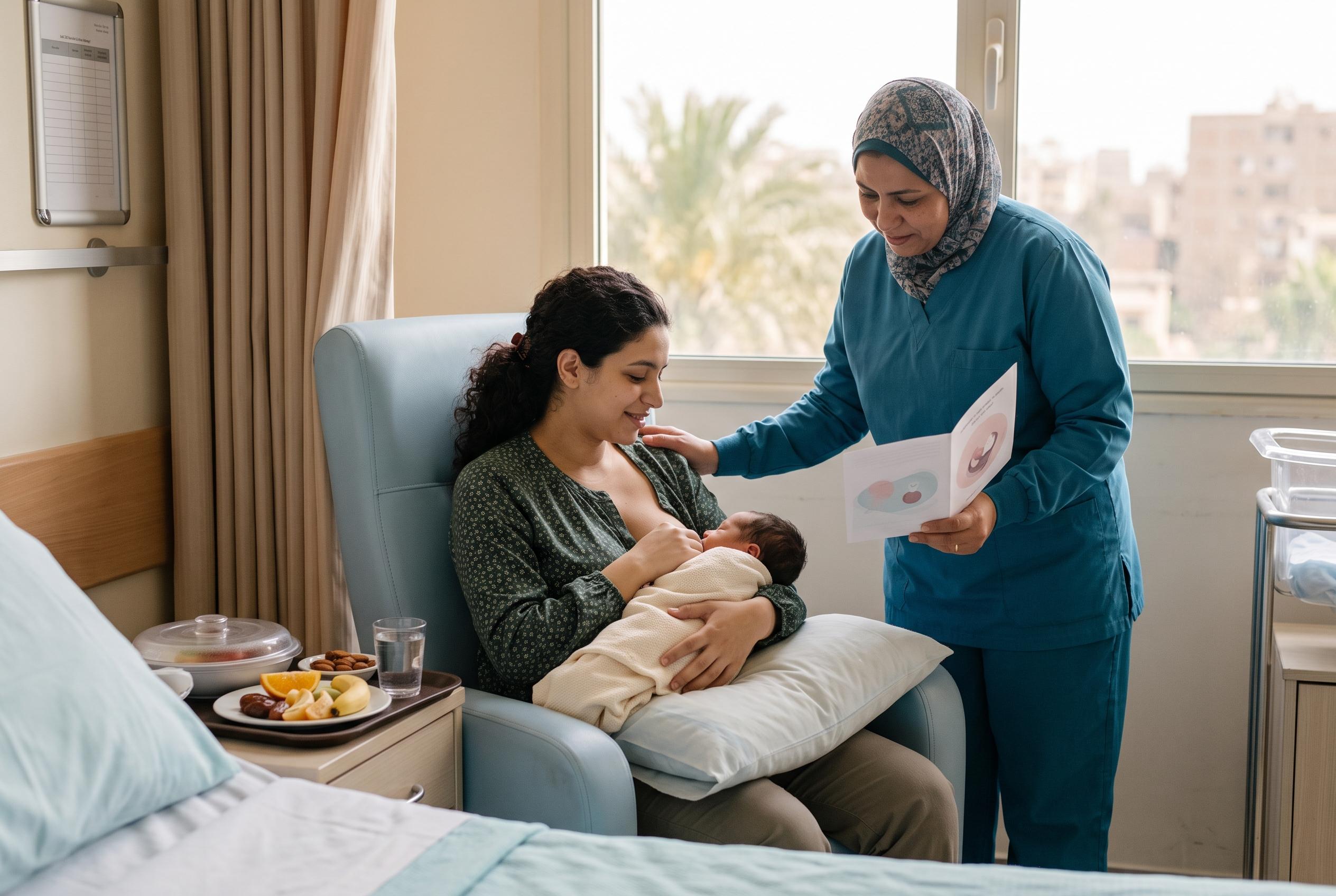

Egypt’s Ministry of Health is launching a detailed breastfeeding campaign, emphasising immediate post-birth practices and maternal nutrition to combat rising malnutrition and stunting among children under five.
Egypt’s Ministry of Health and Population is intensifying its breastfeeding campaign, urging mothers to treat breast milk as the main source of nourishment in a baby’s earliest months and presenting that advice as part of the broader “first 1,000 days” approach from pregnancy to a child’s second birthday. The renewed push lands against a difficult nutritional backdrop: UNICEF says poor infant and young child feeding practices are a direct cause of malnutrition in Egypt, where stunting among children under five stood at 21% in 2014 and exclusive breastfeeding rates at four to five months had fallen from 34% in 2005 to 13% in 2014. (youm7.com)
Reporting by Youm7 shows the ministry has tried to move beyond general endorsements of breastfeeding and into the mechanics of how mothers feed. In guidance issued under the presidential “100 Million Health” campaign and the “Golden 1000 Days” initiative, officials said breast milk changes during a single feed to match a child’s nutritional and physical needs, and warned mothers not to cut feeds short. The same ministry advice, as reported by Youm7, said a satisfying feed may last about 20 to 30 minutes, with milk at the start of a feed containing more water, glucose and protein before later milk becomes more filling. (youm7.com)
The ministry has also used its official Facebook page to challenge what it says are persistent myths about breastfeeding. Al-Masry Al-Youm reported that one of the clearest corrections concerned timing after delivery: mothers should begin breastfeeding in the first hour after birth rather than waiting until they have rested. The paper also highlighted ministry guidance on colostrum, the thick yellow milk produced in the first three days, which officials described as rich in energy and antibodies and said could help babies with jaundice. (almasryalyoum.com)
Other strands of the campaign have centred on the mother’s own diet and on the relationship between mother and child. Al-Wafd reported that the ministry told new mothers a balanced diet and enough water during breastfeeding can help increase milk supply naturally. Ahram Gate, citing the ministry’s Facebook page, added that officials were stressing benefits beyond nutrition alone, saying breastfeeding helps strengthen the bond between mother and infant, supports the child’s immune system and healthy growth, and should be backed by medical advice when mothers need help. (alwafd.news)
That messaging sits inside a wider attempt to reshape maternal and newborn care. When Egypt launched its national midwifery programme in June, Health Minister Khaled Abdel Ghaffar said the state was building an integrated system covering care before pregnancy, during birth and throughout the early years of childhood. In the same event, Deputy Health Minister Abla El-Alfy said the ministry was running 15 initiatives under the “100 Million Health” umbrella, nine of them directly tied to mother and child health. Shorouk reported that El-Alfy said proper newborn resuscitation, immediate skin-to-skin contact and early breastfeeding could reduce neonatal deaths by up to 22%, and that the ministry had established 27 training centres for newborn resuscitation. The programme was launched with the World Health Organization, UNFPA and UNICEF. (shorouknews.com)
UNICEF’s Egypt nutrition programme helps explain why officials have kept returning to breastfeeding in recent months. The agency says anaemia affects 27.2% of children under five and 25% of women of reproductive age, while 14.2% of under-fives are overweight, a sign of what it describes as a double burden of malnutrition. It says the ministry and UNICEF have developed an operational model focused on the “first 1,000 days” to strengthen primary healthcare, prevent stunting, promote breastfeeding and provide nutrition counselling to pregnant women, breastfeeding women and mothers of children up to the age of two. (unicef.org)
UNICEF also says early initiation of breastfeeding in Egypt stood at 27% in the 2014 demographic and health survey, underlining why ministry guidance has concentrated so heavily on what happens immediately after delivery. The agency says it is supporting the expansion of the Baby Friendly Hospital Initiative to encourage breastfeeding in the first hours after birth and exclusive breastfeeding for the first six months, alongside stronger community awareness and support groups for mothers. Taken together, the recent stream of ministry advice suggests officials are trying to turn breastfeeding from a broad public-health slogan into a set of everyday practices, from the first hour after birth to feed length, milk supply and the shift to complementary feeding later in infancy. (unicef.org)
Disclaimer: This content is for informational purposes only and is not intended to be a substitute for professional medical judgment, advice, diagnosis, or treatment.