

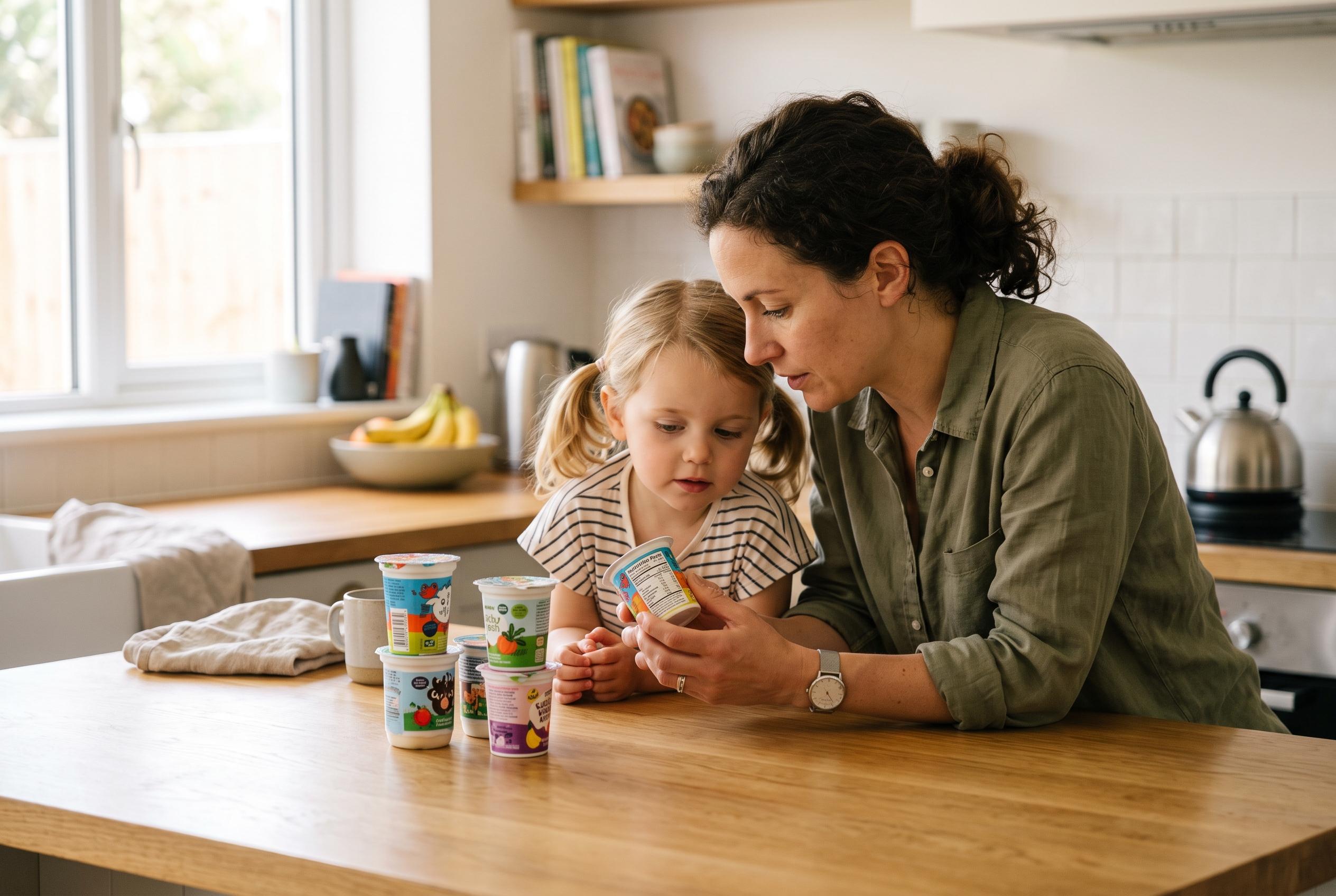

New research exposes the persistent high sugar levels in children’s yoghurts despite some reformulation, calling for tighter regulations and healthier packaging restrictions to protect young consumers.
Children’s yoghurts sold with cartoons, bright colours and other child-friendly designs can still be loaded with sugar, according to new research from Action on Salt & Sugar at Queen Mary University of London.
The group examined 104 products and found an average sugar content of 8.2g per 100g, with levels ranging from 4.7g to 14.1g per 100g. Nestlé’s Smarties Split Pot Vanilla had the highest sugar content in the survey at 14.1g per 100g, equivalent to 15.1g, or almost four teaspoons, in a single serving. At the other end of the table, The Collective Great Dairy Natural + Vitamin D and Yoplait Petits Filous No Added Sugar Strawberry & Banana recorded the lowest levels, at 4.7g per 100g.
The findings suggest only limited progress on reformulation. Action on Salt & Sugar said the average sugar level across the yoghurts it surveyed has fallen from 9.2g per 100g in 2021 to 8.2g this year, an 11% reduction. It highlighted larger cuts at some brands, including The Collective, which it said reduced average sugar levels across its children’s range by 32%, and Lidl’s Milbona Squeezy Pouches Strawberry yoghurt, which it said cut sugar by 43%. Even so, the group said progress was uneven and too dependent on voluntary changes by manufacturers.
The researchers also argued that packaging remains part of the problem. They said cartoons, vivid colours and familiar characters are still widely used on products aimed at children, even though comparable restrictions apply to some advertising for foods high in fat, salt and sugar. Action on Salt & Sugar said one in five products in the survey would provide at least 25% of the recommended free-sugar limit for a child aged four to six in a typical serving, after accounting for naturally occurring milk sugars. Only two products were classed as low in total sugars.
Dr Kawther Hashem, head of research and impact at Action on Salt & Sugar, said parents might reasonably expect child-marketed yoghurts to be among the healthier options, but the survey showed that was often not the case. She said some companies had proved reformulation was possible, but argued that change remained too slow because it relied mainly on voluntary action.
The campaign group is now calling for child-appealing packaging to be reserved for healthier foods, alongside mandatory reformulation rules, clearer reporting and stronger enforcement. Its appeal comes as polling released with the Recipe for Change campaign suggested 60% of Britons believe eating well is difficult today, while 47% said it is harder to eat a balanced diet than it was 20 years ago.
Disclaimer: This content is for informational purposes only and is not intended to be a substitute for professional medical judgment, advice, diagnosis, or treatment.



