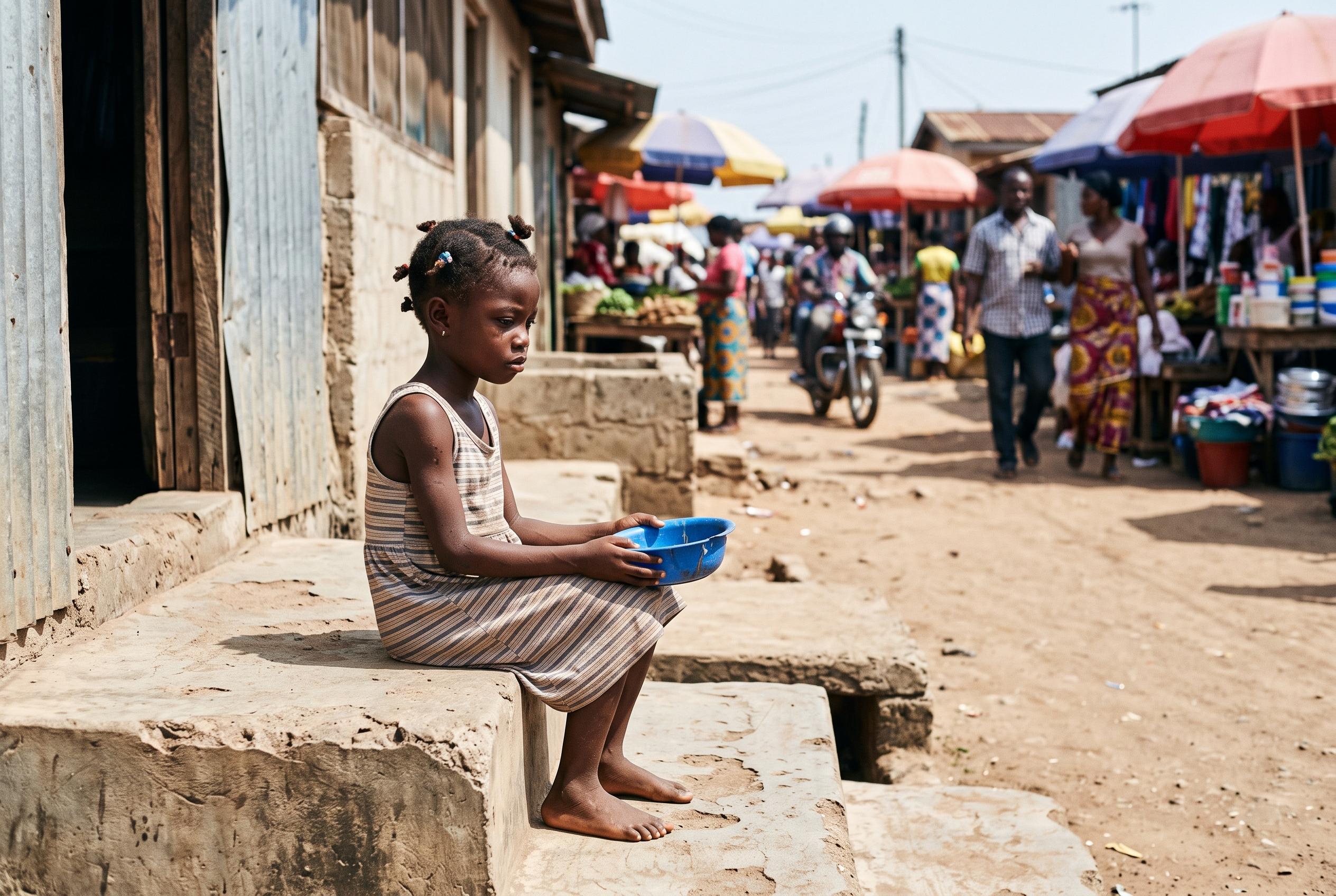

Despite a decline in global hunger levels, millions of African children continue to face severe food poverty, with affordability and policy gaps hindering progress in improving early childhood nutrition.
As global hunger edged down again in 2025, Africa moved further behind on the basic question of whether families can afford to eat properly. The UN’s latest State of Food Security and Nutrition report said 66.6% of Africans were unable to afford a healthy diet in 2025, while the Associated Press reported that the number had already climbed past 1 billion people in 2024. For parents being told to add eggs, meat, fruit and dairy to a child’s plate, that gap between advice and affordability is the heart of the problem. Christine Taljaard-Krugell, a nutrition specialist at North-West University, has argued that child nutrition should not be treated as a private household failing when the prices facing families are shaped by wider economic forces. (fao.org)
The consequences are sharpest in early childhood. UNICEF said in July 2024 that about 64 million African children under five, or one in three, were living in severe child food poverty, meaning they consumed no more than two of eight recognised food groups in a day. Those children are up to 50% more likely to suffer wasting, a dangerous form of malnutrition. UNICEF said four in five of them were being fed only breastmilk or milk and starchy staples such as rice, maize or wheat; fewer than 10% were getting fruit and vegetables, and fewer than 5% were receiving eggs, fish, poultry or meat. In the Democratic Republic of the Congo and Somalia, UNICEF found that in some vulnerable communities more than 80% of parents and caregivers said a child had gone a whole day without eating because there was no money or other resource to provide food. (unicef.org)
Taljaard-Krugell’s point, made in remarks carried by Maravi Post, is that affordability depends on the household purse rather than the food itself. She said dark green leaves, pumpkin, orange-fleshed sweet potato, mango, papaya, beans, cowpeas, groundnuts and small dried fish can offer more nutrition for limited budgets than costlier animal-source foods. In South Africa, she said, pulses give exceptional nutritional value for each rand spent. But she also warned that the arithmetic still works against poor families: even the cheapest nutritious foods can deliver calories at two to 10 times the cost of maize meal. That is why meals that fill a child without nourishing them remain so common. As she put it, “Watery porridge fills a small stomach without feeding a growing child.” UNICEF’s regional data show why that matters: the dominant diet for many of the poorest young children is still milk and starch, not the diverse food mix needed for growth. (maravipost.com)
The broader data support that diagnosis. FAO said 64.8% of Africans could not afford a healthy diet in 2022, when the average least-cost healthy diet on the continent was priced at 3.74 purchasing power parity dollars a day, against a global average of 3.96. The agency says people unable to afford that basket are likely to face at least some degree of food and nutrition insecurity, with heightened risks of hunger, stunting and wasting. Maximo Torero, FAO’s chief economist, said low-income countries had recorded their worst affordability levels since 2017. By 2024, according to AP’s reporting on the following year’s UN update, the global number of people unable to afford a healthy diet had fallen to 2.6 billion from 2.76 billion in 2019, but Africa’s total had risen over the same period from 864 million to just over 1 billion. (fao.org)
Price is only one part of the squeeze. Taljaard-Krugell noted that pulses can be inexpensive to buy but expensive to cook when fuel is scarce, while fruit and vegetables may be cheap only in season and spoil quickly where refrigeration is absent. She has also pointed to policy gaps that keep better diets out of reach, including fortification rules that miss families buying flour from small local mills rather than industrial processors. On food safety, she said treatments that cut aflatoxin contamination in maize and groundnuts by more than 90% in field trials exist, but uptake has been poor: “The technology works and the delivery doesn’t.” UNICEF has highlighted another pressure on diets, warning that cheap, nutrient-poor ultra-processed foods and sugary drinks are increasingly normalised and crowding out healthier choices for young children. (maravipost.com)
School feeding has expanded fast across Africa, but it does not solve the earliest nutritional losses. An African Union biennial report said the number of children receiving school meals rose from 38.4 million in 2013 to 86.86 million in 2024. By that point, 91% of African countries had national school-feeding policies, more than 40 were running home-grown programmes linked to local farmers, and spending had reached $1.96 billion, with 83% financed domestically. Yet the same report said coverage was still only 39%. That matters because these programmes generally reach children once they are already at school age, long after the first 1,000 days when poor diets can do lasting damage. (au.int)
The gains are real where meals do arrive. In Karamoja, north-eastern Uganda, the World Food Programme says 200,000 pupils in nearly 300 schools are receiving daily lunches of atap, a dense maize porridge, with pulses and vegetables. WFP says school enrolment in the region rose by 55% between 2022 and 2025, while attendance jumped by nearly half. Edgar Twinomujuni, a WFP school meals programme policy officer in Uganda, said: “It’s hard to focus on learning when you’re hungry,” adding that for many pupils the meals are “often the main reason to attend school, and may be their only meal of the day.” But the same account says a 2024 survey in Kaabong found that nearly one in five young children were wasted, underlining how school meals can support learning for older children while arriving too late for many under-fives. Uganda is now preparing its first national school meals policy, aimed at reaching 9 million children. (wfp.org)
That is why both UNICEF and Taljaard-Krugell push the argument well beyond parental behaviour. UNICEF’s Gilles Fagninou has called for food systems that make nutritious food “more accessible, affordable and desirable” for caregivers, and the agency has promoted its Child Nutrition Fund as a way to spur domestic investment against malnutrition. In a May 2026 Business Talk interview, Taljaard-Krugell made a similar case for South Africa, saying child nutrition should be seen as a national investment in human potential rather than a private struggle hidden inside poor households. Her critique of current policy is practical as much as moral: governments need better delivery of existing measures, dietary guidelines that are still absent in much of Africa, and grants or cash transfers judged against the actual cost of a nutritious diet, not the amount a treasury finds convenient. What families can feed their children, she argues, is ultimately decided as much by systems, markets and public policy as by kitchen knowledge. (unicef.org)
Disclaimer: This content is for informational purposes only and is not intended to be a substitute for professional medical judgment, advice, diagnosis, or treatment.