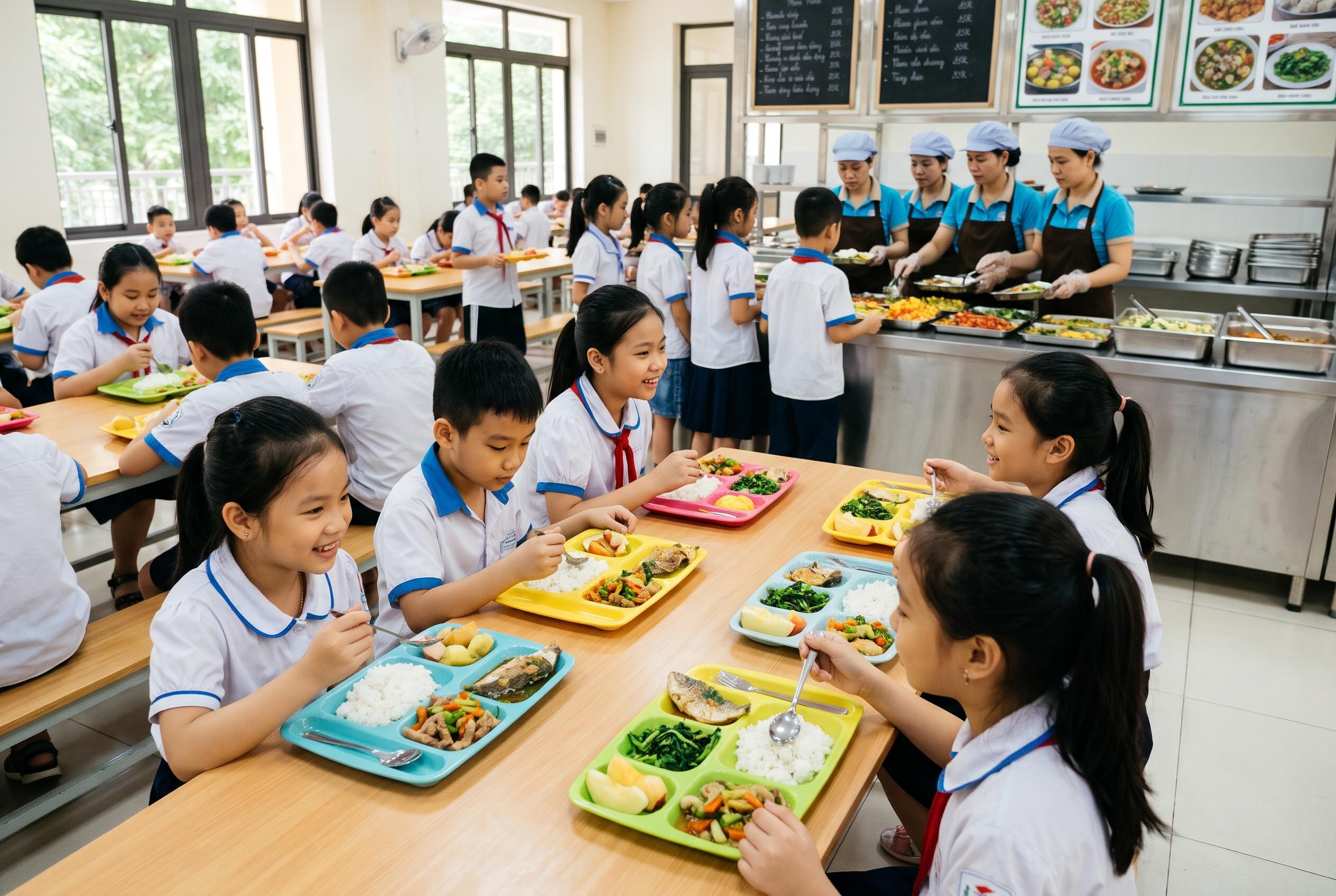

Experts say better-funded school meals will not solve Vietnam’s nutrition crisis without mandatory standards, trained staff and menus tailored to children’s age and needs.
Vietnam’s school meal system is being pushed towards a more scientific model as experts warn that simply serving more food, or spending more on it, will not solve the country’s widening nutrition problems. The debate has sharpened as officials and nutrition specialists point to a double burden: some children still lack essential nutrients, while others are becoming overweight or obese. According to the National Institute of Nutrition, that shift has been especially visible in recent years, with the proportion of children aged 5 to 19 who are overweight or obese rising sharply over the past decade.
Dr Bui Thi Mai Huong of the National Institute of Nutrition said the problem is rooted in uneven living conditions, dietary habits and weak organisation of children’s nutrition. She noted that menu planning in many schools still depends too heavily on experience rather than on consistent nutritional requirements. That approach, she said, makes it difficult to ensure that meals are both safe and properly balanced for each age group. Huong also pointed to gaps in the legal framework, saying Vietnam still lacks a binding national technical standard for school nutrition, which leaves schools without a clear benchmark for meal design and monitoring.
The scale of the challenge is stark in poorer and mountainous areas. A 2025 survey in disadvantaged northern districts found children’s diets met only 68.8% of the recommended iron intake, 48.5% for zinc, 39% for vitamin A, 30.2% for calcium and just 5.5% for vitamin D. Such shortages can affect growth, immunity and bone development, particularly during puberty. Huong and other specialists have argued that the answer lies in standards that are measurable and enforceable, covering energy needs, nutrient balance, micronutrient content and food safety, rather than relying on a one-size-fits-all menu.
The Ministry of Health has already issued guidance aimed at making school meals more nutritious, including recommendations for age-specific energy needs, a balanced daily structure of meals and snacks, and a menu-building process suited to each level of education. Experts also want schools to make greater use of nutrition data, seasonal ingredients and local food sources to keep meals affordable while improving quality. Ha Thi Phuong, nutrition manager at TH Group, has argued that school nutrition should be treated as a universal right rather than something left to the financial capacity of individual families. Researchers and practitioners agree that lasting improvement will depend on tighter standards, better-trained staff, stronger oversight and more systematic planning.
Disclaimer: This content is for informational purposes only and is not intended to be a substitute for professional medical judgment, advice, diagnosis, or treatment.