

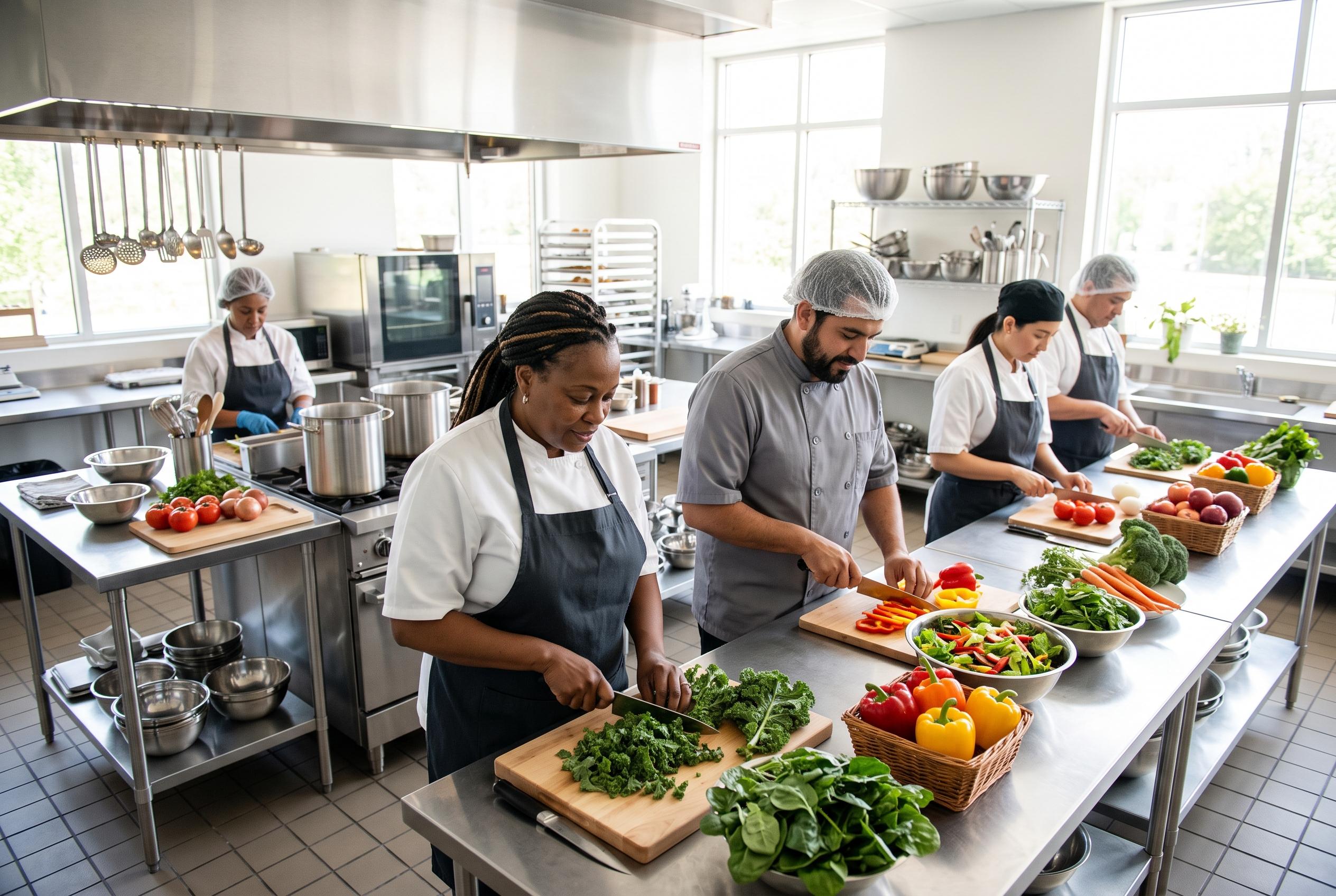

Districts in Cleveland and Santa Fe are rebuilding school kitchens around fresh ingredients and local suppliers, as new US policy proposals seek to accelerate the shift away from packaged meals.
School districts in Cleveland and Santa Fe are showing how a quieter but significant overhaul of lunch programmes is taking shape in public education, with more menus built around fresh produce, scratch cooking and local suppliers rather than packaged, heat-and-serve fare.
In Cleveland, Robert Gorman, executive director of nutrition services for the Cleveland Metropolitan School District, said students have responded well to a revamped cafeteria offer that now includes a buffet counter, locally sourced produce and more whole foods such as eggs and cold meats. The district has also introduced dishes such as cilantro-lime rice made with just five ingredients, a shift Gorman described to The Epoch Times as a return to basics. In Santa Fe, district nutrition director Diana Tarasiewicz said school meals now feature salad bars stocked with local fruit and vegetables, alongside beef from a nearby ranch folded into items ranging from hamburgers to Bolognese sauce.
The changes in both districts have been supported by the Chef Ann Foundation, a non-profit group that works with school leaders to move away from ultra-processed food and towards meals made from whole ingredients. The foundation says its approach is designed not only to improve the nutritional quality of school food, but also to help districts build practical procurement systems that can support local agriculture.
The broader policy backdrop is becoming more favourable. The US Department of Agriculture and Health and Human Services announced the Harvest to Hallways initiative in September, presenting it as a way to connect schools with local farmers and strengthen school meal programmes. At the same time, Congress is considering the bipartisan Scratch Cooked Meals for Students Act, which would establish a pilot programme to help districts replace heat-and-serve kitchens with scratch cooking. The National Conference of State Legislatures says similar ideas have already surfaced in Alaska, California, Maryland, Massachusetts, New York and Pennsylvania, where lawmakers have proposed or passed measures aimed at restricting unhealthy ingredients or encouraging ties with local producers.
The appeal of the effort is obvious, but the operational hurdles are substantial. School food leaders have to work within tight reimbursement rates, retrain staff, and revise purchasing systems that were built around processed ingredients and centralised suppliers. According to the Cleveland district, even simple changes can require more supervision, including point-of-sale monitoring to keep high-demand items from being taken in excess. But the districts involved say the trade-offs can be worth it: both Cleveland and Santa Fe have reported less food waste as scratch cooking has expanded, while Santa Fe has paired composting with classroom lessons about soil and food systems.
There is also a financial case for changing course. Gorman said the district has reduced spending on disposable packaging by moving away from grab-and-go items wrapped in paper and plastic containers. Lori Nelson, the Chef Ann Foundation’s executive director of school food operations, told The Epoch Times that the scale of the school meal system gives the issue unusual weight, noting that there are far more school cafeterias than McDonald’s restaurants. Nelson also argued that better food alone is not enough, saying pupils need enough time to eat and, ideally, recess before lunch so they arrive at the table hungry and focused. For districts willing to rethink menus, schedules and supply chains together, the result could be a more durable model for school nutrition rather than a short-term makeover.
Disclaimer: This content is for informational purposes only and is not intended to be a substitute for professional medical judgment, advice, diagnosis, or treatment.



