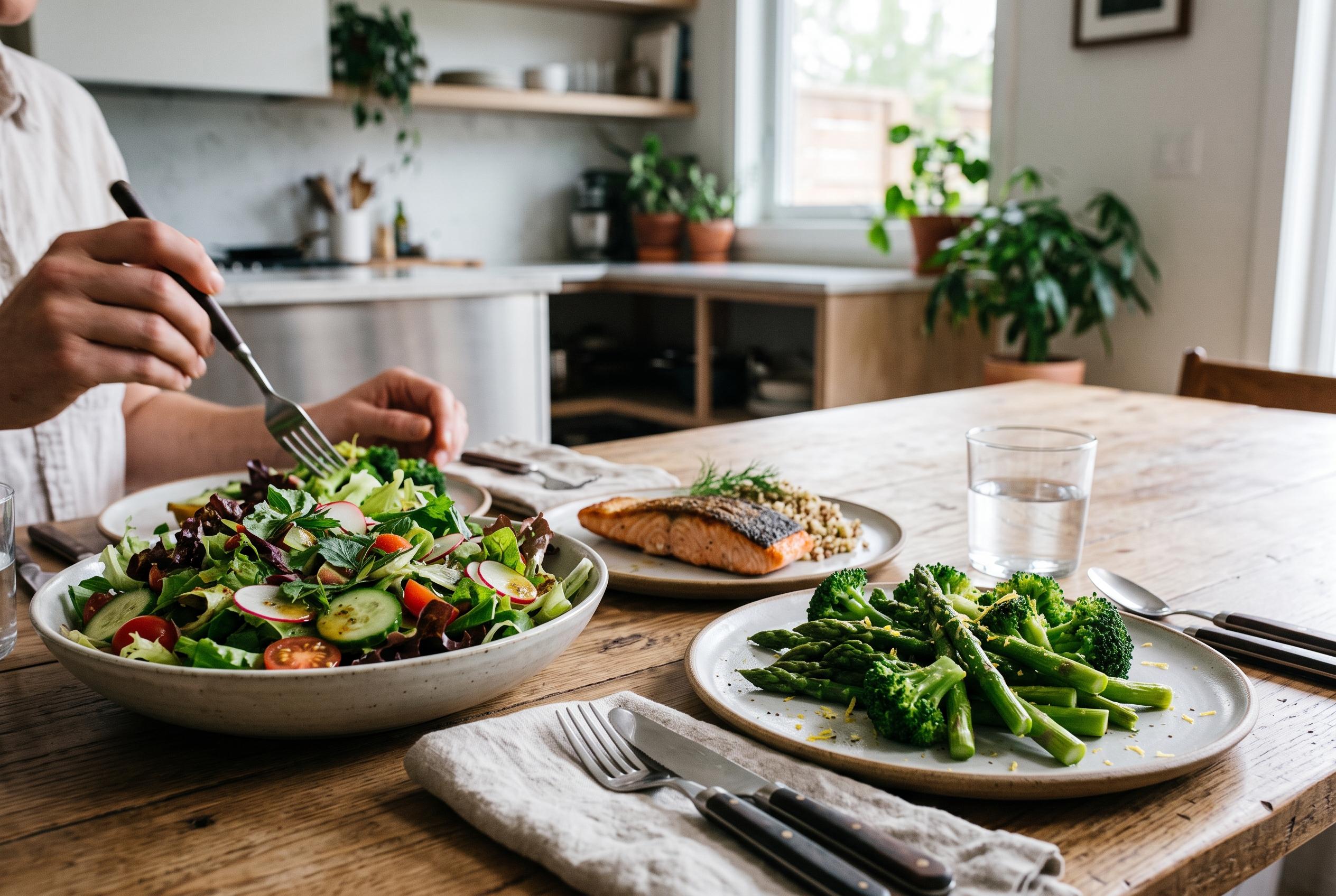

Emerging global food guidance emphasizes vegetables, fruits, and meal sequencing over traditional portion control, shaping new strategies for managing blood sugar and overall health amid sedentary lifestyles.
The most useful version of the “healthy plate” is no longer just a lesson in portion control. Across hospital dietitians, diabetes educators and official food guides, the advice has converged on a broader pattern: make vegetables and fruit the largest share of the meal, keep protein and whole grains to the remaining half, and in some cases eat the fibrous foods first rather than starting with rice or roti. Health Canada and Joslin Diabetes Center both present that broad structure, while more recent Indian reporting has added the idea of meal sequencing to help steady energy and blood sugar. (canada.ca)
At the AajTak Health Summit in New Delhi on 29 September 2025, nutritionist and health coach Nandita Iyer argued that the point of the plate method is to get away from fad thinking. She pushed back against detoxes, miracle foods and demonised ingredients, urging people to look at diet as a whole. In her telling, a familiar meal of roti, dal and aloo sabzi can still be overwhelmingly starchy, which is why she described India as “a high-carb society” in an era of increasingly sedentary lives. Her shorthand was simple: half the plate vegetables and fruit, a quarter protein, a quarter carbohydrates, plus a thumb-sized portion of fat. (indiatoday.in)
That does not mean staple foods such as rice have to disappear. Writing in The Indian Express, Apollo Hospitals dietitian Varsha Gorey said rice can remain part of a healthy meal if it is paired with lean protein, vegetables and a modest amount of healthy fat. Gorey recommended the familiar half-plate of vegetables, with protein and a complex carbohydrate taking a quarter each. In the same piece, Nanavati Max dietitian Ushakiran Sisodia suggested roughly two parts vegetables to one part rice, arguing that the extra fibre helps curb sharp blood-sugar rises. Sisodia also said a rice-and-dal combination can provide vegetarians with all the essential amino acids. (indianexpress.com)
A further twist is not what goes on the plate, but what is eaten first. Hindustan Times, citing a 2025 study in the Asia Pacific Journal of Clinical Nutrition led by Saeko Imai, reported that patients with type 2 diabetes who ate vegetables before carbohydrates saw their HbA1c levels fall from 8.3% to 6.8% over two years. The paper was used to support a practical routine from nutritionists Prateek Kumar and Veena V: begin with salad or low-starch vegetables such as bhindi, gourds, cabbage or French beans, move on to protein such as rajma, paneer, tofu, eggs, meat or fish, and leave rice, roti or potatoes until last. (hindustantimes.com)
Official guidance outside India lands in much the same place. Health Canada tells people to build meals with half the plate made up of vegetables and fruit, one quarter protein foods and one quarter whole grain foods, while adding an important caveat: the picture is a guide, not a literal instruction on exactly how much to eat at one sitting. The department says the same proportions can be used for breakfasts, snacks and mixed dishes, whether food is packed in a lunch box, laid out buffet-style or shared from a platter. (canada.ca)
Joslin Diabetes Center’s AADI Healthy Plate uses a 2:1:1 ratio, meaning two parts vegetables to one part protein and one part carbohydrate. Its examples make the principle concrete: broccoli, spinach, tomatoes, mushrooms and peppers on the larger side; brown rice, peas or lentils in the carbohydrate quarter; and tofu, low-fat paneer or fish in the protein section. The centre also notes that the method still works for people who do not eat from a flat plate, suggesting that the carbohydrate portion can sit in a bowl while vegetables and protein remain on a plate. (joslin.org)
For anyone wondering what that looks like in an ordinary kitchen, Care Insurance’s meal guide offers combinations that would be familiar in many homes rather than resembling diet food. Its examples include vegetable poha with curd or sprouts for breakfast, palak sabzi with moong dal or paneer bhurji and multigrain rotis for lunch, and stir-fried capsicum and beans with grilled fish or soy chunks and a small portion of brown rice for dinner. The emphasis is on rearranging the balance of everyday food, not giving up favourite flavours. (careinsurance.com)
The same guide warns that a carefully built plate can be undermined by what comes with it. Sweet lassi and packaged juices add a large sugar load; pickle and papad can push up salt and oil; and deep-frying or over-boiling vegetables erodes much of their nutritional value. Taken together, the reporting suggests that the healthiest lunch is less a strict formula than a repeatable pattern: vegetables in the lead, protein given real space, starch kept in proportion, and enough flexibility for the method to work with breakfast bowls, rice plates or family meals alike. (careinsurance.com)
Disclaimer: This content is for informational purposes only and is not intended to be a substitute for professional medical judgment, advice, diagnosis, or treatment.