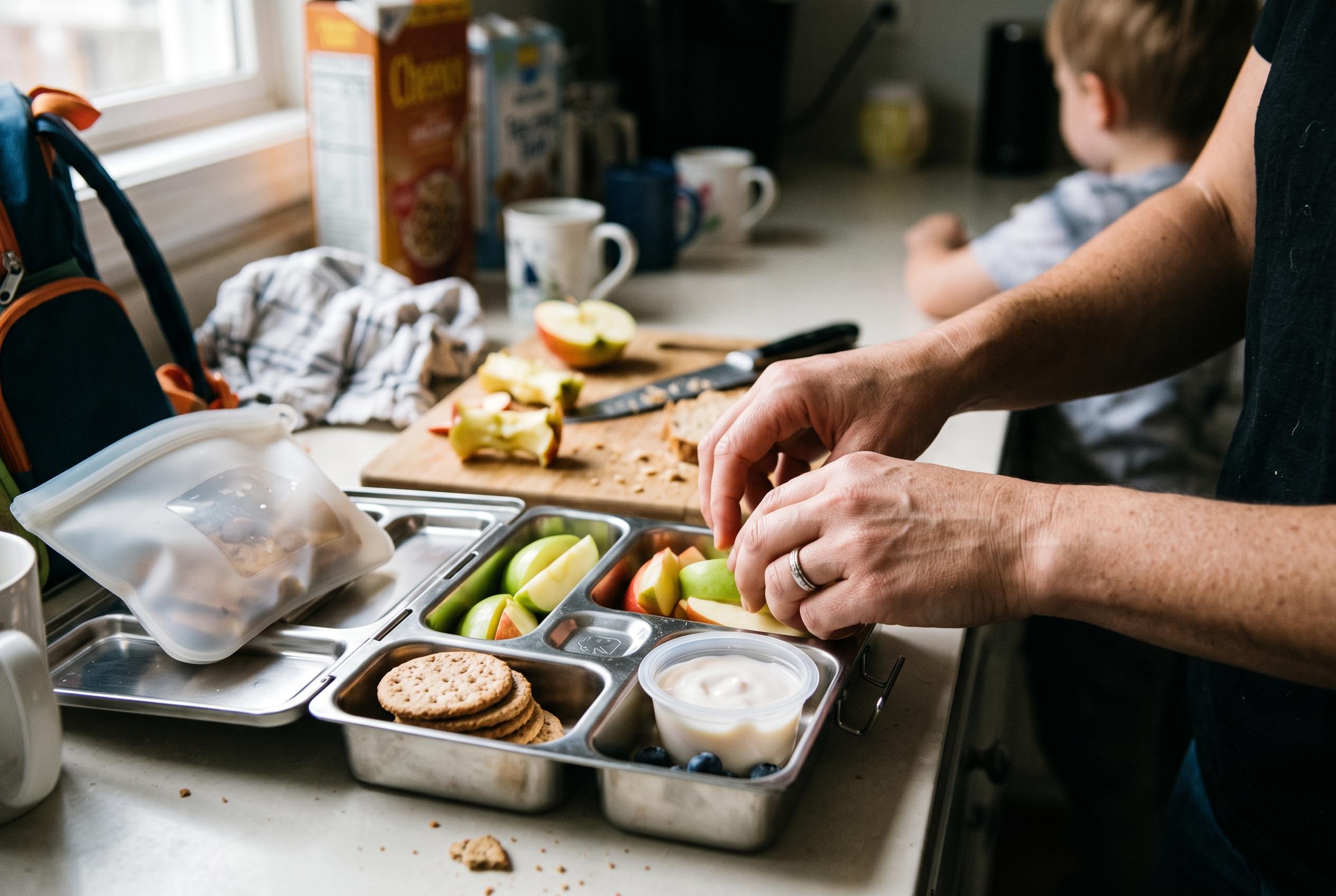

A registered dietitian shares her no-fuss philosophy on packed lunches, emphasising practicality and routine over perfection to ease parents’ stress while ensuring children eat nutritious meals they enjoy.
A registered dietitian whose advice on children’s packed lunches has been widely syndicated this week says the real goal is not an immaculate lunchbox but one that children will actually eat. Writing in a first-person essay carried by Business Insider and republished by outlets including AOL, Johannah Katz said her benchmark for her two school-age children is far simpler: make sure each lunch covers protein, a high-fibre carbohydrate, fruit or vegetables, and a source of healthy fat.
That approach, she suggested, is shaped less by ideology than by the mechanics of family life. In versions of the piece published by AOL and other mirrors, Katz described mornings that start before dawn because her children, aged seven and nine, catch an early school bus. She said she gets up ahead of them to make sure everything is packed, while also trying to stay on top of work, school timetables, sport, after-school activities and the general business of running a home.
Katz presents that schedule as the reason appearance has slipped well down her list of priorities. She wrote that becoming a dietitian had once left her imagining she would turn out polished, aspirational lunches, the sort parents pin for back-to-school inspiration. Instead, she said, she is not producing “gourmet meals”, nor cutting cucumbers into stars or sandwiches into hearts. The German edition published by Business Insider framed the same point even more bluntly, describing the lunch her children get as a simple “Pausenbrot” rather than a showpiece.
A central part of her method is repetition. Katz said she regularly sends the same main items again and again, changing the sides and snacks rather than reinventing the whole meal each day. In the syndicated versions, she argued that adults eat repetitively too and that routine does not automatically make a diet poorer. The point, as she tells it, is to distinguish between predictability and inadequacy: a familiar lunch can still be nutritionally sound.
She also pushed back against the idea that every lunchbox must be the place where children encounter something new. According to the versions carried by local Yahoo-style outlets and news aggregators, Katz said variety can be built across the wider pattern of eating rather than forced into every midday meal. That matters, she argued, because expecting each lunch to be unique, homemade and visually impressive only adds another layer of decision fatigue for parents who are already stretched.
Her list of acceptable shortcuts is notably practical. Katz said she uses ready-made peanut butter and jam sandwiches, bean-based pasta, and peas stirred in for what she described as an easy way to add vegetables and colour. She also relies on minimally processed bought items such as freeze-dried fruit, fruit snacks made from a single ingredient, lower-sugar yoghurt, GoGo squeeZ pouches and mini Perfect Bars. Hard-boiled eggs are another regular fallback. The piece’s syndication across outlets from AOL to Inkl did not change that shopping list, suggesting that its appeal lies precisely in how ordinary and repeatable it is.
Katz extended the same logic to kitchen equipment. She said she saves time with a multi-purpose chopper for fruit and vegetables and a separate steamer for eggs, and added that she recommends similar conveniences to her own clients. Her reasoning is not that packaged food is ideal in the abstract, but that convenience makes healthy habits easier to keep up. In one of the republished versions, she said she leans heavily on dependable prepared items because she knows they will be eaten and because they lower stress.
The argument ends where it begins: with permission for parents to lower the standard they set for themselves. Katz wrote that she once felt a professional obligation to optimise every lunch as an example to others, but now tells clients and herself that “there is no such thing as perfection”. If the lunchbox contains the main nutritional building blocks and the children eat what is inside, she said, that counts as success. The fact that the essay has already appeared in multiple English-language syndications as well as a German translation suggests that her message is landing well beyond one household: for many parents, a good-enough lunch may be more useful than an ideal one.
Disclaimer: This content is for informational purposes only and is not intended to be a substitute for professional medical judgment, advice, diagnosis, or treatment.