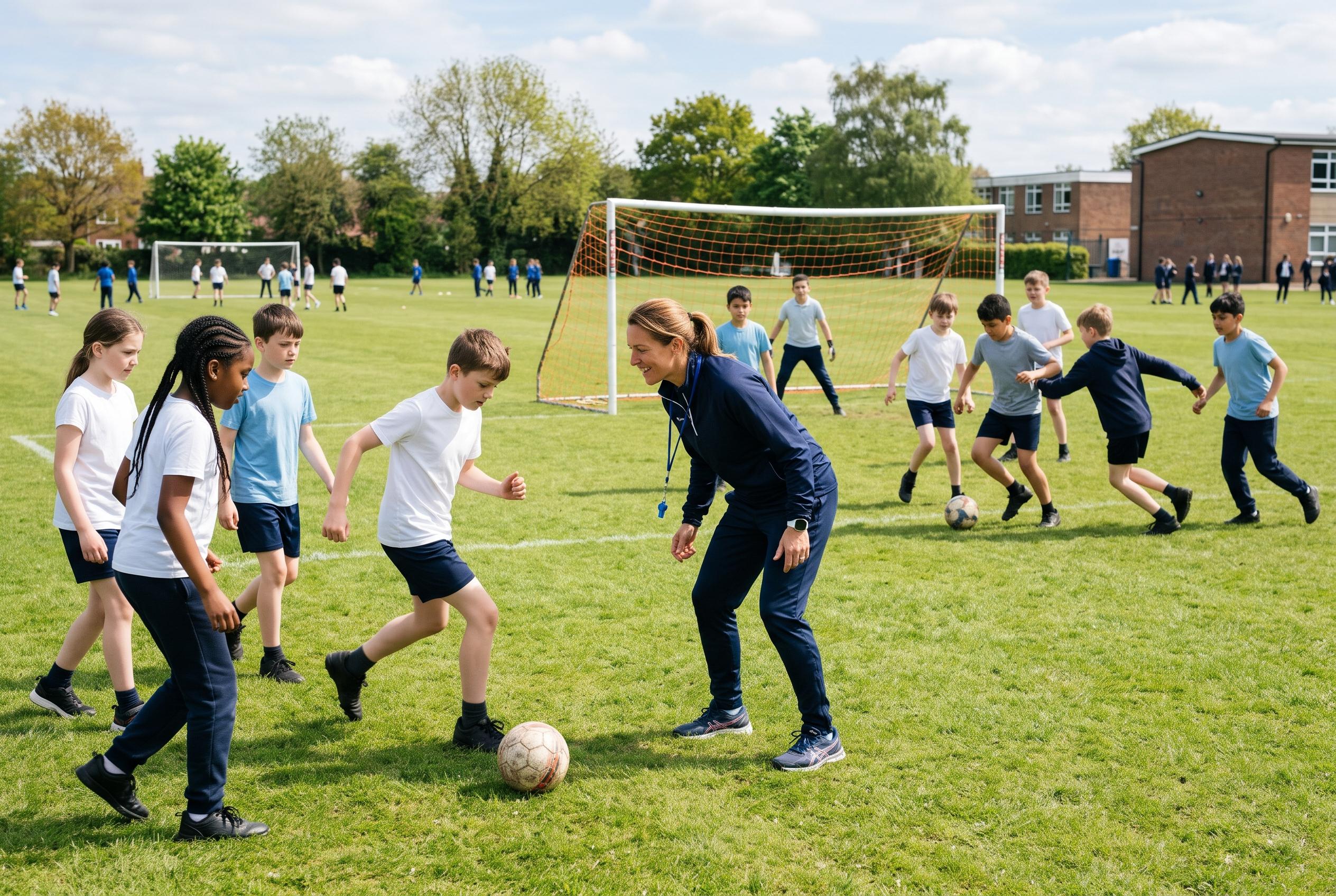

Effective PE is less about choosing between drills and game-led learning than knowing when to use each, helping pupils become adaptable, confident and motivated movers.
In physical education, the argument is often framed as a choice between two rival methods: drilling technique until it is polished, or throwing children into games and letting skill emerge through experience. But that split can be misleading. The stronger question, as the PE Scholar essay argues, is not which camp should win, but how teachers can help children become adaptable movers who can apply what they learn in meaningful situations.
The article draws a useful distinction between technique and skill. Technique is the mechanics of a movement in isolation: the grip, the body position, the arm action. Skill is the ability to use that movement under pressure, when space, time and opponents are all changing. That difference matters because a child can look competent in a closed drill and still struggle to use the same movement in a real game. In practice, the essay argues, teaching should not wait until pupils have perfected technique before they are allowed to experience the game itself.
To explain that balance, the piece uses the image of a “pedagogical DJ”: a teacher who knows when to turn the technical volume up and when to let the game drive learning. Rather than acting as a drill sergeant or stepping back entirely, the teacher should read the needs of the group and adjust the task accordingly. A child who cannot serve a volleyball without hitting the net may need direct technical help, while another may benefit more from a messy, decision-rich game that forces tactical thinking and adaptation.
That thinking is closely aligned with Teaching Games for Understanding, a model developed by David Bunker and Rod Thorpe in the early 1980s. As the related material notes, TGfU begins with game awareness, tactical understanding and decision-making before moving towards refined execution. Reviews of the model have found that this game-led approach can improve pupils’ understanding, decision-making and problem-solving, while still supporting technical development. The point is not to abandon technique, but to place it in a context where children can see why it matters.
The article also argues that movement should not be reduced to health messaging or correctness for its own sake. Drawing on ideas associated with Scott Kretchmar, it suggests that enjoyment, meaning and autonomy are central if children are to stay active beyond school. If lessons become a sequence of correction, repetition and compliance, pupils may come to see physical activity as a chore. If, instead, they are given problems to solve, space to explore and opportunities to succeed in varied settings, movement is more likely to become something they value.
That is where the Constraints-Led Approach comes in. Rather than stopping play every few seconds to correct form, the teacher designs the environment so that the right solutions become more likely. The essay points to the STEP framework , space, task, equipment and people , as a practical way to adjust difficulty on the fly. It also warns against the false comfort of blocked practice, where pupils repeat the same movement until it appears learned, only to fail when the context changes. More varied practice may look untidy, but it can produce deeper learning because it forces children to adapt rather than merely repeat.
The broader message is that effective PE is not about choosing between technique and skill, but about knowing when each is needed. Good teaching, the article suggests, involves purposeful observation, informed intervention and a willingness to let pupils wrestle with problems long enough to learn from them. For teachers, that means becoming less like commanders on the sideline and more like designers of rich learning environments. For pupils, it means lessons that build not only competence, but confidence, enjoyment and the capacity to keep moving long after school ends.
Disclaimer: This content is for informational purposes only and is not intended to be a substitute for professional medical judgment, advice, diagnosis, or treatment.