

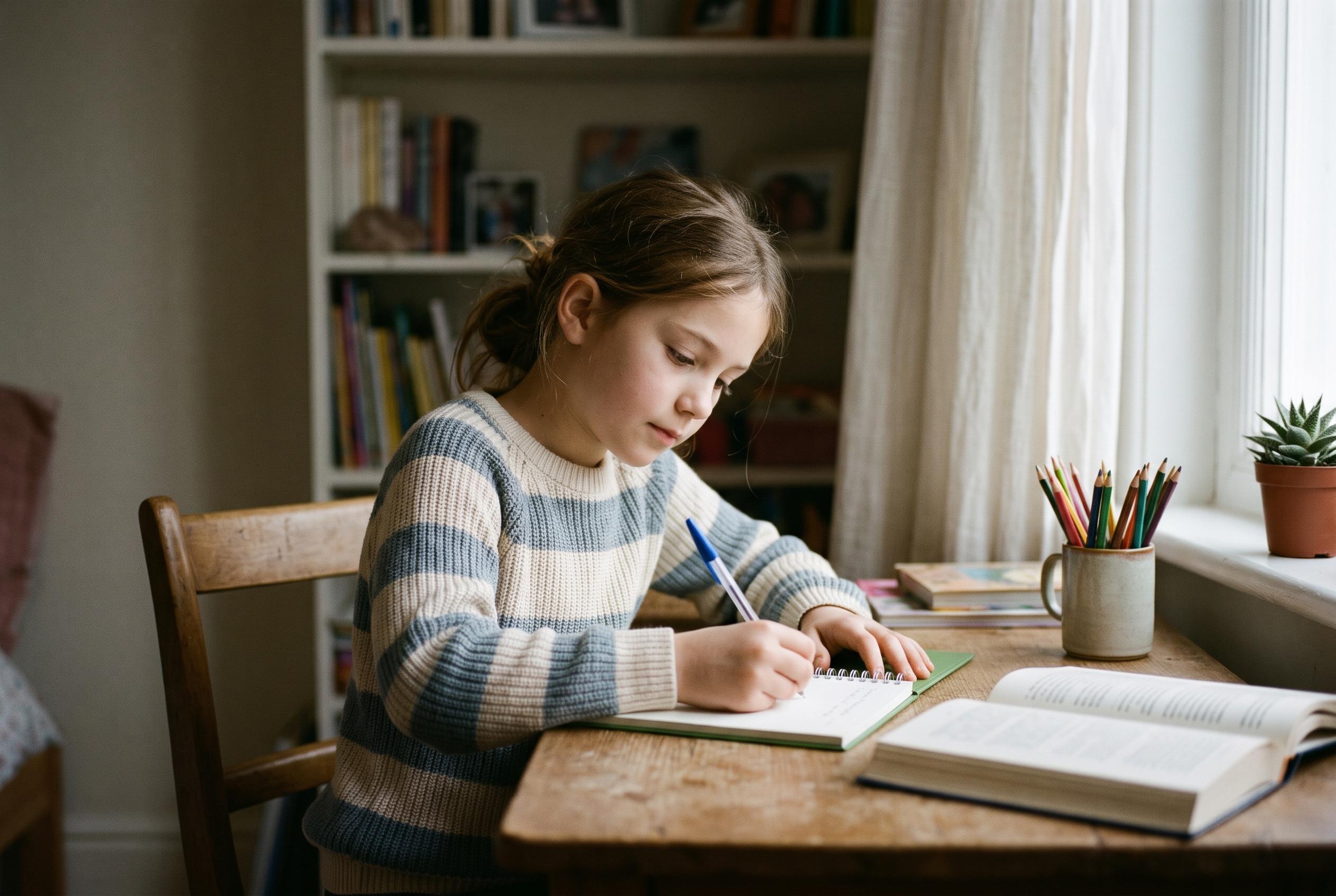

From easing worries to building writing confidence, a flexible journalling habit can give children a private space to understand and express themselves.
Parents often look for simple habits that can help children slow down, make sense of their thoughts and build confidence. Keeping a journal can do all three. Writing regularly gives children a private place to record what happened in their day, work through feelings and practise putting experiences into words. It can also be an easy way to introduce reflection without turning it into a chore.
One of the clearest benefits is emotional release. According to the Institute of Child Psychology, journalling can help children process feelings, improve emotional regulation and build resilience. National Geographic has also reported that journalling can be especially useful when children are facing stress or uncertainty, because it gives them a place to express what they may not yet know how to say out loud. That matters for parents too: a journal can help children organise worries before they spill over into conflict or shutdown.
There is also a strong educational case for the habit. Bombay Kids Company says regular journalling can strengthen reading, writing and comprehension, while EverythingMom notes that it can improve communication skills, memory and self-esteem. For many children, the page becomes a low-pressure space to practise sentence building, story structure and descriptive language. Over time, that kind of informal writing can make schoolwork feel less intimidating and help children become more confident communicators.
Not every child will want to fill lined pages with paragraphs, and that is part of the point. The Institute of Child Psychology and PlanetSpark both suggest that journalling can take many forms, from drawings and prompts to nature logs, feelings journals and bullet-style lists. Some children may prefer sketching, while others may like writing about a walk, a holiday or a favourite memory. Letting children choose the format often makes the habit more likely to stick, because it feels personal rather than prescribed.
Parents can also use prompts to make the first step easier. Simple questions about friends, family memories, favourite activities or hopes for the future can help children get started when they are unsure what to write. The most useful prompts are often the ones that invite a child to notice, describe and reflect. A few minutes a day can be enough to build the habit, and the routine itself may become as valuable as the writing.
For many families, the real strength of journalling is that it grows with the child. What begins as a few words and a drawing can develop into poems, lists, comics or longer reflections. Along the way, children are not just preserving memories; they are learning how to observe, express and understand themselves more clearly.
Disclaimer: This content is for informational purposes only and is not intended to be a substitute for professional medical judgment, advice, diagnosis, or treatment.



